

238
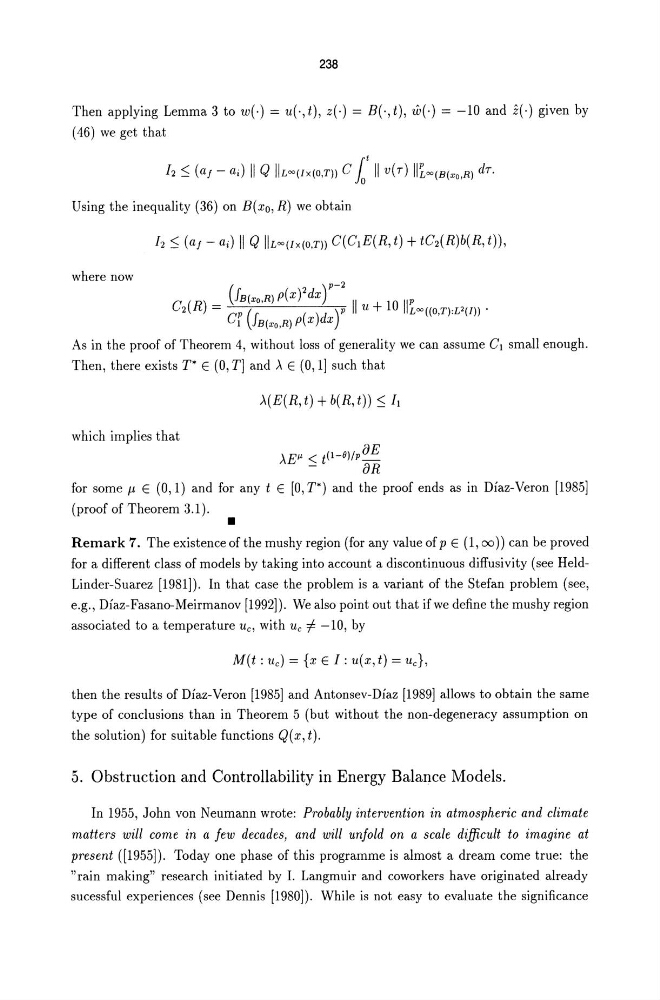
Then applying Lemma 3 to w(-) = u(·, t), z(·) = B(·, t), w(·) = -10 and i(-) given by
(46) we get that
12 :<:: (aj - ai) II Q IILoo(Ix(o,T» C f II V(T) Iltoo(B(xo,R) dT.
Using the inequality (36) on B(xo, R) we obtain
where now
(IB(XO,R) p(x )2dx r2
p
C2(R) = p (
)P II u + 10 IILoo((o,T):L2(I) .
CI fB(xo,R) p(x)dx
As in the proof of Theorem 4, without loss of generality we can assume CI small enough.
Then, there exists T* E (0, T] and ,X E (0,1] such that
'x(E(R,t)+b(R,t)):<:: II
which implies that
'xEI' < t(l-o)/p 8E
-
8R
for some f-l E (0,1) and for any t E [0, T*) and the proof ends as in Diaz-Veron [1985]
(proof of Theorem 3.1) . •
Remark 7. The existence of the mushy region (for any value of p E (1, (Xl)) can be proved
for a different class of models by taking into account a discontinuous diffusivity (see HeldLinder-Suarez [1981]). In that case the problem is a variant of the Stefan problem (see,
e.g., Diaz-Fasano-Meirmanov [1992]). We also point out that if we define the mushy region
associated to a temperature U e , with U e =I- -10, by
M(t: ue) = {x E I: u(x,t) = uc},
then the results of Diaz-Veron [1985] and Antonsev-Diaz [1989] allows to obtain the same
type of conclusions than in Theorem 5 (but without the non-degeneracy assumption on
the solution) for suitable functions Q(x, t).
5. Obstruction and Controllability in Energy Balance Models.
In 1955, John von Neumann wrote: Probably intervention in atmospheric and climate
matters will come in a few decades, and will unfold on a scale difficult to imagine at
present ([1955]). Today one phase of this programme is almost a dream come true: the
"rain making" research initiated by I. Langmuir and coworkers have originated already
sucessful experiences (see Dennis [1980]). While is not easy to evaluate the significance
Then applying Lemma 3 to w(-) = u(·, t), z(·) = B(·, t), w(·) = -10 and i(-) given by
(46) we get that
12 :<:: (aj - ai) II Q IILoo(Ix(o,T» C f II V(T) Iltoo(B(xo,R) dT.
Using the inequality (36) on B(xo, R) we obtain
where now
(IB(XO,R) p(x )2dx r2
p
C2(R) = p (
)P II u + 10 IILoo((o,T):L2(I) .
CI fB(xo,R) p(x)dx
As in the proof of Theorem 4, without loss of generality we can assume CI small enough.
Then, there exists T* E (0, T] and ,X E (0,1] such that
'x(E(R,t)+b(R,t)):<:: II
which implies that
'xEI' < t(l-o)/p 8E
-
8R
for some f-l E (0,1) and for any t E [0, T*) and the proof ends as in Diaz-Veron [1985]
(proof of Theorem 3.1) . •
Remark 7. The existence of the mushy region (for any value of p E (1, (Xl)) can be proved
for a different class of models by taking into account a discontinuous diffusivity (see HeldLinder-Suarez [1981]). In that case the problem is a variant of the Stefan problem (see,
e.g., Diaz-Fasano-Meirmanov [1992]). We also point out that if we define the mushy region
associated to a temperature U e , with U e =I- -10, by
M(t: ue) = {x E I: u(x,t) = uc},
then the results of Diaz-Veron [1985] and Antonsev-Diaz [1989] allows to obtain the same
type of conclusions than in Theorem 5 (but without the non-degeneracy assumption on
the solution) for suitable functions Q(x, t).
5. Obstruction and Controllability in Energy Balance Models.
In 1955, John von Neumann wrote: Probably intervention in atmospheric and climate
matters will come in a few decades, and will unfold on a scale difficult to imagine at
present ([1955]). Today one phase of this programme is almost a dream come true: the
"rain making" research initiated by I. Langmuir and coworkers have originated already
sucessful experiences (see Dennis [1980]). While is not easy to evaluate the significance