

237
Theorem 5 . Let p > 2, Ra given by (4) and (5) and Re given by (7). Assume (44) and
Uo E Loo(l) such that there exist Xo E I and Ra > 0 satisfying
M(O) = {x E I: uo(x) = -10}:) B(xo,Ro)(= {x E I: Ix - xol < Ro}).
If u is the bounded weak solution of (P) satisfying the weak p-nondegeneracy property then
there exists T* E (0, T] and a nonincreasing function R(t) with R(O) = Ro such that
M(t) = {x E I: u(x,t) = -10}:) B(xo,R(t))
for any t E [0, T*).
Proof. We shall use an energy method as developped in Diaz-Veron [1985]. Given u
bounded weak solution of (P) we define v = u+ 10. As in Lemma 3.1 of the above reference
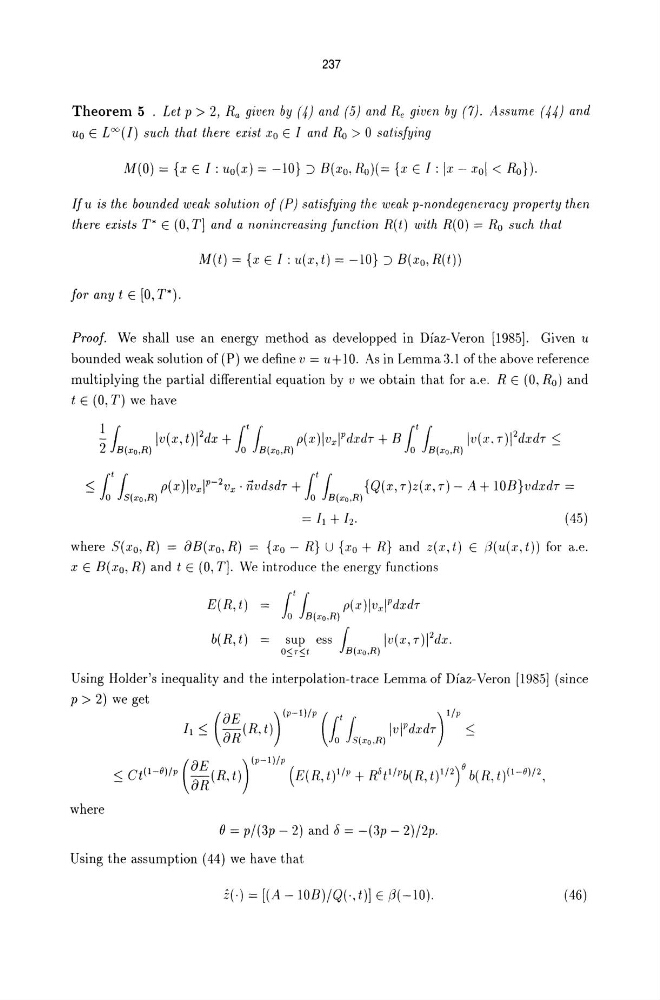
multiplying the partial differential equation by v we obtain that for a.e. R E (0, Ra) and
t E (0, T) we have
~ {
Iv(x, tWdx + t { p(x)lvxIPdxdr + B t ( Iv(x, rWdxdr ~
2 JB(xo,R)
Jo JB(xo,R)
Jo JB(xo,R)
~ {t {
p(x)lvx IP- 2 vx .nvdsdr+ {t {
{Q(x,r)z(x,r)-A+10B}vdxdr =
Jo JS(xo,R)
Jo JB(xo,R)
= II + 12,
(45)
where S(xo,R) = 8B(xo,R) = {xo - R} U {xo + R} and z(x,t) E !3(u(x,t)) for a.e.
x E B(xo, R) and t E (0, T]. We introduce the energy functions
E(R,t)
b(R, t)
Using Holder's inequality and the interpolation-trace Lemma of Diaz-Veron [1985] (since
p> 2) we get
where
() = p/(3p - 2) and 8 = -(3p - 2)/2p.
Using the assumption (44) we have that
z(·) = [(A -10B)/Q(·,t)] E 13(-10).
(46)
Theorem 5 . Let p > 2, Ra given by (4) and (5) and Re given by (7). Assume (44) and
Uo E Loo(l) such that there exist Xo E I and Ra > 0 satisfying
M(O) = {x E I: uo(x) = -10}:) B(xo,Ro)(= {x E I: Ix - xol < Ro}).
If u is the bounded weak solution of (P) satisfying the weak p-nondegeneracy property then
there exists T* E (0, T] and a nonincreasing function R(t) with R(O) = Ro such that
M(t) = {x E I: u(x,t) = -10}:) B(xo,R(t))
for any t E [0, T*).
Proof. We shall use an energy method as developped in Diaz-Veron [1985]. Given u
bounded weak solution of (P) we define v = u+ 10. As in Lemma 3.1 of the above reference
multiplying the partial differential equation by v we obtain that for a.e. R E (0, Ra) and
t E (0, T) we have
~ {
Iv(x, tWdx + t { p(x)lvxIPdxdr + B t ( Iv(x, rWdxdr ~
2 JB(xo,R)
Jo JB(xo,R)
Jo JB(xo,R)
~ {t {
p(x)lvx IP- 2 vx .nvdsdr+ {t {
{Q(x,r)z(x,r)-A+10B}vdxdr =
Jo JS(xo,R)
Jo JB(xo,R)
= II + 12,
(45)
where S(xo,R) = 8B(xo,R) = {xo - R} U {xo + R} and z(x,t) E !3(u(x,t)) for a.e.
x E B(xo, R) and t E (0, T]. We introduce the energy functions
E(R,t)
b(R, t)
Using Holder's inequality and the interpolation-trace Lemma of Diaz-Veron [1985] (since
p> 2) we get
where
() = p/(3p - 2) and 8 = -(3p - 2)/2p.
Using the assumption (44) we have that
z(·) = [(A -10B)/Q(·,t)] E 13(-10).
(46)