

234
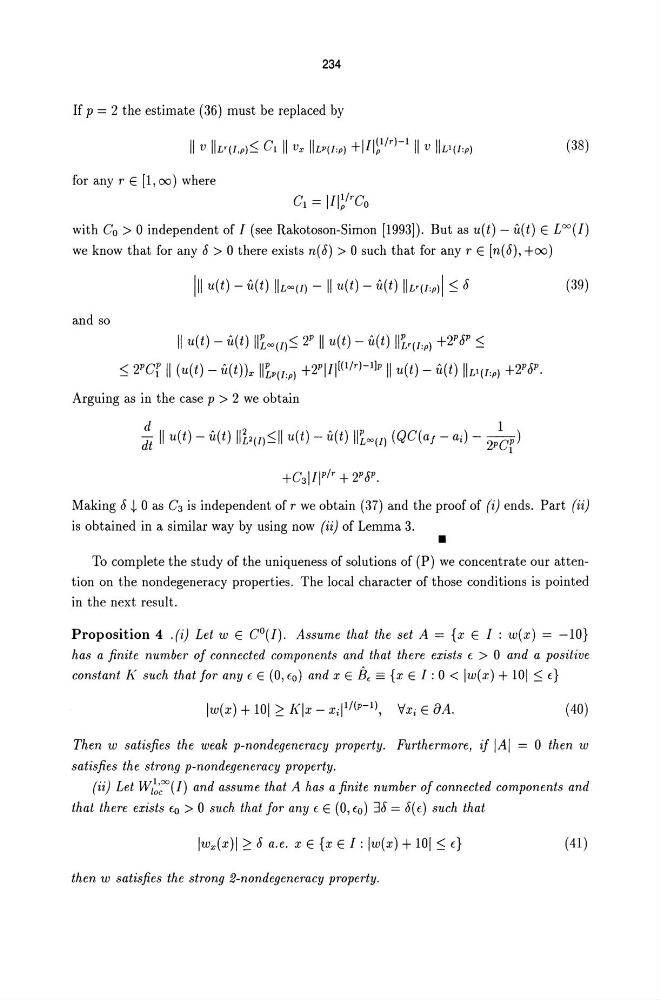
If p = 2 the estimate (36) must be replaced by
II v Ilu(I,p):::; CI I I VX IILP(I:p) +III~I/r)-1 I I V 11L'(I:p)
(38)
for any r E [1, 00) where
CI = III!/rco
with Co > 0 independent of I (see Rakotoson-Simon [1993]). But as u(t) - u(t) E Loo(l)
we know that for any 8 > 0 there exists n(8) > 0 such that for any r E [n(8),+00)
III u(t) - u(t) lIu"'(1) - II u(t) - u(t) IIU(I:p)I :::; 8
and so
II u(t) - u(t) lIioo(I):::; 2 P II u(t) - u(t) Ilir(I:p) +2 P 8 P :::;
:::; 2 P Ci II (u(t) - u(t))x lIiP(I:p) +2 P III[(I/r)-I]p II u(t) - u(t) 1IL'(I:p) +2 P 8 P •
Arguing as in the case p > 2 we obtain
~ II u(t) - u(t) 1112(1):::;11 u(t) - u(t) lIioo(l) (QC(af - ai) - 2p~f)
+C3 IIIP/r + 2 P 8 P •
(39)
Making 8 ~ 0 as C3 is independent of r we obtain (37) and the proof of (i) ends. Part (ii)
is obtained in a similar way by using now (ii) of Lemma 3.
•
To complete the study of the uniqueness of solutions of (P) we concentrate our attention on the nondegeneracy properties. The local character of those conditions is pointed
in the next result.
Proposition 4 .(i) Let w E C°(l). Assume that the set A = {x E I : w(x) = -IO}
has a finite number of connected components and that there exists ( > 0 and a positive
constant K such that for any ( E (0, (0) and x E Sf == {x E I: 0 < Iw(x) + 101 :::; (}
Iw(x) + 101 ? Klx - xill/(p-I), 'r/Xi E 8A.
(40)
Then w satisfies the weak p-nondegeneracy property. Furthermore, if IAI = 0 then w
satisfies the strong p-nondegeneracy property.
(ii) Let It/~~oo(l) and assume that A has a finite number of connected components and
that there exists (0 > 0 such that for any ( E (0, (0) 38 = 8(() such that
Iwx(X)1 ? 8 a.e. x E {x E I: Iw(x) + 101:::; (}
(41)
then w satisfies the strong 2-nondegeneracy property.
If p = 2 the estimate (36) must be replaced by
II v Ilu(I,p):::; CI I I VX IILP(I:p) +III~I/r)-1 I I V 11L'(I:p)
(38)
for any r E [1, 00) where
CI = III!/rco
with Co > 0 independent of I (see Rakotoson-Simon [1993]). But as u(t) - u(t) E Loo(l)
we know that for any 8 > 0 there exists n(8) > 0 such that for any r E [n(8),+00)
III u(t) - u(t) lIu"'(1) - II u(t) - u(t) IIU(I:p)I :::; 8
and so
II u(t) - u(t) lIioo(I):::; 2 P II u(t) - u(t) Ilir(I:p) +2 P 8 P :::;
:::; 2 P Ci II (u(t) - u(t))x lIiP(I:p) +2 P III[(I/r)-I]p II u(t) - u(t) 1IL'(I:p) +2 P 8 P •
Arguing as in the case p > 2 we obtain
~ II u(t) - u(t) 1112(1):::;11 u(t) - u(t) lIioo(l) (QC(af - ai) - 2p~f)
+C3 IIIP/r + 2 P 8 P •
(39)
Making 8 ~ 0 as C3 is independent of r we obtain (37) and the proof of (i) ends. Part (ii)
is obtained in a similar way by using now (ii) of Lemma 3.
•
To complete the study of the uniqueness of solutions of (P) we concentrate our attention on the nondegeneracy properties. The local character of those conditions is pointed
in the next result.
Proposition 4 .(i) Let w E C°(l). Assume that the set A = {x E I : w(x) = -IO}
has a finite number of connected components and that there exists ( > 0 and a positive
constant K such that for any ( E (0, (0) and x E Sf == {x E I: 0 < Iw(x) + 101 :::; (}
Iw(x) + 101 ? Klx - xill/(p-I), 'r/Xi E 8A.
(40)
Then w satisfies the weak p-nondegeneracy property. Furthermore, if IAI = 0 then w
satisfies the strong p-nondegeneracy property.
(ii) Let It/~~oo(l) and assume that A has a finite number of connected components and
that there exists (0 > 0 such that for any ( E (0, (0) 38 = 8(() such that
Iwx(X)1 ? 8 a.e. x E {x E I: Iw(x) + 101:::; (}
(41)
then w satisfies the strong 2-nondegeneracy property.