

233
where
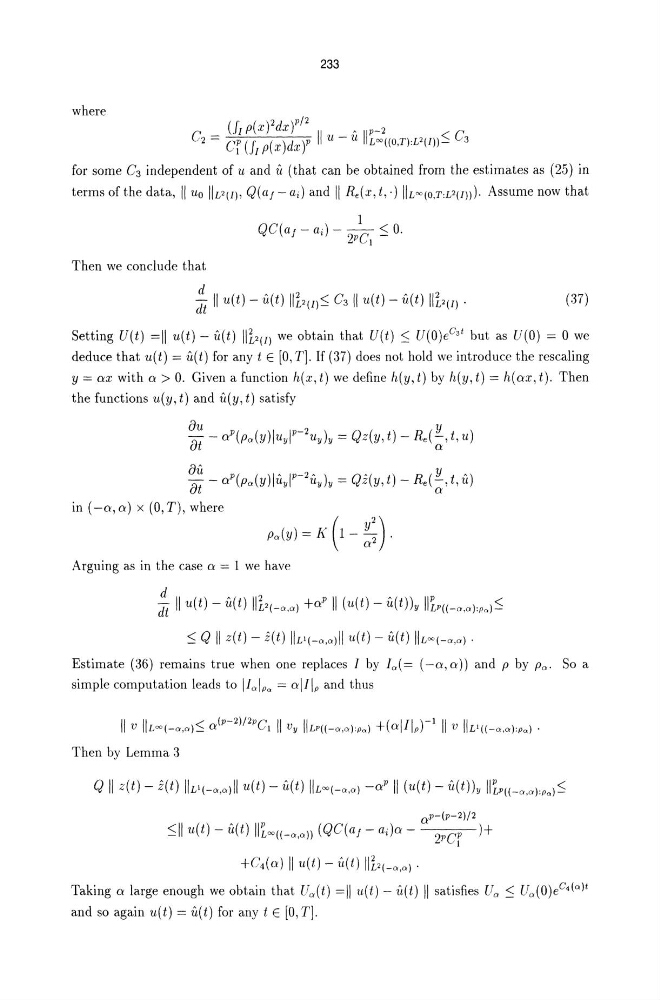
C _ (II p( X )2dx )P/2 I I _' IIp-2
< C
2 - Cf (II p( X )dx Y U U LOO((O,T):£2(I))- 3
for some C3 independent of u and u (that can be obtained from the estimates as (25) in
terms of the data, II Uo IIL2(!), Q(aj - ail and II Re(x, t,.) lIu"'(o,T:£2(!)))' Assume now that
QC(aj - a·) - _1_ < O.
I
2PC 1 -
Then we conclude that
! II u(t) - u(t) Ili2(I):S C3 I I u(t) - u(t) Ili2(I) .
(37)
Setting U(t) =11 u(t) - u(t) lIi2(!) we obtain that U(t) :S U(0)e C3t but as U(O) = 0 we
deduce that u(t) = u(t) for any t E [0, T]. If (37) does not hold we introduce the rescaling
y = ax with a > O. Given a function h(x, t) we define h(y, t) by h(y, t) = h(ax, t). Then
the functions u(y, t) and u(y, t) satisfy
in (-a,a) x (O,T), where
Arguing as in the case a = 1 we have
! II u(t) - u(t) lIi2(-a,a) +a P II (u(t) - u(t))y IltP((-a,a):pa):S
:S Q I I z(t) - z(t) 1I£I(-a,a)11 u(t) - u(t) I!L""(-a,a) .
Estimate (36) remains true when one replaces I by Ia(= (-a,a)) and P by Pal So a
simple computation leads to IIalpa = ailip and thus
II v IILOO(-a,a):S a(p-2)/2 P C1 I I vy IILP((-a,a):Pa) +(aillpt l II v II£I((-a,a):pa) .
Then by Lemma 3
Q II z(t) - z(t) 1I£I(-a,a)11 u(t) - u(t) IILoo(-a,a) -a P II (u(t) - u(t))y IItp((-a,a):Pa):S
p-(p-2)/2
:SII u(t) - u(t) IItoo((-a,all (QC(aj - ai)a - a 2 P Cf )+
+C4 (a) II u(t) - u(t) Ili2(-a,a) .
Taking a large enough we obtain that Ua(t) =11 u(t) - u(t) II satisfies Ua :S U,,(0)e C4 (a)t
and so again u(t) = u(t) for any t E [0, T].
where
C _ (II p( X )2dx )P/2 I I _' IIp-2
< C
2 - Cf (II p( X )dx Y U U LOO((O,T):£2(I))- 3
for some C3 independent of u and u (that can be obtained from the estimates as (25) in
terms of the data, II Uo IIL2(!), Q(aj - ail and II Re(x, t,.) lIu"'(o,T:£2(!)))' Assume now that
QC(aj - a·) - _1_ < O.
I
2PC 1 -
Then we conclude that
! II u(t) - u(t) Ili2(I):S C3 I I u(t) - u(t) Ili2(I) .
(37)
Setting U(t) =11 u(t) - u(t) lIi2(!) we obtain that U(t) :S U(0)e C3t but as U(O) = 0 we
deduce that u(t) = u(t) for any t E [0, T]. If (37) does not hold we introduce the rescaling
y = ax with a > O. Given a function h(x, t) we define h(y, t) by h(y, t) = h(ax, t). Then
the functions u(y, t) and u(y, t) satisfy
in (-a,a) x (O,T), where
Arguing as in the case a = 1 we have
! II u(t) - u(t) lIi2(-a,a) +a P II (u(t) - u(t))y IltP((-a,a):pa):S
:S Q I I z(t) - z(t) 1I£I(-a,a)11 u(t) - u(t) I!L""(-a,a) .
Estimate (36) remains true when one replaces I by Ia(= (-a,a)) and P by Pal So a
simple computation leads to IIalpa = ailip and thus
II v IILOO(-a,a):S a(p-2)/2 P C1 I I vy IILP((-a,a):Pa) +(aillpt l II v II£I((-a,a):pa) .
Then by Lemma 3
Q II z(t) - z(t) 1I£I(-a,a)11 u(t) - u(t) IILoo(-a,a) -a P II (u(t) - u(t))y IItp((-a,a):Pa):S
p-(p-2)/2
:SII u(t) - u(t) IItoo((-a,all (QC(aj - ai)a - a 2 P Cf )+
+C4 (a) II u(t) - u(t) Ili2(-a,a) .
Taking a large enough we obtain that Ua(t) =11 u(t) - u(t) II satisfies Ua :S U,,(0)e C4 (a)t
and so again u(t) = u(t) for any t E [0, T].