

229
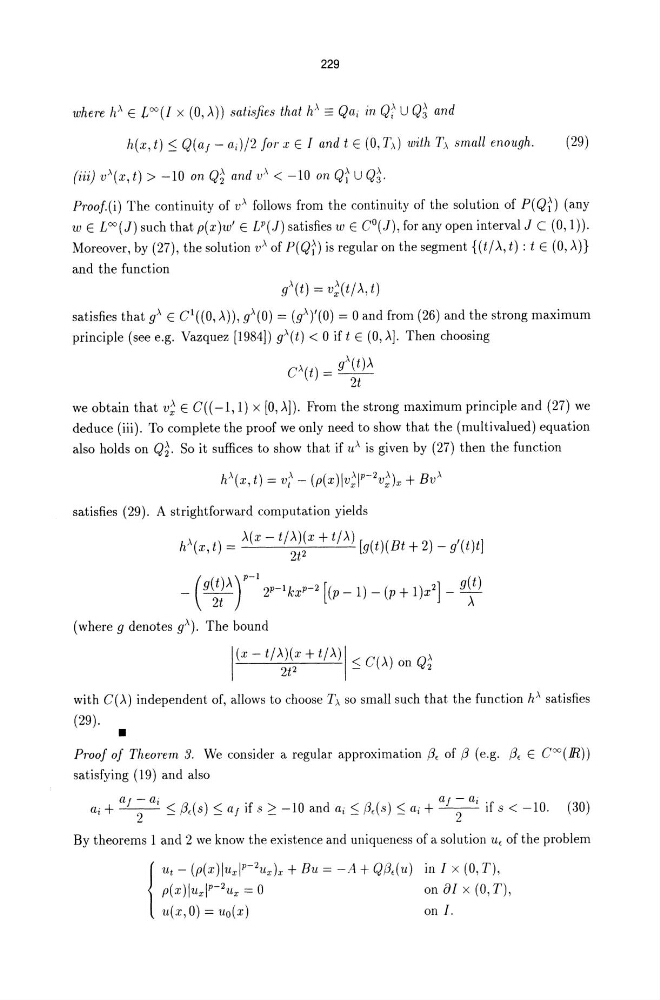
where h'\ E Loo(1 x (0, ,x)) satisfies that hA == Qai in Q;\ U Qi and
h(x, t) ::; Q(aj - a;)/2 for x E J and t E (0, TA) with TA small enough,
(29)
(iii) vA(x,t) > -10 on Q~ and v'\ < -10 on Q; U Q~.
Proof.(i) The continuity of vA follows from the continuity of the solution of P(Qt) (any
wE UD(J) such that p(x)w' E £P(J) satisfies wE C°(J), for any open interval J c (0,1)).
Moreover, by (27), the solution v'\ of p(Qi) is regular on the segment {(tl,x, t) : t E (O,,x)}
and the function
i(t) = v;(tl'\' t)
satisfies that gA E C l ( (O,,x)), l(O) = (l )'(0) = 0 and from (26) and the strong maximum
principle (see e,g. Vazquez [1984]) gA(t) < 0 if t E (0, 'x]. Then choosing
C'\t) = l(t),x
2t
we obtain that v; E C( (-1,1) x [0, ,xl). From the strong maximum principle and (27) we
deduce (iii). To complete the proof we only need to show that the (multivalued) equation
also holds on Q~, SO it suffices to show that if u A is given by (27) then the function
satisfies (29), A strightforward computation yields
h At ) 'x(x-tl,x)(x+tl,x) [ ()(E
)
't)]
x, t =
2
g t t + 2 - g t t
2t
-(g~t r1 2 P - 1 kx p - 2 [(p - 1) - (p + 1 )X2]_ g~t)
(where g denotes gAl. The bound
I (x - t I A~t~X + t / ,X) I ::; C (A) on Q~
with C(A) independent of, allows to choose TA so small such that the function hA satisfies
(29),
•
Proof of Theo1'€1n 3. We consider a regular approximation (3, of (3 (e.g. (3, E coot JR))
satisfying (19) and also
aj-a'
aj-aai + T : : ; (3,(s) ::; aj if 5 ?: -10 and ai ::; ,6,(5) ::; ai + -2-' if 5 < -10. (30)
By theorems 1 and 2 we know the existence and uniqueness of a solution u, of the problem
1
Ut - (p(x)lu xI P - 2 ux)x + Eu = -11 + Q(3,(u)
p(x)IUx I P - 2 ux = 0
u(x, 0) = uo(x)
in J x (0, 'I'),
on 31 x (0, TJ,
on I.
where h'\ E Loo(1 x (0, ,x)) satisfies that hA == Qai in Q;\ U Qi and
h(x, t) ::; Q(aj - a;)/2 for x E J and t E (0, TA) with TA small enough,
(29)
(iii) vA(x,t) > -10 on Q~ and v'\ < -10 on Q; U Q~.
Proof.(i) The continuity of vA follows from the continuity of the solution of P(Qt) (any
wE UD(J) such that p(x)w' E £P(J) satisfies wE C°(J), for any open interval J c (0,1)).
Moreover, by (27), the solution v'\ of p(Qi) is regular on the segment {(tl,x, t) : t E (O,,x)}
and the function
i(t) = v;(tl'\' t)
satisfies that gA E C l ( (O,,x)), l(O) = (l )'(0) = 0 and from (26) and the strong maximum
principle (see e,g. Vazquez [1984]) gA(t) < 0 if t E (0, 'x]. Then choosing
C'\t) = l(t),x
2t
we obtain that v; E C( (-1,1) x [0, ,xl). From the strong maximum principle and (27) we
deduce (iii). To complete the proof we only need to show that the (multivalued) equation
also holds on Q~, SO it suffices to show that if u A is given by (27) then the function
satisfies (29), A strightforward computation yields
h At ) 'x(x-tl,x)(x+tl,x) [ ()(E
)
't)]
x, t =
2
g t t + 2 - g t t
2t
-(g~t r1 2 P - 1 kx p - 2 [(p - 1) - (p + 1 )X2]_ g~t)
(where g denotes gAl. The bound
I (x - t I A~t~X + t / ,X) I ::; C (A) on Q~
with C(A) independent of, allows to choose TA so small such that the function hA satisfies
(29),
•
Proof of Theo1'€1n 3. We consider a regular approximation (3, of (3 (e.g. (3, E coot JR))
satisfying (19) and also
aj-a'
aj-aai + T : : ; (3,(s) ::; aj if 5 ?: -10 and ai ::; ,6,(5) ::; ai + -2-' if 5 < -10. (30)
By theorems 1 and 2 we know the existence and uniqueness of a solution u, of the problem
1
Ut - (p(x)lu xI P - 2 ux)x + Eu = -11 + Q(3,(u)
p(x)IUx I P - 2 ux = 0
u(x, 0) = uo(x)
in J x (0, 'I'),
on 31 x (0, TJ,
on I.