

228
with
f(z) = Bz + lOB - A + Qa;.
Moreover z(x, 0) > 0 and z(O,O) = o. Then from (26) and the strong maximum principle
(see Vazquez [1984]) we deduce that z(x,t) > 0 [i.e. u*(x,t) < -10] for all (x,t) E
(-1,1) x (O,T].
•
The nonuniqueness of the solutions will be a consequence of the existence of solutions
which exhibit the presence of "free-ice zones".
Theorem 3. Under the assumptions of Proposition 2 there exists at least one weak
solution u of (P) such that {(x, t) : u(x, t) > -1O} is not empty for any t > 0 small
enough.
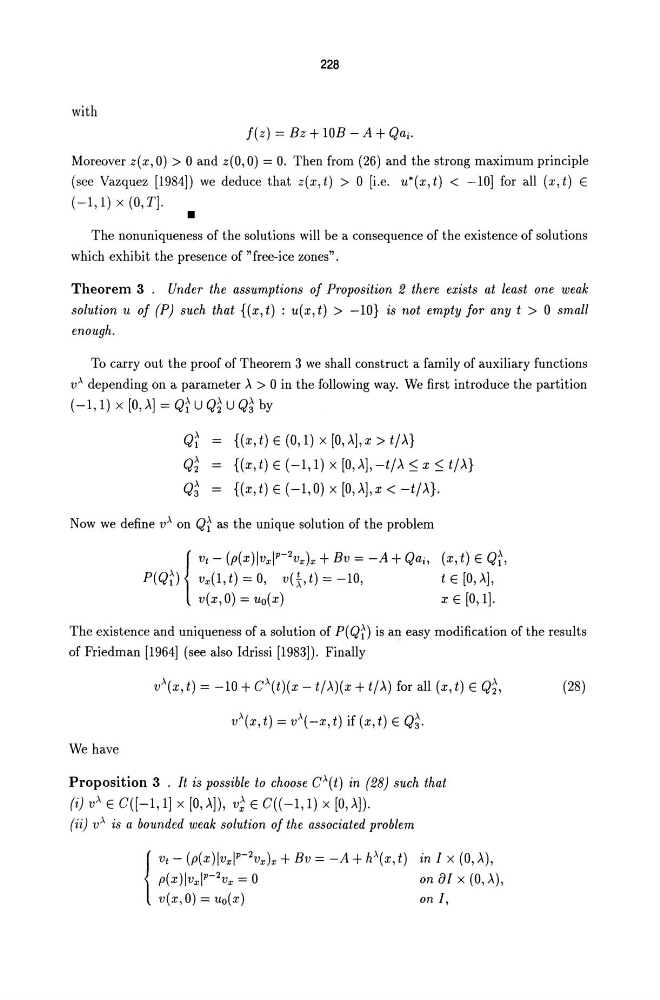
To carry out the proof of Theorem 3 we shall construct a family of auxiliary functions
vA depending on a parameter A > 0 in the following way. We first introduce the partition
(-1,1) x [0, A] = Q~ U Qi U Q~ by
Q~
{(x,t)E(O,I) x [O,A],x>tfA}
Q; = {(x,t) E (-1,1) x [O,A],-tfA ~ x ~ tfA}
Q~ = {(x,t) E (-1,0) x [0, A], x < -tfA}.
Now we define vA on Q~ as the unique solution of the problem
A { Vt - (p(~lvxIP-2~x)x ~ Bv = -A + Qaj, (x, t) E Q~,
P(Ql) vx (l,t)-O, vC>;,t)--lO,
tE[O,A],
v(x,O)=uo(x)
xE[O,l].
The existence and uniqueness of a solution of P( Q~) is an easy modification of the results
of Friedman [1964] (see also Idrissi [1983]). Finally
vA(x, t) = -10 + CA(t)(x - tf A)(X + tf A) for all (x, t) E Q;,
(28)
We have
Proposition 3 . It is possible to choose CA(t) in (28) such that
(i) vA E C([-l,l] x [0, A]), v; E C((-l,l) x [0, A]).
(ii) vA is a bounded weak solution of the associated problem
{
Vt - (p(x)lvxI P - 2 vx)x + Bv = -A + hA(x, t)
p( x) Ivx l p - 2 vx = 0
v(x,O) = uo(x)
in I x (0, A),
on 81 x (0, A),
on I,
with
f(z) = Bz + lOB - A + Qa;.
Moreover z(x, 0) > 0 and z(O,O) = o. Then from (26) and the strong maximum principle
(see Vazquez [1984]) we deduce that z(x,t) > 0 [i.e. u*(x,t) < -10] for all (x,t) E
(-1,1) x (O,T].
•
The nonuniqueness of the solutions will be a consequence of the existence of solutions
which exhibit the presence of "free-ice zones".
Theorem 3. Under the assumptions of Proposition 2 there exists at least one weak
solution u of (P) such that {(x, t) : u(x, t) > -1O} is not empty for any t > 0 small
enough.
To carry out the proof of Theorem 3 we shall construct a family of auxiliary functions
vA depending on a parameter A > 0 in the following way. We first introduce the partition
(-1,1) x [0, A] = Q~ U Qi U Q~ by
Q~
{(x,t)E(O,I) x [O,A],x>tfA}
Q; = {(x,t) E (-1,1) x [O,A],-tfA ~ x ~ tfA}
Q~ = {(x,t) E (-1,0) x [0, A], x < -tfA}.
Now we define vA on Q~ as the unique solution of the problem
A { Vt - (p(~lvxIP-2~x)x ~ Bv = -A + Qaj, (x, t) E Q~,
P(Ql) vx (l,t)-O, vC>;,t)--lO,
tE[O,A],
v(x,O)=uo(x)
xE[O,l].
The existence and uniqueness of a solution of P( Q~) is an easy modification of the results
of Friedman [1964] (see also Idrissi [1983]). Finally
vA(x, t) = -10 + CA(t)(x - tf A)(X + tf A) for all (x, t) E Q;,
(28)
We have
Proposition 3 . It is possible to choose CA(t) in (28) such that
(i) vA E C([-l,l] x [0, A]), v; E C((-l,l) x [0, A]).
(ii) vA is a bounded weak solution of the associated problem
{
Vt - (p(x)lvxI P - 2 vx)x + Bv = -A + hA(x, t)
p( x) Ivx l p - 2 vx = 0
v(x,O) = uo(x)
in I x (0, A),
on 81 x (0, A),
on I,