

219
In contrast to that, Sellers [1969] proposes a continuous linear piecewise function with a
very large increasing rate near -10. We remark that in seasonally averaged models the
terms Q 5' (x) are replaced by a more general function 5'( t, x) "almost" periodic in time.
This is of relevance in the study of ice ages since snowcover over the summer is a necessary
condition for the growth of continental glaciers as, for instance, the ones of Antarctica
and Greenland (see the work by North Mengel and Short [1983] and its references). We
also point out that the modeling of clouds is one of the most important open problems in
the study of the solar energy absortion.
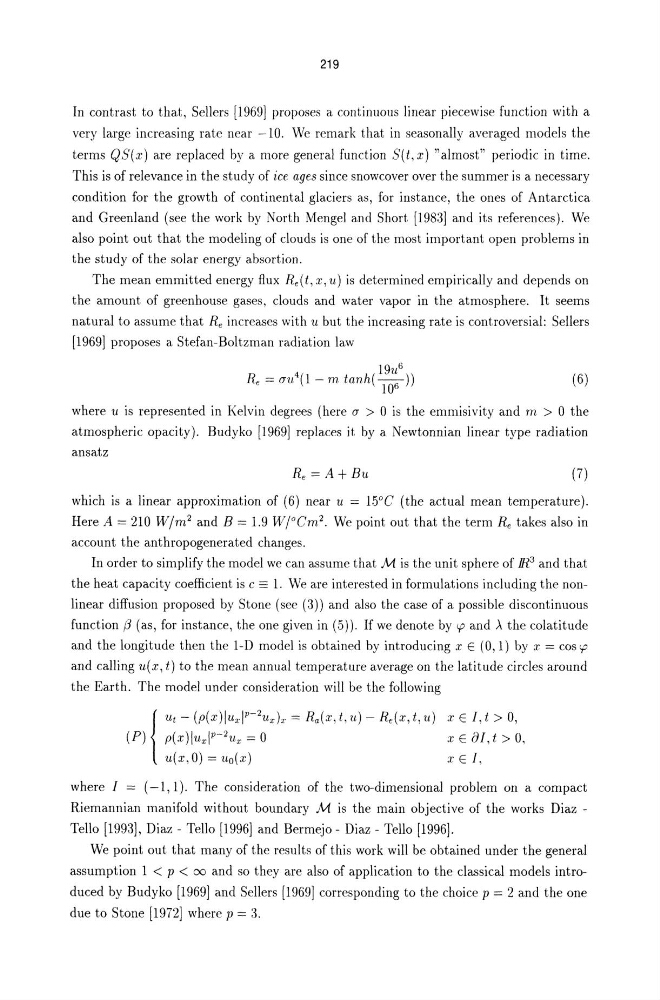
The mean emmitted energy flux Re(t, x, u) is determined empirically and depends on
the amount of greenhouse gases, clouds and water vapor in the atmosphere. It seems
natural to assume that Re increases with u but the increasing rate is controversial: Sellers
[1969] proposes a Stefan-Boltzman radiation law
(6)
where u is represented in Kelvin degrees (here a > ° is the emmisivity and m > ° the
atmospheric opacity). Budyko [1969] replaces it by a Newtonnian linear type radiation
ansatz
Re = A+ Bu
(7)
which is a linear approximation of (6) near u = 15°C (the actual mean temperature).
Here A = 210 W/m 2 and B = 1.9 W/oCm2. We point out that the term Re takes also in
account the anthropogenerated changes.
In order to simplify the model we can assume that M is the unit sphere of 1R 3 and that
the heat capacity coefficient is c == 1. We are interested in formulations including the nonlinear diffusion proposed by Stone (see (3)) and also the case of a possible discontinuous
function (3 (as, for instance, the one given in (5)). If we denote by 'f! and oX the colatitude
and the longitude then the 1-D model is obtained by introducing x E (0,1) by x = cos'f!
and calling u(x, t) to the mean annual temperature average on the latitude circles around
the Earth. The model under consideration will be the following
{
Ut - (p(x)lu x I P - 2 ux )x = Ra(x,t,u) - Re(x,t,u) x E I,t > 0,
(P) p(x)lux I P - 2 ux = 0
x E aI, t > 0,
u(x,O)=uo(x)
xEI,
where I = (-1,1). The consideration of the two-dimensional problem on a compact
Riemannian manifold without boundary M is the main objective of the works Diaz -
Tello [1993], Diaz - Tello [1996] and Bermejo - Diaz - Tello [1996].
We point out that many of the results of this work will be obtained under the general
assumption 1 < p < 00 and so they are also of application to the classical models introduced by Budyko [1969] and Sellers [1969] corresponding to the choice p = 2 and the one
due to Stone [1972] where p = 3.
In contrast to that, Sellers [1969] proposes a continuous linear piecewise function with a
very large increasing rate near -10. We remark that in seasonally averaged models the
terms Q 5' (x) are replaced by a more general function 5'( t, x) "almost" periodic in time.
This is of relevance in the study of ice ages since snowcover over the summer is a necessary
condition for the growth of continental glaciers as, for instance, the ones of Antarctica
and Greenland (see the work by North Mengel and Short [1983] and its references). We
also point out that the modeling of clouds is one of the most important open problems in
the study of the solar energy absortion.
The mean emmitted energy flux Re(t, x, u) is determined empirically and depends on
the amount of greenhouse gases, clouds and water vapor in the atmosphere. It seems
natural to assume that Re increases with u but the increasing rate is controversial: Sellers
[1969] proposes a Stefan-Boltzman radiation law
(6)
where u is represented in Kelvin degrees (here a > ° is the emmisivity and m > ° the
atmospheric opacity). Budyko [1969] replaces it by a Newtonnian linear type radiation
ansatz
Re = A+ Bu
(7)
which is a linear approximation of (6) near u = 15°C (the actual mean temperature).
Here A = 210 W/m 2 and B = 1.9 W/oCm2. We point out that the term Re takes also in
account the anthropogenerated changes.
In order to simplify the model we can assume that M is the unit sphere of 1R 3 and that
the heat capacity coefficient is c == 1. We are interested in formulations including the nonlinear diffusion proposed by Stone (see (3)) and also the case of a possible discontinuous
function (3 (as, for instance, the one given in (5)). If we denote by 'f! and oX the colatitude
and the longitude then the 1-D model is obtained by introducing x E (0,1) by x = cos'f!
and calling u(x, t) to the mean annual temperature average on the latitude circles around
the Earth. The model under consideration will be the following
{
Ut - (p(x)lu x I P - 2 ux )x = Ra(x,t,u) - Re(x,t,u) x E I,t > 0,
(P) p(x)lux I P - 2 ux = 0
x E aI, t > 0,
u(x,O)=uo(x)
xEI,
where I = (-1,1). The consideration of the two-dimensional problem on a compact
Riemannian manifold without boundary M is the main objective of the works Diaz -
Tello [1993], Diaz - Tello [1996] and Bermejo - Diaz - Tello [1996].
We point out that many of the results of this work will be obtained under the general
assumption 1 < p < 00 and so they are also of application to the classical models introduced by Budyko [1969] and Sellers [1969] corresponding to the choice p = 2 and the one
due to Stone [1972] where p = 3.