

218
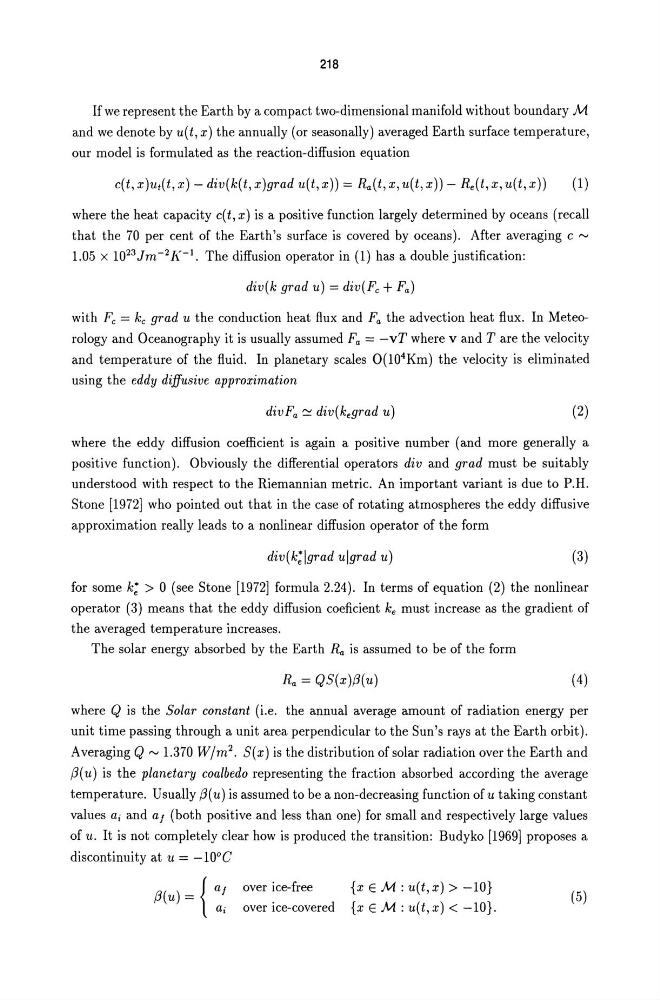
If we represent the Earth by a compact two-dimensional manifold without boundary M
and we denote by u( t, x) the annually (or seasonally) averaged Earth surface temperature,
our model is formulated as the reaction-diffusion equation
c(t, x )Ut(t, x) - div(k(t, x)grad u(t, x)) = Ra(t, x, u(t, x)) - Re(t, x, u(t, x)) (1)
where the heat capacity c(t, x) is a positive function largely determined by oceans (recall
that the 70 per cent of the Earth's surface is covered by oceans). After averaging c '"
1.05 x 10 23 Jm- 2 K- 1 • The diffusion operator in (1) has a double justification:
div(k grad u) = div(Fe + Fa)
with Fe = ke grad u the conduction heat flux and Fa the advection heat flux. In Meteorology and Oceanography it is usually assumed Fa = -vT where v and T are the velocity
and temperature of the fluid. In planetary scales O(104Km) the velocity is eliminated
using the eddy diffusive approximation
divFa ~ div(kegrad u)
(2)
where the eddy diffusion coefficient is again a positive number (and more generally a
positive function). Obviously the differential operators div and grad must be suitably
understood with respect to the Riemannian metric. An important variant is due to P.R.
Stone [1972] who pointed out that in the case of rotating atmospheres the eddy diffusive
approximation really leads to a nonlinear diffusion operator of the form
div(k;lgrad ulgrad u)
(3)
for some k; > 0 (see Stone [1972] formula 2.24). In terms of equation (2) the nonlinear
operator (3) means that the eddy diffusion coeficient ke must increase as the gradient of
the averaged temperature increases.
The solar energy absorbed by the Earth Ra is assumed to be of the form
Ra = QS(x){3(u)
(4)
where Q is the Solar constant (i.e. the annual average amount of radiation energy per
unit time passing through a unit area perpendicular to the Sun's rays at the Earth orbit).
Averaging Q '" 1.370 W/m2. S( x) is the distribution of solar radiation over the Earth and
(3( u) is the planetary coalbedo representing the fraction absorbed according the average
temperature. Usually (3( u) is assumed to be a non-decreasing function of u taking constant
values aj and a f (both positive and less than one) for small and respectively large values
of u. It is not completely clear how is produced the transition: Budyko [1969] proposes a
discontinuity at u = -lOoe
(3(u) = { :~
over ice-free
{x EM: u(t,x) > -10}
over ice-covered {x EM: u(t,x) < -10}.
(5)
If we represent the Earth by a compact two-dimensional manifold without boundary M
and we denote by u( t, x) the annually (or seasonally) averaged Earth surface temperature,
our model is formulated as the reaction-diffusion equation
c(t, x )Ut(t, x) - div(k(t, x)grad u(t, x)) = Ra(t, x, u(t, x)) - Re(t, x, u(t, x)) (1)
where the heat capacity c(t, x) is a positive function largely determined by oceans (recall
that the 70 per cent of the Earth's surface is covered by oceans). After averaging c '"
1.05 x 10 23 Jm- 2 K- 1 • The diffusion operator in (1) has a double justification:
div(k grad u) = div(Fe + Fa)
with Fe = ke grad u the conduction heat flux and Fa the advection heat flux. In Meteorology and Oceanography it is usually assumed Fa = -vT where v and T are the velocity
and temperature of the fluid. In planetary scales O(104Km) the velocity is eliminated
using the eddy diffusive approximation
divFa ~ div(kegrad u)
(2)
where the eddy diffusion coefficient is again a positive number (and more generally a
positive function). Obviously the differential operators div and grad must be suitably
understood with respect to the Riemannian metric. An important variant is due to P.R.
Stone [1972] who pointed out that in the case of rotating atmospheres the eddy diffusive
approximation really leads to a nonlinear diffusion operator of the form
div(k;lgrad ulgrad u)
(3)
for some k; > 0 (see Stone [1972] formula 2.24). In terms of equation (2) the nonlinear
operator (3) means that the eddy diffusion coeficient ke must increase as the gradient of
the averaged temperature increases.
The solar energy absorbed by the Earth Ra is assumed to be of the form
Ra = QS(x){3(u)
(4)
where Q is the Solar constant (i.e. the annual average amount of radiation energy per
unit time passing through a unit area perpendicular to the Sun's rays at the Earth orbit).
Averaging Q '" 1.370 W/m2. S( x) is the distribution of solar radiation over the Earth and
(3( u) is the planetary coalbedo representing the fraction absorbed according the average
temperature. Usually (3( u) is assumed to be a non-decreasing function of u taking constant
values aj and a f (both positive and less than one) for small and respectively large values
of u. It is not completely clear how is produced the transition: Budyko [1969] proposes a
discontinuity at u = -lOoe
(3(u) = { :~
over ice-free
{x EM: u(t,x) > -10}
over ice-covered {x EM: u(t,x) < -10}.
(5)