

199
where (J is a C I function from lI4 into [0,1]' equal to 1 on [0,1] and to 0 on [4,00].
The prepared form of equation (1.15) reads
{
du
dt + Au = Re(u),
u(O) = Uo.
(3.4)
We assume that the initial value problem (3.4) is well posed in E and we denote by
{So(t)}t>o the corresponding semigroup. We also assume that the ball of E centered
at 0 of r~dius p is an absorbing set for (3.4) as well, so that (3.4) and (1.15) have the
same long term dynamics and the same attractors.
We discuss now the existence of an inertial manifold for the prepared equation
and indicate below the relations between an inertial manifold for (3.4) and an inertial
manifold for (1.15).
We observe that
Lemma 3.1. For every u, vEE,
with
IRo(u)IE ::; Mo,
IRo(u) - Ro(v)IE ::; MI ,
Mo = do(2p),
Lo
Ml = 2-do(2p) + d1(2p),
P
where Lo is the Lipschitz constant of (J.
(3.5)
(3.6)
(3.7)
(3.8)
Proof. Relation (3.5) is obvious since Ro = 0 outside the ball of E centered at 0 of
radius 2p ; (3.6) is also obvious if lulE ::; 2p and IvlE ::; 2p or if lulE > 2p and IvlE > 2p.
Now if, say, lulE ::; 2p and IvlE > 2p, we denote by u. the intersection of the segment
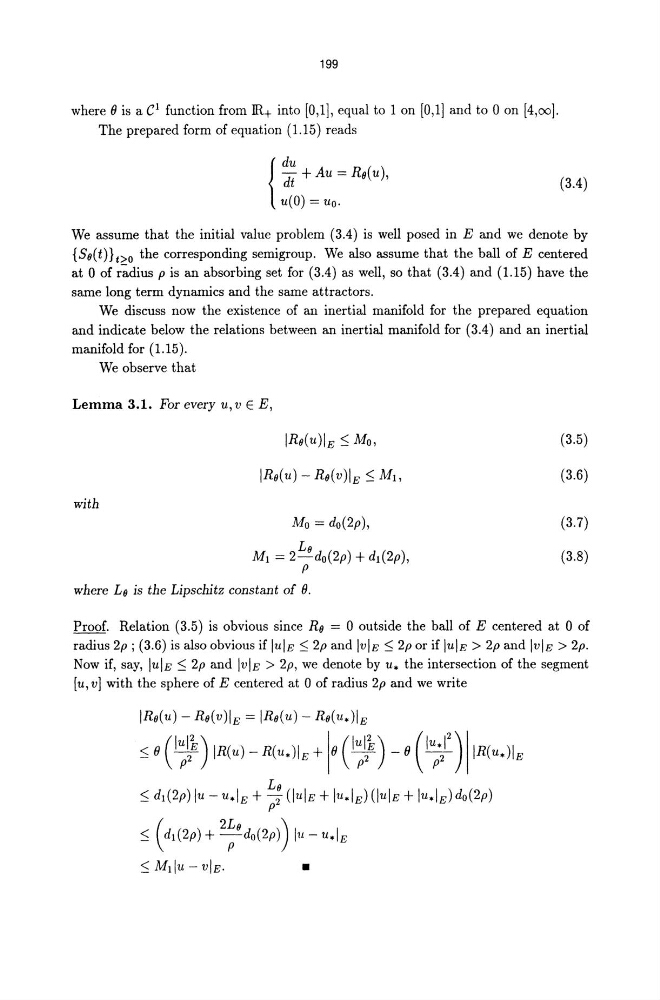
[u, vI with the sphere of E centered at 0 of radius 2p and we write
where (J is a C I function from lI4 into [0,1]' equal to 1 on [0,1] and to 0 on [4,00].
The prepared form of equation (1.15) reads
{
du
dt + Au = Re(u),
u(O) = Uo.
(3.4)
We assume that the initial value problem (3.4) is well posed in E and we denote by
{So(t)}t>o the corresponding semigroup. We also assume that the ball of E centered
at 0 of r~dius p is an absorbing set for (3.4) as well, so that (3.4) and (1.15) have the
same long term dynamics and the same attractors.
We discuss now the existence of an inertial manifold for the prepared equation
and indicate below the relations between an inertial manifold for (3.4) and an inertial
manifold for (1.15).
We observe that
Lemma 3.1. For every u, vEE,
with
IRo(u)IE ::; Mo,
IRo(u) - Ro(v)IE ::; MI ,
Mo = do(2p),
Lo
Ml = 2-do(2p) + d1(2p),
P
where Lo is the Lipschitz constant of (J.
(3.5)
(3.6)
(3.7)
(3.8)
Proof. Relation (3.5) is obvious since Ro = 0 outside the ball of E centered at 0 of
radius 2p ; (3.6) is also obvious if lulE ::; 2p and IvlE ::; 2p or if lulE > 2p and IvlE > 2p.
Now if, say, lulE ::; 2p and IvlE > 2p, we denote by u. the intersection of the segment
[u, vI with the sphere of E centered at 0 of radius 2p and we write