

198
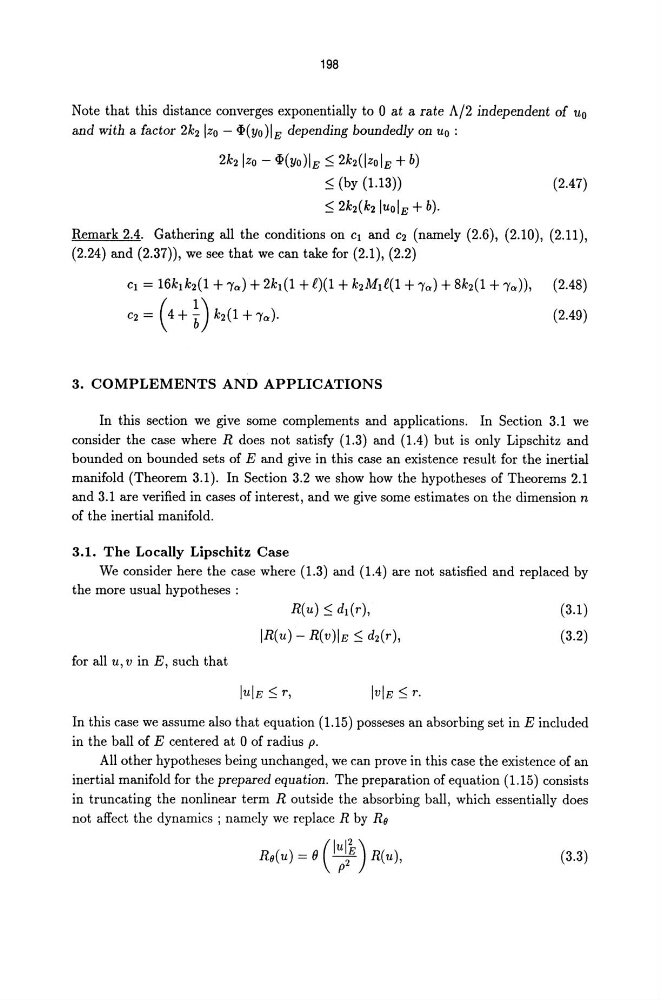
Note that this distance converges exponentially to 0 at a rate A/2 independent of Uo
and with a factor 2k2lzo - (YO)IE depending boundedly on Uo :
2k2lzo - (YO)IE :::; 2k2(lzolE + b)
:::; (by (1.13))
(2.47)
:::; 2k2(k2luolE + b).
Remark 2.4. Gathering all the conditions on CI and C2 (namely (2.6), (2.10), (2.11),
(2.24) and (2.37)), we see that we can take for (2.1), (2.2)
CI = 16kIk2(1 + ,,,) + 2kl (1 + £)(1 + k2MI£(1 + ,,,) + 8k2(1 + ,,,)), (2.48)
C2 = (4 + ~) k2(1 + ,,,).
(2.49)
3. COMPLEMENTS AND APPLICATIONS
In this section we give some complements and applications. In Section 3.1 we
consider the case where R does not satisfy (1.3) and (1.4) but is only Lipschitz and
bounded on bounded sets of E and give in this case an existence result for the inertial
manifold (Theorem 3.1). In Section 3.2 we show how the hypotheses of Theorems 2.1
and 3.1 are verified in cases of interest, and we give some estimates on the dimension n
of the inertial manifold.
3.1. The Locally Lipschitz Case
We consider here the case where (1.3) and (1.4) are not satisfied and replaced by
the more usual hypotheses :
for all u, v in E, such that
R(u):::; dl(r),
IR(u) - R(v)IE :::; d2(r),
lulE:::; r,
IvlE :::; r.
(3.1)
(3.2)
In this case we assume also that equation (1.15) posseses an absorbing set in E included
in the ball of E centered at 0 of radius p.
All other hypotheses being unchanged, we can prove in this case the existence of an
inertial manifold for the prepared equation. The preparation of equation (1.15) consists
in truncating the nonlinear term R outside the absorbing ball, which essentially does
not affect the dynamics ; namely we replace R by Ro
( IU I2 )
Ro(u) = B p2 E R(u),
(3.3)
Note that this distance converges exponentially to 0 at a rate A/2 independent of Uo
and with a factor 2k2lzo - (YO)IE depending boundedly on Uo :
2k2lzo - (YO)IE :::; 2k2(lzolE + b)
:::; (by (1.13))
(2.47)
:::; 2k2(k2luolE + b).
Remark 2.4. Gathering all the conditions on CI and C2 (namely (2.6), (2.10), (2.11),
(2.24) and (2.37)), we see that we can take for (2.1), (2.2)
CI = 16kIk2(1 + ,,,) + 2kl (1 + £)(1 + k2MI£(1 + ,,,) + 8k2(1 + ,,,)), (2.48)
C2 = (4 + ~) k2(1 + ,,,).
(2.49)
3. COMPLEMENTS AND APPLICATIONS
In this section we give some complements and applications. In Section 3.1 we
consider the case where R does not satisfy (1.3) and (1.4) but is only Lipschitz and
bounded on bounded sets of E and give in this case an existence result for the inertial
manifold (Theorem 3.1). In Section 3.2 we show how the hypotheses of Theorems 2.1
and 3.1 are verified in cases of interest, and we give some estimates on the dimension n
of the inertial manifold.
3.1. The Locally Lipschitz Case
We consider here the case where (1.3) and (1.4) are not satisfied and replaced by
the more usual hypotheses :
for all u, v in E, such that
R(u):::; dl(r),
IR(u) - R(v)IE :::; d2(r),
lulE:::; r,
IvlE :::; r.
(3.1)
(3.2)
In this case we assume also that equation (1.15) posseses an absorbing set in E included
in the ball of E centered at 0 of radius p.
All other hypotheses being unchanged, we can prove in this case the existence of an
inertial manifold for the prepared equation. The preparation of equation (1.15) consists
in truncating the nonlinear term R outside the absorbing ball, which essentially does
not affect the dynamics ; namely we replace R by Ro
( IU I2 )
Ro(u) = B p2 E R(u),
(3.3)