

186
It is clear that for 1fJ E Fl,b, (1.25) is an ordinary (finite dimensional) system of
differential equations which possesses a unique solution y = y( t), defined for all t E IR.
It is easy to see (we will prove more below), that for Yo E PnE, T1fJ(yo) given by
(1.24) belongs to QnE. Hence T1fJis a mapping from PnE into QnE. In fact, under
suitable hypotheses, we show in Section 2 that T 1fJ belongs to Fl,b and that T is a strict
contraction. By the Contraction Principle, we see that T possesses a fixed point we show that the graph of 2. THE MAIN RESULT (Lipschitz case).
In this section we state and prove one of our main results, namely the existence of
inertial manifolds in the globally Lipschitz case, i.e. when R satisfies (1.3) and (1.4).
We refer the reader to Section 3 for the locally Lipschitz case.
2.1. Existence of Inertial Manifolds
Our aim is to prove the following
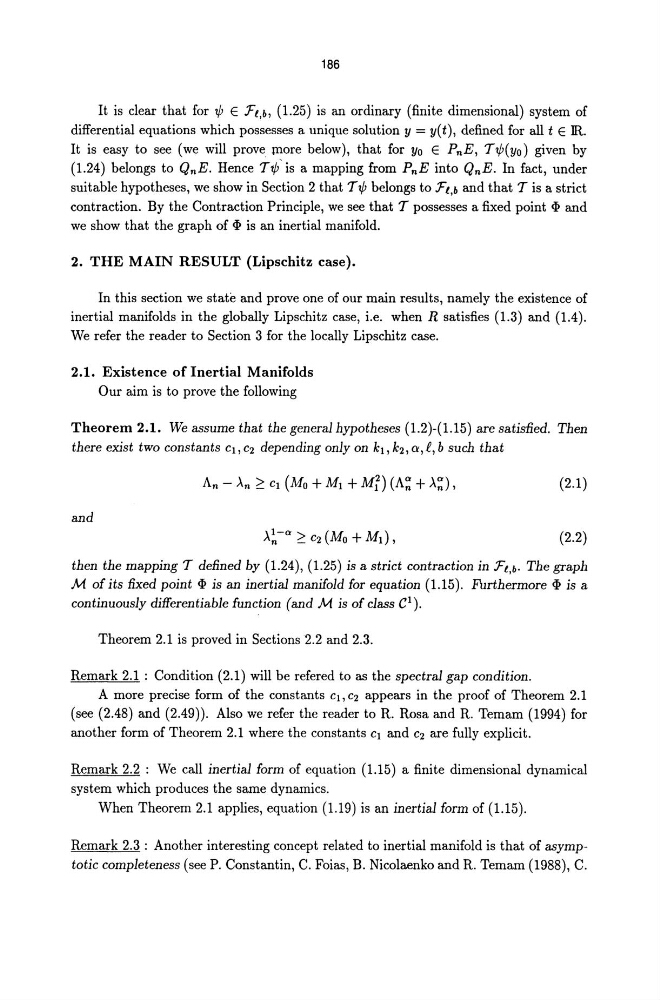
Theorem 2.1. We assume that the general hypotheses (1.2)-(1.15) are satisfied. Then
there exist two constants Cl, C2 depending only on kl' k2' a, e, b such that
(2.1)
and
(2.2)
then the mapping T defined by (1.24), (1.25) is a strict contraction in Fe,b' The graph
M of its fixed point continuously differentiable function (and M is of class C 1 ).
Theorem 2.1 is proved in Sections 2.2 and 2.3.
Remark 2.1 ; Condition (2.1) will be refered to as the spectral gap condition.
A more precise form of the constants Cl, C2 appears in the proof of Theorem 2.1
(see (2.48) and (2.49)). Also we refer the reader to R. Rosa and R. Temam (1994) for
another form of Theorem 2.1 where the constants Cl and C2 are fully explicit.
Remark 2.2 ; We call inertial form of equation (1.15) a finite dimensional dynamical
system which produces the same dynamics.
When Theorem 2.1 applies, equation (1.19) is an inertial form of (1.15).
Remark 2.3 ; Another interesting concept related to inertial manifold is that of asymptotic completeness (see P. Constantin, C. Foias, B. Nicolaenko and R. Temam (1988), C.
It is clear that for 1fJ E Fl,b, (1.25) is an ordinary (finite dimensional) system of
differential equations which possesses a unique solution y = y( t), defined for all t E IR.
It is easy to see (we will prove more below), that for Yo E PnE, T1fJ(yo) given by
(1.24) belongs to QnE. Hence T1fJis a mapping from PnE into QnE. In fact, under
suitable hypotheses, we show in Section 2 that T 1fJ belongs to Fl,b and that T is a strict
contraction. By the Contraction Principle, we see that T possesses a fixed point we show that the graph of 2. THE MAIN RESULT (Lipschitz case).
In this section we state and prove one of our main results, namely the existence of
inertial manifolds in the globally Lipschitz case, i.e. when R satisfies (1.3) and (1.4).
We refer the reader to Section 3 for the locally Lipschitz case.
2.1. Existence of Inertial Manifolds
Our aim is to prove the following
Theorem 2.1. We assume that the general hypotheses (1.2)-(1.15) are satisfied. Then
there exist two constants Cl, C2 depending only on kl' k2' a, e, b such that
(2.1)
and
(2.2)
then the mapping T defined by (1.24), (1.25) is a strict contraction in Fe,b' The graph
M of its fixed point continuously differentiable function (and M is of class C 1 ).
Theorem 2.1 is proved in Sections 2.2 and 2.3.
Remark 2.1 ; Condition (2.1) will be refered to as the spectral gap condition.
A more precise form of the constants Cl, C2 appears in the proof of Theorem 2.1
(see (2.48) and (2.49)). Also we refer the reader to R. Rosa and R. Temam (1994) for
another form of Theorem 2.1 where the constants Cl and C2 are fully explicit.
Remark 2.2 ; We call inertial form of equation (1.15) a finite dimensional dynamical
system which produces the same dynamics.
When Theorem 2.1 applies, equation (1.19) is an inertial form of (1.15).
Remark 2.3 ; Another interesting concept related to inertial manifold is that of asymptotic completeness (see P. Constantin, C. Foias, B. Nicolaenko and R. Temam (1988), C.