

177
divu = 0
(IlI.44)
In that particular case, properties of the special basis allow us to simply solve these
equations as we just have to search u verifying (Ill.43) under the form:
Nb
Curl. Nb Ma
::Ii
u = L, bi,o(t) ~ + L L, bdt) _ r.. Curlqi COS(jn:x3)
i=1
'JJli
'=}j=l
'JJli
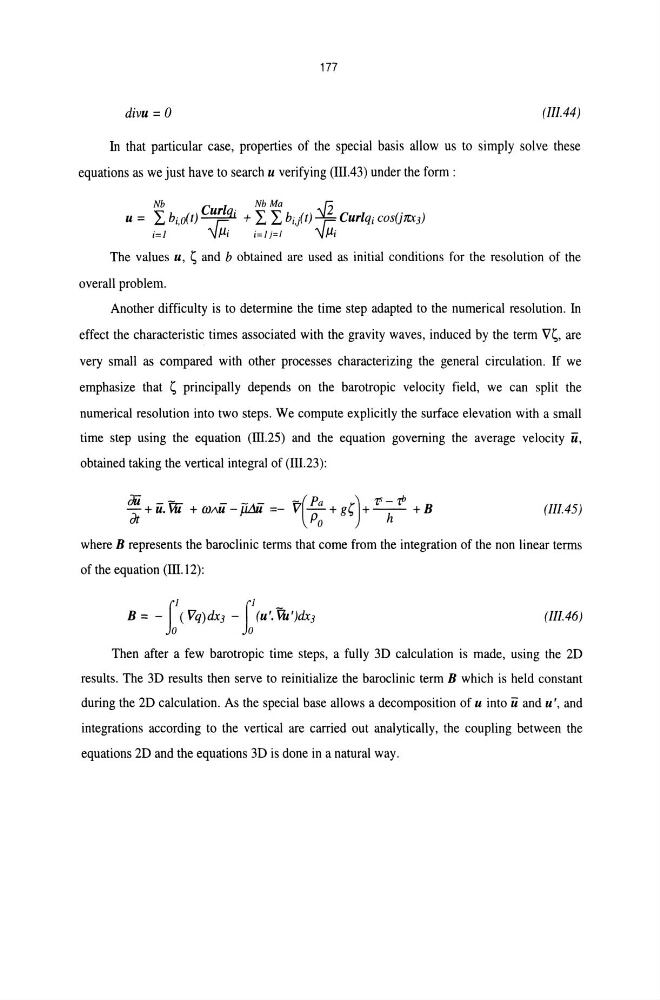
The values u, ~ and b obtained are used as initial conditions for the resolution of the
overall problem.
Another difficulty is to determine the time step adapted to the numerical resolution. In
effect the characteristic times associated with the gravity waves, induced by the term V~, are
very small as compared with other processes characterizing the general circulation. If we
emphasize that ~ principally depends on the barotropic velocity field, we can split the
numerical resolution into two steps. We compute explicitly the surface elevation with a small
time step using the equation (ID.25) and the equation governing the average velocity ii,
obtained taking the vertical integral of (111.23):
dii -i'r.
-
iill;;
-v(Pa r) 'E'-1'> B
at + u. YU + (j)/IU -,......... =- Po + go, + -h- +
(III.45)
where B represents the baroc1inic terms that come from the integration of the non linear terms
of the equation (Ill. 12):
(Ill. 46)
Then after a few barotropic time steps, a fully 3D calculation is made, using the 2D
results. The 3D results then serve to reinitialize the baroc1inic term B which is held constant
during the 2D calculation. As the special base allows a decomposition of u into ii and u', and
integrations according to the vertical are carried out analytically, the coupling between the
equations 2D and the equations 3D is done in a natural way.
divu = 0
(IlI.44)
In that particular case, properties of the special basis allow us to simply solve these
equations as we just have to search u verifying (Ill.43) under the form:
Nb
Curl. Nb Ma
::Ii
u = L, bi,o(t) ~ + L L, bdt) _ r.. Curlqi COS(jn:x3)
i=1
'JJli
'=}j=l
'JJli
The values u, ~ and b obtained are used as initial conditions for the resolution of the
overall problem.
Another difficulty is to determine the time step adapted to the numerical resolution. In
effect the characteristic times associated with the gravity waves, induced by the term V~, are
very small as compared with other processes characterizing the general circulation. If we
emphasize that ~ principally depends on the barotropic velocity field, we can split the
numerical resolution into two steps. We compute explicitly the surface elevation with a small
time step using the equation (ID.25) and the equation governing the average velocity ii,
obtained taking the vertical integral of (111.23):
dii -i'r.
-
iill;;
-v(Pa r) 'E'-1'> B
at + u. YU + (j)/IU -,......... =- Po + go, + -h- +
(III.45)
where B represents the baroc1inic terms that come from the integration of the non linear terms
of the equation (Ill. 12):
(Ill. 46)
Then after a few barotropic time steps, a fully 3D calculation is made, using the 2D
results. The 3D results then serve to reinitialize the baroc1inic term B which is held constant
during the 2D calculation. As the special base allows a decomposition of u into ii and u', and
integrations according to the vertical are carried out analytically, the coupling between the
equations 2D and the equations 3D is done in a natural way.