

175
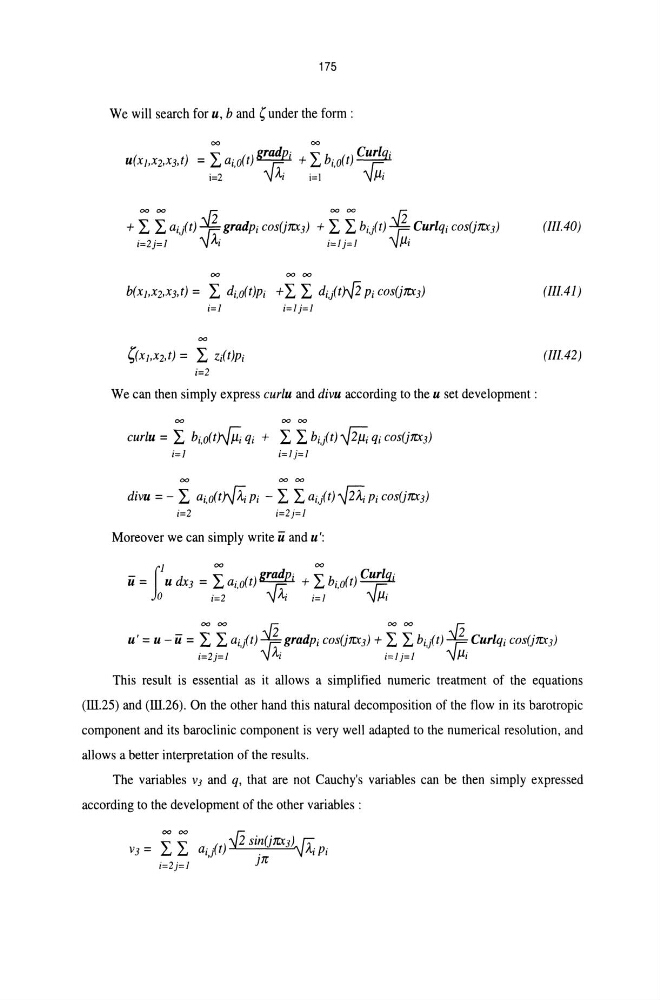
We will search for u, band S under the form:
(III. 40)
00
00 00
(I/lAl)
i=1
i=1 j=1
S(Xj, X2,t) = L Z;(t)Pi
(Ill. 42)
i=2
We can then simply express curlu and divu according to the u set development:
00
00 00
curlu = L bi,O(t$ qi + L L bdt) ~ qi COS(j1CX3)
i=1
i=1 j=1
00
00 00
divu = - L ai,o(t~ Pi - L L aiit) ~ Pi COS(j1CX3)
i=2
i=2j=1
Moreover we can simply write Ii and u ':
i
l
00
00
rad .
Curl·
Ii = u dx3 = L ai,O(t)t:!!!!Y!i + L bi,O(t) ~
o
i=2
~ i=1
~
0 0 0 0 . r : ;
o o o o . r : ;
u' = u - it = L. L. adt)-:k gradpi COS(j1CX3) + L L bi,lt)-:t Curlqi COS(j1CX3)
i=2j=1
'\I A;
i=lj=1
'\I IIi
This result is essential as it allows a simplified numeric treatment of the equations
(ID.25) and (III.26). On the other hand this natural decomposition of the flow in its barotropic
component and its baroc1inic component is very well adapted to the numerical resolution, and
allows a better interpretation of the results.
The variables V3 and q, that are not Cauchy's variables can be then simply expressed
according to the development of the other variables:
We will search for u, band S under the form:
(III. 40)
00
00 00
(I/lAl)
i=1
i=1 j=1
S(Xj, X2,t) = L Z;(t)Pi
(Ill. 42)
i=2
We can then simply express curlu and divu according to the u set development:
00
00 00
curlu = L bi,O(t$ qi + L L bdt) ~ qi COS(j1CX3)
i=1
i=1 j=1
00
00 00
divu = - L ai,o(t~ Pi - L L aiit) ~ Pi COS(j1CX3)
i=2
i=2j=1
Moreover we can simply write Ii and u ':
i
l
00
00
rad .
Curl·
Ii = u dx3 = L ai,O(t)t:!!!!Y!i + L bi,O(t) ~
o
i=2
~ i=1
~
0 0 0 0 . r : ;
o o o o . r : ;
u' = u - it = L. L. adt)-:k gradpi COS(j1CX3) + L L bi,lt)-:t Curlqi COS(j1CX3)
i=2j=1
'\I A;
i=lj=1
'\I IIi
This result is essential as it allows a simplified numeric treatment of the equations
(ID.25) and (III.26). On the other hand this natural decomposition of the flow in its barotropic
component and its baroc1inic component is very well adapted to the numerical resolution, and
allows a better interpretation of the results.
The variables V3 and q, that are not Cauchy's variables can be then simply expressed
according to the development of the other variables: