

116
would be stable over the cool areas (i.e. over most of the grid point) , resulting in small
vertical fluxes. In the mixture approach, this effect would dominate. On the other hand ,
even with a small fractional cover, because of the non-linear nature of the aerodynamic
resistance (or drag coefficient, see Fig. 3), the instability induced by the warm and dry
areas may have an effect of the same order of magnitude of, or even greater than, that of
the cool areas. Therefore, the mixture approach would lead to a relatively large error.
(a)
(b)
Tr
Tr
r.
r ..
r.
T
1-1
T.
T .. ,
T" 2
r,
r2
r,
!!.
T
1-1
T
1-1
T,
T2
T,
T2
Homogeneoul Mixture
Mosaic:
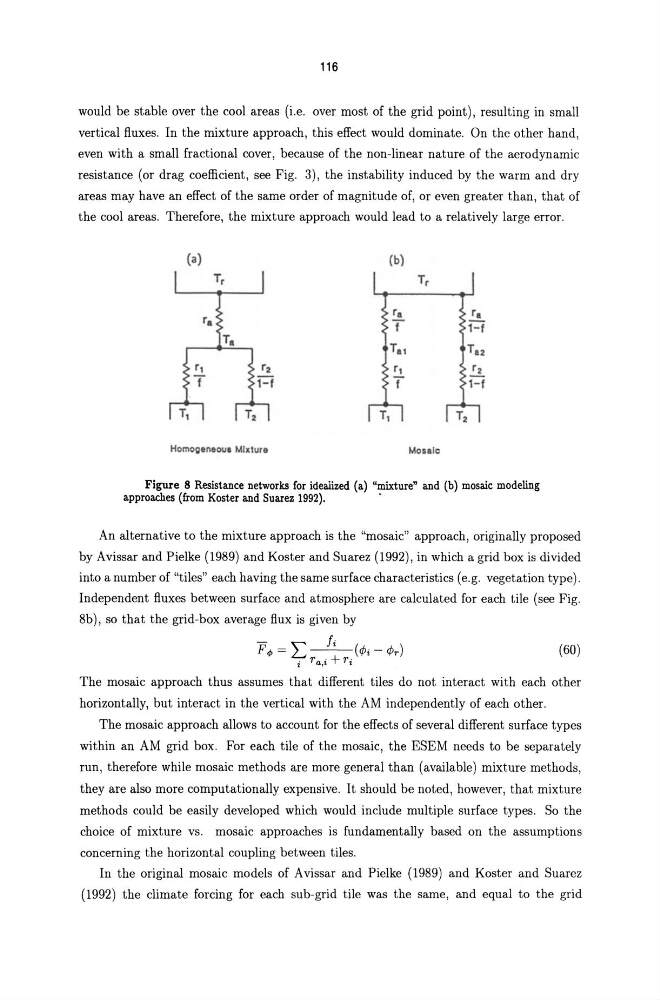
Figure 8 Resistance networks for idealized (a) "mixture" and (b) mosaic modeling
approaches (from Koster and Suarez 1992).
.
An alternative to the mixture approach is the "mosaic" approach, originally proposed
by Avissar and Pielke (1989) and Koster and Suarez (1992) , in which a grid box is divided
into a number of "tiles" each having the same surface characteristics (e.g. vegetation type).
Independent fluxes between surface and atmosphere are calculated for each tile (see Fig.
8b), so that t he grid-box average flux is given by
F"' = L~+ i (¢i-¢r)
i Ta,i
ri
(60)
The mosaic approach thus assumes that different tiles do not interact with each other
horizontally, but interact in the vertical with the AM independently of each other.
The mosaic approach allows to account for the effects of several different surface types
within an AM grid box. For each tile of the mosaic, the ESEM needs to be separately
run, therefore while mosaic methods are more general than (available) mixture methods,
they are also more computationally expensive. It should be noted, however, that mixture
methods could be easily developed which would include multiple surface types. So the
choice of mixture vs. mosaic approaches is fundamentally based on the assumptions
concerning the horizontal coupling between tiles.
In the original mosaic models of A vissar and Pielke (1989) and Koster and Suarez
(1992) the climate forcing for each sub-grid tile was the same, and equal to the grid
would be stable over the cool areas (i.e. over most of the grid point) , resulting in small
vertical fluxes. In the mixture approach, this effect would dominate. On the other hand ,
even with a small fractional cover, because of the non-linear nature of the aerodynamic
resistance (or drag coefficient, see Fig. 3), the instability induced by the warm and dry
areas may have an effect of the same order of magnitude of, or even greater than, that of
the cool areas. Therefore, the mixture approach would lead to a relatively large error.
(a)
(b)
Tr
Tr
r.
r ..
r.
T
1-1
T.
T .. ,
T" 2
r,
r2
r,
!!.
T
1-1
T
1-1
T,
T2
T,
T2
Homogeneoul Mixture
Mosaic:
Figure 8 Resistance networks for idealized (a) "mixture" and (b) mosaic modeling
approaches (from Koster and Suarez 1992).
.
An alternative to the mixture approach is the "mosaic" approach, originally proposed
by Avissar and Pielke (1989) and Koster and Suarez (1992) , in which a grid box is divided
into a number of "tiles" each having the same surface characteristics (e.g. vegetation type).
Independent fluxes between surface and atmosphere are calculated for each tile (see Fig.
8b), so that t he grid-box average flux is given by
F"' = L~+ i (¢i-¢r)
i Ta,i
ri
(60)
The mosaic approach thus assumes that different tiles do not interact with each other
horizontally, but interact in the vertical with the AM independently of each other.
The mosaic approach allows to account for the effects of several different surface types
within an AM grid box. For each tile of the mosaic, the ESEM needs to be separately
run, therefore while mosaic methods are more general than (available) mixture methods,
they are also more computationally expensive. It should be noted, however, that mixture
methods could be easily developed which would include multiple surface types. So the
choice of mixture vs. mosaic approaches is fundamentally based on the assumptions
concerning the horizontal coupling between tiles.
In the original mosaic models of A vissar and Pielke (1989) and Koster and Suarez
(1992) the climate forcing for each sub-grid tile was the same, and equal to the grid