

115
effects include the contribution of heterogeneous surfaces on the grid-average fluxes of
momentum, energy and water, or more generally on the grid-average energy and water
budgets. Indirect effects are associated with the impact that surface fluxes from heterogeneous surfaces may have on atmospheric circulations, i.e. they are essentially dynamical
in nature. Surface heterogeneities can induce mesoscale circulations, such as the seabreeze, the vegetation-breeze, slope and urban circulations, which can affect local climate
and modify the surface-atmosphere exchanges. In addition, gradients of sensible and latent heat fluxes can provide baroclinicity and moist static energy to overlying synoptic
systems.
This section is thus organized so as to discuss separately the different approaches which
have been developed to study direct and indirect effects of inter-patch and intra-patch
surface heterogeneity.
4.2. Direct effects of surface heterogeneity
4.2.1 Inter-patch heterogeneity
A number of approaches of increasing complexity have been proposed to represent
the direct effects of inter-patch heterogeneity within an AM grid cell. The simplest is
that adopted by most ESEMs, e.g. SiB and BATS, and has been called the "mixture"
approach (Koster and Suarez 1992). In this approach, the surface is assumed to be
covered by a homogeneous mixture of two surface types (e.g. tall and short vegetation,
or vegetated and non-vegetated areas) with tightly coupled energy balances. The two
types simultaneously interact with the soil and with an interface layer (e.g. canopy air)
which in turn is interfaced with the AM bottom level. This approach has also been called
"big-leaf' to reflect the assumption that a large grid area is characterized by homogeneous
vegetation properties.
The resistance network for a surface variable ¢ (e.g. temperature or moisture) in the
mixture approach is illustrated in Fig. 8a from the work of Koster and Suarez (1992),
where the subscripts a and r refer to the interface and atmospheric layer, respectively,
r is the resistance and f is the fractional cover for the vegetation type i. From Fig.
8a, assuming that the interface layer has negligible capacity for the quantity ¢ (e.g.
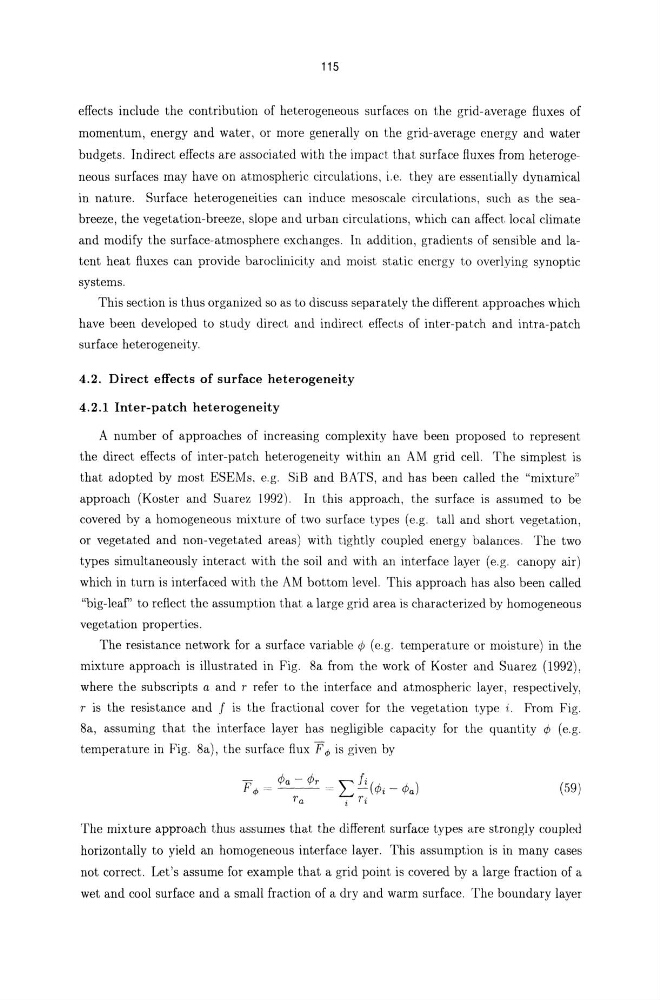
temperature in Fig. 8a), the surface flux F is given by
(59)
The mixture approach thus assumes that the different surface types are strongly coupled
horizontally to yield an homogeneous interface layer. This assumption is in many cases
not correct. Let's assume for example that a grid point is covered by a large fraction of a
wet and cool surface and a small fraction of a dry and warm surface. The boundary layer
effects include the contribution of heterogeneous surfaces on the grid-average fluxes of
momentum, energy and water, or more generally on the grid-average energy and water
budgets. Indirect effects are associated with the impact that surface fluxes from heterogeneous surfaces may have on atmospheric circulations, i.e. they are essentially dynamical
in nature. Surface heterogeneities can induce mesoscale circulations, such as the seabreeze, the vegetation-breeze, slope and urban circulations, which can affect local climate
and modify the surface-atmosphere exchanges. In addition, gradients of sensible and latent heat fluxes can provide baroclinicity and moist static energy to overlying synoptic
systems.
This section is thus organized so as to discuss separately the different approaches which
have been developed to study direct and indirect effects of inter-patch and intra-patch
surface heterogeneity.
4.2. Direct effects of surface heterogeneity
4.2.1 Inter-patch heterogeneity
A number of approaches of increasing complexity have been proposed to represent
the direct effects of inter-patch heterogeneity within an AM grid cell. The simplest is
that adopted by most ESEMs, e.g. SiB and BATS, and has been called the "mixture"
approach (Koster and Suarez 1992). In this approach, the surface is assumed to be
covered by a homogeneous mixture of two surface types (e.g. tall and short vegetation,
or vegetated and non-vegetated areas) with tightly coupled energy balances. The two
types simultaneously interact with the soil and with an interface layer (e.g. canopy air)
which in turn is interfaced with the AM bottom level. This approach has also been called
"big-leaf' to reflect the assumption that a large grid area is characterized by homogeneous
vegetation properties.
The resistance network for a surface variable ¢ (e.g. temperature or moisture) in the
mixture approach is illustrated in Fig. 8a from the work of Koster and Suarez (1992),
where the subscripts a and r refer to the interface and atmospheric layer, respectively,
r is the resistance and f is the fractional cover for the vegetation type i. From Fig.
8a, assuming that the interface layer has negligible capacity for the quantity ¢ (e.g.
temperature in Fig. 8a), the surface flux F is given by
(59)
The mixture approach thus assumes that the different surface types are strongly coupled
horizontally to yield an homogeneous interface layer. This assumption is in many cases
not correct. Let's assume for example that a grid point is covered by a large fraction of a
wet and cool surface and a small fraction of a dry and warm surface. The boundary layer