

91
This is a set of seven differential equations in the seven unknowns u, v, W, p, T, p and
q, which can be simplified depending on the scale of motions under consideration and
can be written in different systems of coordinates. For example, in general circulation
models (GCMs) of the atmosphere, scale analysis reduces the equation for the vertical
component of the wind to the hydrostatic equation and Eqs. (1)-(5) are often written
using as vertical coordinate (J = p/p" where Ps is surface pressure. In addition, other
continuity equations can be added to the system (1)-(5) for different chemical constituents
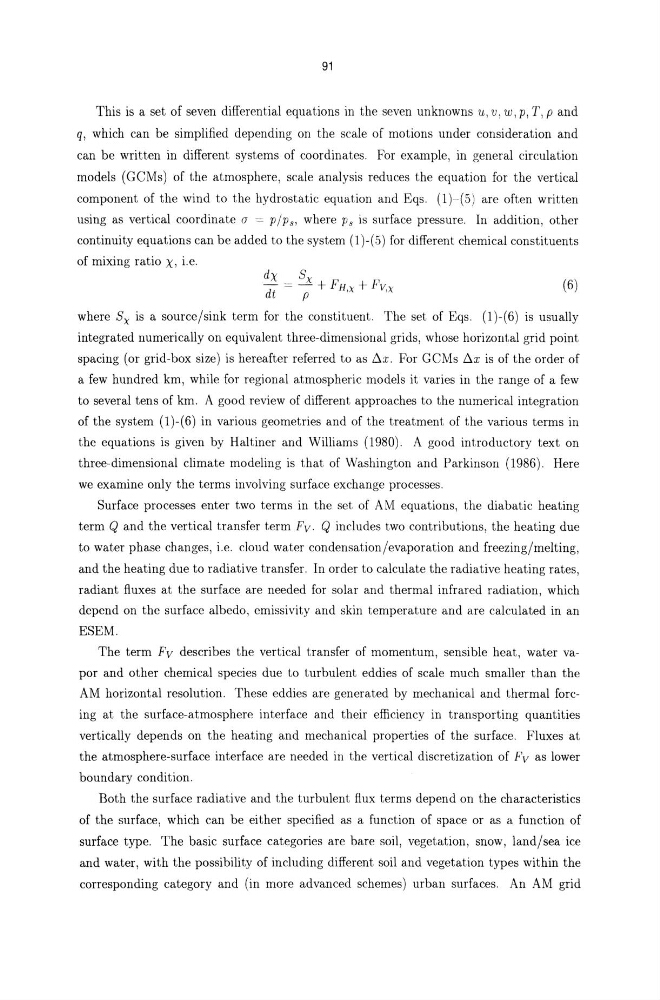
of mixing ratio X, i.e.
(6)
where Sx is a source/sink term for the constituent. The set of Eqs. (1)-(6) is usually
integrated numerically on equivalent three-dimensional grids, whose horizontal grid point
spacing (or grid-box size) is hereafter referred to as ~x. For GCMs ~x is of the order of
a few hundred km, while for regional atmospheric models it varies in the range of a few
to several tens of km. A good review of different approaches to the numerical integration
of the system (1)-(6) in various geometries and of the treatment of the various terms in
the equations is given by Haltiner and Williams (1980). A good introductory text on
three-dimensional climate modeling is that of Washington and Parkinson (1986). Here
we examine only the terms involving surface exchange processes.
Surface processes enter two terms in the set of AM equations, the diabatic heating
term Q and the vertical transfer term Fv. Q includes two contributions, the heating due
to water phase changes, i.e. cloud water condensation/evaporation and freezing/melting,
and the heating due to radiative transfer. In order to calculate the radiative heating rates,
radiant fluxes at the surface are needed for solar and thermal infrared radiation, which
depend on the surface albedo, emissivity and skin temperature and are calculated in an
ESEM.
The term Fv describes the vertical transfer of momentum, sensible heat, water vapor and other chemical species due to turbulent eddies of scale much smaller than the
AM horizontal resolution. These eddies are generated by mechanical and thermal forcing at the surface-atmosphere interface and their efficiency in transporting quantities
vertically depends on the heating and mechanical properties of the surface. Fluxes at
the atmosphere-surface interface are needed in the vertical discretization of Fv as lower
boundary condition.
Both the surface radiative and the turbulent flux terms depend on the characteristics
of the surface, which can be either specified as a function of space or as a function of
surface type. The basic surface categories are bare soil, vegetation, snow, land/sea ice
and water, with the possibility of including different soil and vegetation types within the
corresponding category and (in more advanced schemes) urban surfaces. An AM grid
This is a set of seven differential equations in the seven unknowns u, v, W, p, T, p and
q, which can be simplified depending on the scale of motions under consideration and
can be written in different systems of coordinates. For example, in general circulation
models (GCMs) of the atmosphere, scale analysis reduces the equation for the vertical
component of the wind to the hydrostatic equation and Eqs. (1)-(5) are often written
using as vertical coordinate (J = p/p" where Ps is surface pressure. In addition, other
continuity equations can be added to the system (1)-(5) for different chemical constituents
of mixing ratio X, i.e.
(6)
where Sx is a source/sink term for the constituent. The set of Eqs. (1)-(6) is usually
integrated numerically on equivalent three-dimensional grids, whose horizontal grid point
spacing (or grid-box size) is hereafter referred to as ~x. For GCMs ~x is of the order of
a few hundred km, while for regional atmospheric models it varies in the range of a few
to several tens of km. A good review of different approaches to the numerical integration
of the system (1)-(6) in various geometries and of the treatment of the various terms in
the equations is given by Haltiner and Williams (1980). A good introductory text on
three-dimensional climate modeling is that of Washington and Parkinson (1986). Here
we examine only the terms involving surface exchange processes.
Surface processes enter two terms in the set of AM equations, the diabatic heating
term Q and the vertical transfer term Fv. Q includes two contributions, the heating due
to water phase changes, i.e. cloud water condensation/evaporation and freezing/melting,
and the heating due to radiative transfer. In order to calculate the radiative heating rates,
radiant fluxes at the surface are needed for solar and thermal infrared radiation, which
depend on the surface albedo, emissivity and skin temperature and are calculated in an
ESEM.
The term Fv describes the vertical transfer of momentum, sensible heat, water vapor and other chemical species due to turbulent eddies of scale much smaller than the
AM horizontal resolution. These eddies are generated by mechanical and thermal forcing at the surface-atmosphere interface and their efficiency in transporting quantities
vertically depends on the heating and mechanical properties of the surface. Fluxes at
the atmosphere-surface interface are needed in the vertical discretization of Fv as lower
boundary condition.
Both the surface radiative and the turbulent flux terms depend on the characteristics
of the surface, which can be either specified as a function of space or as a function of
surface type. The basic surface categories are bare soil, vegetation, snow, land/sea ice
and water, with the possibility of including different soil and vegetation types within the
corresponding category and (in more advanced schemes) urban surfaces. An AM grid