

90
act as interface between hydrology models and CSMs by calculating the water budget of a
surface soil zone where biophysical processes (e.g. evapotranspiration) occur and providing this budget as boundary condition for the hydrology module. In turn, the hydrology
model would provide the runoff efficiency and the energy and water fluxes at the lower
boundary of the ESEM soil region.
Finally, ESEMs have an important role in atmospheric chemistry-tracer transport
modeling, since sources, vertical transport in the lower atmosphere and dry deposition
processes are strongly related to the efficiency of surface-atmosphere exchanges and to
the characteristics of the surface (e.g. Giorgi 1986).
Therefore, the emergency of climate system modeling places ESEMs in a new perspective. While ESEMs were mostly developed as tools to provide lower boundary conditions
for climate models (see section 2.1), their role can now be viewed as that of interface for
interactive coupling of different components of the climate system (see Fig. 1). The basic
mechanisms by which the interfacing between surface and atmosphere takes place in a
climate model are introduced in the next section.
2.1. Description of interfacing processes between surface and atmosphere
From the atmospheric modeling viewpoint, the primary role of ESEMs is that of
describing the exchanges of momentum, energy, water and, possibly, chemical constituents
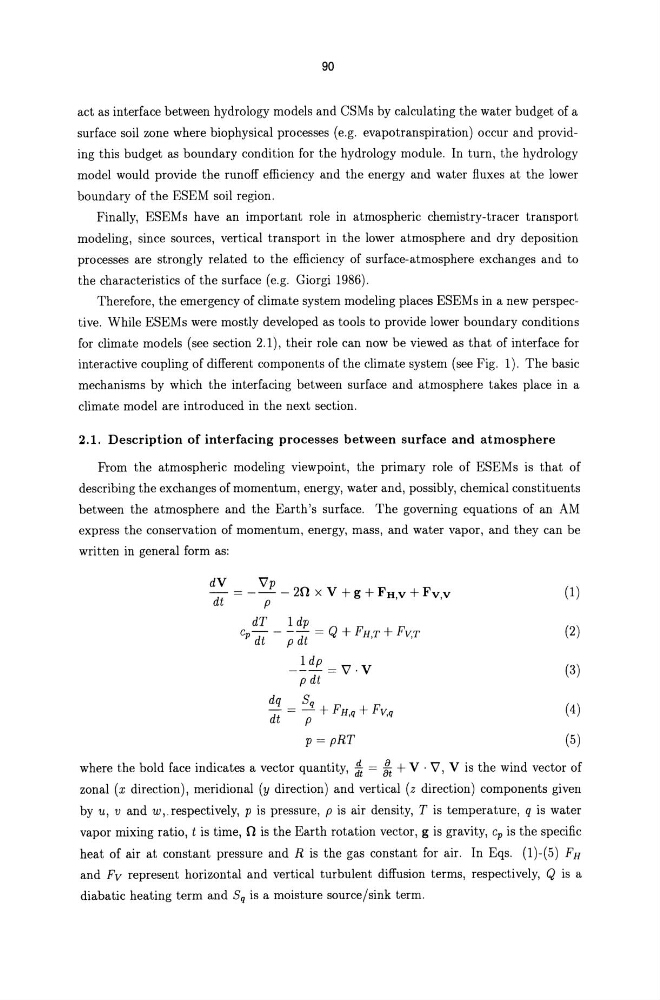
between the atmosphere and the Earth's surface. The governing equations of an AM
express the conservation of momentum, energy, mass, and water vapor, and they can be
written in general form as:
dV
'Vp
-
= - - - 20 x V +g+FHV+Fvv
dt
p
"
dT
1 dp
C -
- - - = Q + FHT + FVT
p dt
pdt
"
_~ dp = 'V. V
pdt
dq
Sq
dt = p + FH,q + FV,q
p = pRT
(1)
(2)
(3)
(4)
(5)
where the bold face indicates a vector quantity, 1ft = -Nt + V . 'V, V is the wind vector of
zonal (x direction), meridional (y direction) and vertical (z direction) components given
by u, v and w, respectively, p is pressure, p is air density, T is temperature, q is water
vapor mixing ratio, t is time, 0 is the Earth rotation vector, g is gravity, cp is the specific
heat of air at constant pressure and R is the gas constant for air. In Eqs. (1)-(5) FH
and Fv represent horizontal and vertical turbulent diffusion terms, respectively, Q is a
diabatic heating term and Sq is a moisture source/sink term.
act as interface between hydrology models and CSMs by calculating the water budget of a
surface soil zone where biophysical processes (e.g. evapotranspiration) occur and providing this budget as boundary condition for the hydrology module. In turn, the hydrology
model would provide the runoff efficiency and the energy and water fluxes at the lower
boundary of the ESEM soil region.
Finally, ESEMs have an important role in atmospheric chemistry-tracer transport
modeling, since sources, vertical transport in the lower atmosphere and dry deposition
processes are strongly related to the efficiency of surface-atmosphere exchanges and to
the characteristics of the surface (e.g. Giorgi 1986).
Therefore, the emergency of climate system modeling places ESEMs in a new perspective. While ESEMs were mostly developed as tools to provide lower boundary conditions
for climate models (see section 2.1), their role can now be viewed as that of interface for
interactive coupling of different components of the climate system (see Fig. 1). The basic
mechanisms by which the interfacing between surface and atmosphere takes place in a
climate model are introduced in the next section.
2.1. Description of interfacing processes between surface and atmosphere
From the atmospheric modeling viewpoint, the primary role of ESEMs is that of
describing the exchanges of momentum, energy, water and, possibly, chemical constituents
between the atmosphere and the Earth's surface. The governing equations of an AM
express the conservation of momentum, energy, mass, and water vapor, and they can be
written in general form as:
dV
'Vp
-
= - - - 20 x V +g+FHV+Fvv
dt
p
"
dT
1 dp
C -
- - - = Q + FHT + FVT
p dt
pdt
"
_~ dp = 'V. V
pdt
dq
Sq
dt = p + FH,q + FV,q
p = pRT
(1)
(2)
(3)
(4)
(5)
where the bold face indicates a vector quantity, 1ft = -Nt + V . 'V, V is the wind vector of
zonal (x direction), meridional (y direction) and vertical (z direction) components given
by u, v and w, respectively, p is pressure, p is air density, T is temperature, q is water
vapor mixing ratio, t is time, 0 is the Earth rotation vector, g is gravity, cp is the specific
heat of air at constant pressure and R is the gas constant for air. In Eqs. (1)-(5) FH
and Fv represent horizontal and vertical turbulent diffusion terms, respectively, Q is a
diabatic heating term and Sq is a moisture source/sink term.