

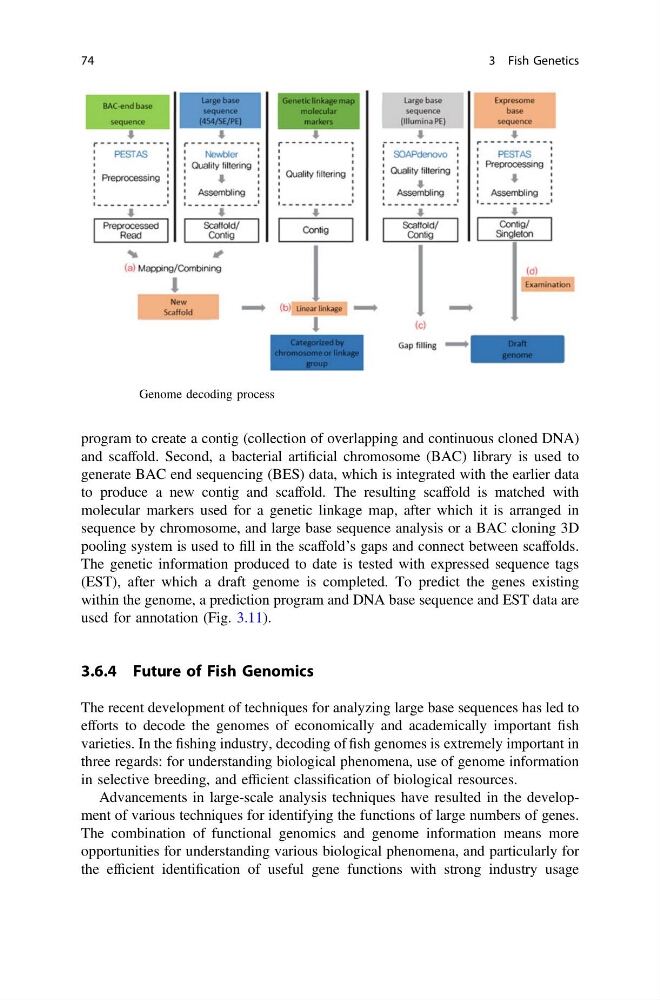
program to create a contig (collection of overlapping and continuous cloned DNA)
and scaffold. Second, a bacterial artificial chromosome (BAC) library is used to
generate BAC end sequencing (BES) data, which is integrated with the earlier data
to produce a new contig and scaffold. The resulting scaffold is matched with
molecular markers used for a genetic linkage map, after which it is arranged in
sequence by chromosome, and large base sequence analysis or a BAC cloning 3D
pooling system is used to fill in the scaffold’s gaps and connect between scaffolds.
The genetic information produced to date is tested with expressed sequence tags
(EST), after which a draft genome is completed. To predict the genes existing
within the genome, a prediction program and DNA base sequence and EST data are
used for annotation (Fig. 3.11).
3.6.4 Future of Fish Genomics
The recent development of techniques for analyzing large base sequences has led to
efforts to decode the genomes of economically and academically important fish
varieties. In the fishing industry, decoding of fish genomes is extremely important in
three regards: for understanding biological phenomena, use of genome information
in selective breeding, and efficient classification of biological resources.
Advancements in large-scale analysis techniques have resulted in the development of various techniques for identifying the functions of large numbers of genes.
The combination of functional genomics and genome information means more
opportunities for understanding various biological phenomena, and particularly for
the efficient identification of useful gene functions with strong industry usage
Fig. 3.11 Genome decoding process
74
3 Fish Genetics
and scaffold. Second, a bacterial artificial chromosome (BAC) library is used to
generate BAC end sequencing (BES) data, which is integrated with the earlier data
to produce a new contig and scaffold. The resulting scaffold is matched with
molecular markers used for a genetic linkage map, after which it is arranged in
sequence by chromosome, and large base sequence analysis or a BAC cloning 3D
pooling system is used to fill in the scaffold’s gaps and connect between scaffolds.
The genetic information produced to date is tested with expressed sequence tags
(EST), after which a draft genome is completed. To predict the genes existing
within the genome, a prediction program and DNA base sequence and EST data are
used for annotation (Fig. 3.11).
3.6.4 Future of Fish Genomics
The recent development of techniques for analyzing large base sequences has led to
efforts to decode the genomes of economically and academically important fish
varieties. In the fishing industry, decoding of fish genomes is extremely important in
three regards: for understanding biological phenomena, use of genome information
in selective breeding, and efficient classification of biological resources.
Advancements in large-scale analysis techniques have resulted in the development of various techniques for identifying the functions of large numbers of genes.
The combination of functional genomics and genome information means more
opportunities for understanding various biological phenomena, and particularly for
the efficient identification of useful gene functions with strong industry usage
Fig. 3.11 Genome decoding process
74
3 Fish Genetics