

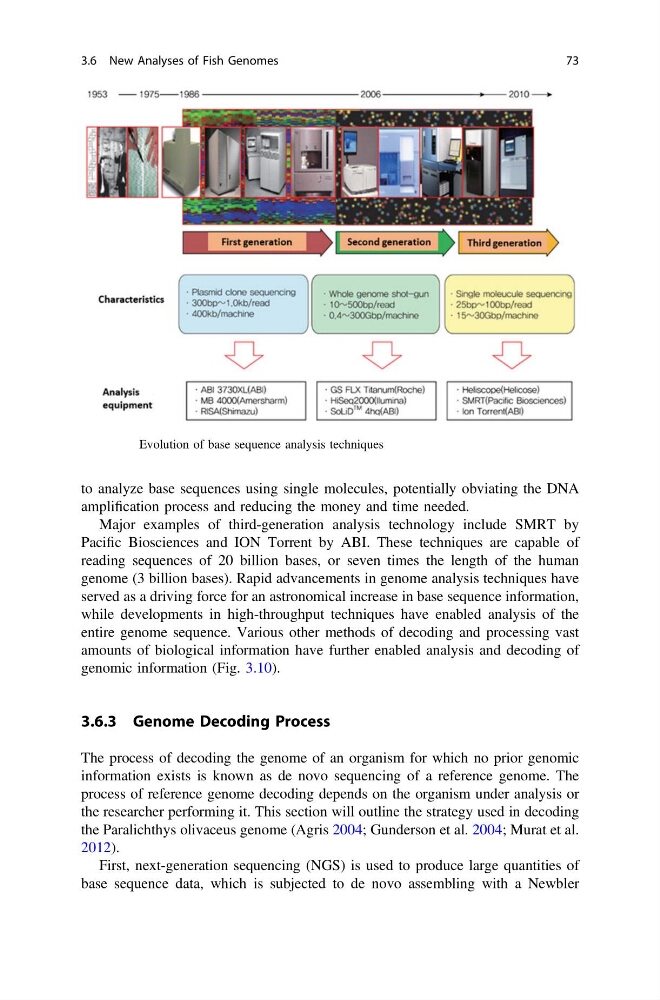
to analyze base sequences using single molecules, potentially obviating the DNA
amplification process and reducing the money and time needed.
Major examples of third-generation analysis technology include SMRT by
Pacific Biosciences and ION Torrent by ABI. These techniques are capable of
reading sequences of 20 billion bases, or seven times the length of the human
genome (3 billion bases). Rapid advancements in genome analysis techniques have
served as a driving force for an astronomical increase in base sequence information,
while developments in high-throughput techniques have enabled analysis of the
entire genome sequence. Various other methods of decoding and processing vast
amounts of biological information have further enabled analysis and decoding of
genomic information (Fig. 3.10).
3.6.3 Genome Decoding Process
The process of decoding the genome of an organism for which no prior genomic
information exists is known as de novo sequencing of a reference genome. The
process of reference genome decoding depends on the organism under analysis or
the researcher performing it. This section will outline the strategy used in decoding
the Paralichthys olivaceus genome (Agris 2004; Gunderson et al. 2004; Murat et al.
2012).
First, next-generation sequencing (NGS) is used to produce large quantities of
base sequence data, which is subjected to de novo assembling with a Newbler
Fig. 3.10 Evolution of base sequence analysis techniques
3.6 New Analyses of Fish Genomes
73
amplification process and reducing the money and time needed.
Major examples of third-generation analysis technology include SMRT by
Pacific Biosciences and ION Torrent by ABI. These techniques are capable of
reading sequences of 20 billion bases, or seven times the length of the human
genome (3 billion bases). Rapid advancements in genome analysis techniques have
served as a driving force for an astronomical increase in base sequence information,
while developments in high-throughput techniques have enabled analysis of the
entire genome sequence. Various other methods of decoding and processing vast
amounts of biological information have further enabled analysis and decoding of
genomic information (Fig. 3.10).
3.6.3 Genome Decoding Process
The process of decoding the genome of an organism for which no prior genomic
information exists is known as de novo sequencing of a reference genome. The
process of reference genome decoding depends on the organism under analysis or
the researcher performing it. This section will outline the strategy used in decoding
the Paralichthys olivaceus genome (Agris 2004; Gunderson et al. 2004; Murat et al.
2012).
First, next-generation sequencing (NGS) is used to produce large quantities of
base sequence data, which is subjected to de novo assembling with a Newbler
Fig. 3.10 Evolution of base sequence analysis techniques
3.6 New Analyses of Fish Genomes
73