

transmitted from bacteria to plants or animals. These applications have ushered in
advancements in practical biotechnology involving the use of biological organisms.
The discovery of restriction enzymes truncating double-stranded DNA ushered
in rapid developments in recombinant DNA technology. Bacterial enzymes known
as restriction enzymes perform the role of “scissors” in creating recombinant DNA.
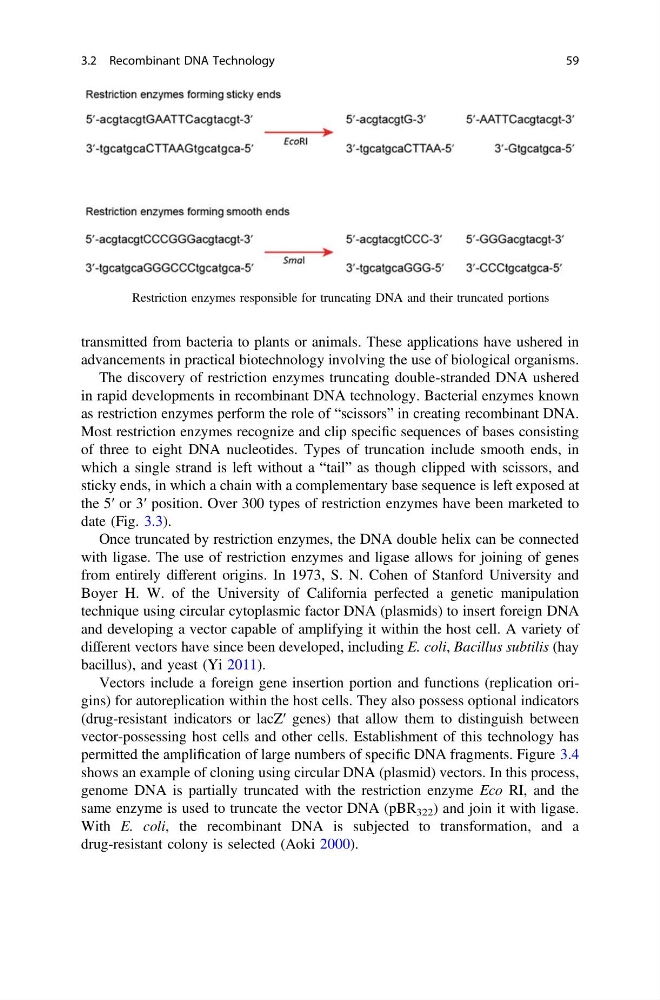
Most restriction enzymes recognize and clip specific sequences of bases consisting
of three to eight DNA nucleotides. Types of truncation include smooth ends, in
which a single strand is left without a “tail” as though clipped with scissors, and
sticky ends, in which a chain with a complementary base sequence is left exposed at
the 5′ or 3′ position. Over 300 types of restriction enzymes have been marketed to
date (Fig. 3.3).
Once truncated by restriction enzymes, the DNA double helix can be connected
with ligase. The use of restriction enzymes and ligase allows for joining of genes
from entirely different origins. In 1973, S. N. Cohen of Stanford University and
Boyer H. W. of the University of California perfected a genetic manipulation
technique using circular cytoplasmic factor DNA (plasmids) to insert foreign DNA
and developing a vector capable of amplifying it within the host cell. A variety of
different vectors have since been developed, including E. coli, Bacillus subtilis (hay
bacillus), and yeast (Yi 2011).
Vectors include a foreign gene insertion portion and functions (replication origins) for autoreplication within the host cells. They also possess optional indicators
(drug-resistant indicators or lacZ′ genes) that allow them to distinguish between
vector-possessing host cells and other cells. Establishment of this technology has
permitted the amplification of large numbers of specific DNA fragments. Figure 3.4
shows an example of cloning using circular DNA (plasmid) vectors. In this process,
genome DNA is partially truncated with the restriction enzyme Eco RI, and the
same enzyme is used to truncate the vector DNA (pBR 322 ) and join it with ligase.
With E. coli, the recombinant DNA is subjected to transformation, and a
drug-resistant colony is selected (Aoki 2000).
Fig. 3.3 Restriction enzymes responsible for truncating DNA and their truncated portions
3.2 Recombinant DNA Technology
59
advancements in practical biotechnology involving the use of biological organisms.
The discovery of restriction enzymes truncating double-stranded DNA ushered
in rapid developments in recombinant DNA technology. Bacterial enzymes known
as restriction enzymes perform the role of “scissors” in creating recombinant DNA.
Most restriction enzymes recognize and clip specific sequences of bases consisting
of three to eight DNA nucleotides. Types of truncation include smooth ends, in
which a single strand is left without a “tail” as though clipped with scissors, and
sticky ends, in which a chain with a complementary base sequence is left exposed at
the 5′ or 3′ position. Over 300 types of restriction enzymes have been marketed to
date (Fig. 3.3).
Once truncated by restriction enzymes, the DNA double helix can be connected
with ligase. The use of restriction enzymes and ligase allows for joining of genes
from entirely different origins. In 1973, S. N. Cohen of Stanford University and
Boyer H. W. of the University of California perfected a genetic manipulation
technique using circular cytoplasmic factor DNA (plasmids) to insert foreign DNA
and developing a vector capable of amplifying it within the host cell. A variety of
different vectors have since been developed, including E. coli, Bacillus subtilis (hay
bacillus), and yeast (Yi 2011).
Vectors include a foreign gene insertion portion and functions (replication origins) for autoreplication within the host cells. They also possess optional indicators
(drug-resistant indicators or lacZ′ genes) that allow them to distinguish between
vector-possessing host cells and other cells. Establishment of this technology has
permitted the amplification of large numbers of specific DNA fragments. Figure 3.4
shows an example of cloning using circular DNA (plasmid) vectors. In this process,
genome DNA is partially truncated with the restriction enzyme Eco RI, and the
same enzyme is used to truncate the vector DNA (pBR 322 ) and join it with ligase.
With E. coli, the recombinant DNA is subjected to transformation, and a
drug-resistant colony is selected (Aoki 2000).
Fig. 3.3 Restriction enzymes responsible for truncating DNA and their truncated portions
3.2 Recombinant DNA Technology
59