

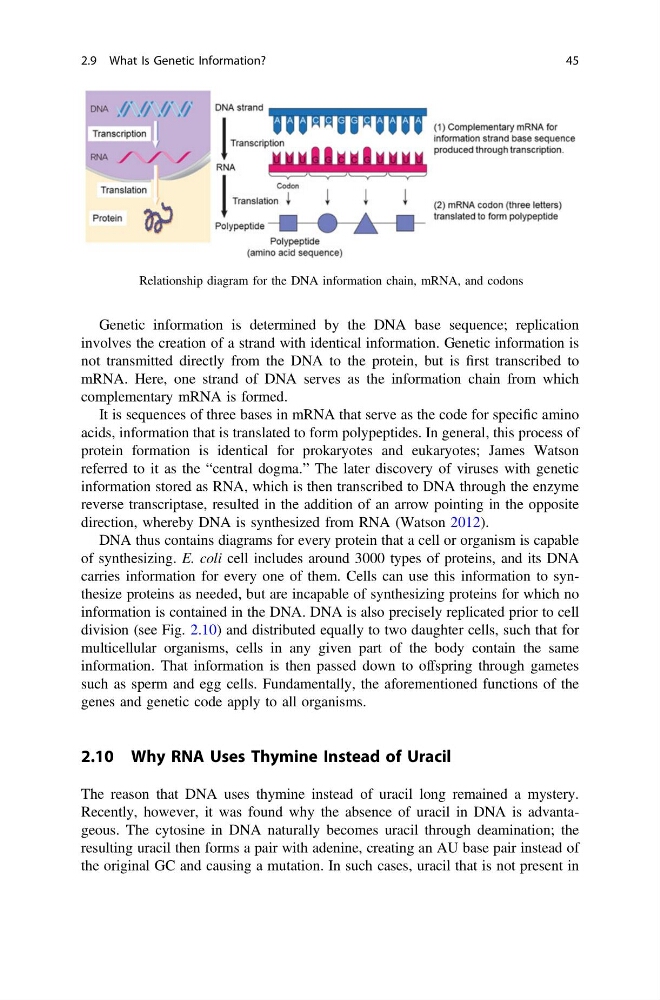
Genetic information is determined by the DNA base sequence; replication
involves the creation of a strand with identical information. Genetic information is
not transmitted directly from the DNA to the protein, but is first transcribed to
mRNA. Here, one strand of DNA serves as the information chain from which
complementary mRNA is formed.
It is sequences of three bases in mRNA that serve as the code for specific amino
acids, information that is translated to form polypeptides. In general, this process of
protein formation is identical for prokaryotes and eukaryotes; James Watson
referred to it as the “central dogma.” The later discovery of viruses with genetic
information stored as RNA, which is then transcribed to DNA through the enzyme
reverse transcriptase, resulted in the addition of an arrow pointing in the opposite
direction, whereby DNA is synthesized from RNA (Watson 2012).
DNA thus contains diagrams for every protein that a cell or organism is capable
of synthesizing. E. coli cell includes around 3000 types of proteins, and its DNA
carries information for every one of them. Cells can use this information to synthesize proteins as needed, but are incapable of synthesizing proteins for which no
information is contained in the DNA. DNA is also precisely replicated prior to cell
division (see Fig. 2.10) and distributed equally to two daughter cells, such that for
multicellular organisms, cells in any given part of the body contain the same
information. That information is then passed down to offspring through gametes
such as sperm and egg cells. Fundamentally, the aforementioned functions of the
genes and genetic code apply to all organisms.
2.10 Why RNA Uses Thymine Instead of Uracil
The reason that DNA uses thymine instead of uracil long remained a mystery.
Recently, however, it was found why the absence of uracil in DNA is advantageous. The cytosine in DNA naturally becomes uracil through deamination; the
resulting uracil then forms a pair with adenine, creating an AU base pair instead of
the original GC and causing a mutation. In such cases, uracil that is not present in
Fig. 2.17 Relationship diagram for the DNA information chain, mRNA, and codons
2.9 What Is Genetic Information?
45
involves the creation of a strand with identical information. Genetic information is
not transmitted directly from the DNA to the protein, but is first transcribed to
mRNA. Here, one strand of DNA serves as the information chain from which
complementary mRNA is formed.
It is sequences of three bases in mRNA that serve as the code for specific amino
acids, information that is translated to form polypeptides. In general, this process of
protein formation is identical for prokaryotes and eukaryotes; James Watson
referred to it as the “central dogma.” The later discovery of viruses with genetic
information stored as RNA, which is then transcribed to DNA through the enzyme
reverse transcriptase, resulted in the addition of an arrow pointing in the opposite
direction, whereby DNA is synthesized from RNA (Watson 2012).
DNA thus contains diagrams for every protein that a cell or organism is capable
of synthesizing. E. coli cell includes around 3000 types of proteins, and its DNA
carries information for every one of them. Cells can use this information to synthesize proteins as needed, but are incapable of synthesizing proteins for which no
information is contained in the DNA. DNA is also precisely replicated prior to cell
division (see Fig. 2.10) and distributed equally to two daughter cells, such that for
multicellular organisms, cells in any given part of the body contain the same
information. That information is then passed down to offspring through gametes
such as sperm and egg cells. Fundamentally, the aforementioned functions of the
genes and genetic code apply to all organisms.
2.10 Why RNA Uses Thymine Instead of Uracil
The reason that DNA uses thymine instead of uracil long remained a mystery.
Recently, however, it was found why the absence of uracil in DNA is advantageous. The cytosine in DNA naturally becomes uracil through deamination; the
resulting uracil then forms a pair with adenine, creating an AU base pair instead of
the original GC and causing a mutation. In such cases, uracil that is not present in
Fig. 2.17 Relationship diagram for the DNA information chain, mRNA, and codons
2.9 What Is Genetic Information?
45