

From the protease inhibitor-producing strains obtained with this approach, those
exhibiting high levels of inhibition activity and production stability can be selected
for analysis of taxanomic character, and the chemical structures for the isolated and
refined inhibitor substances can be identified.
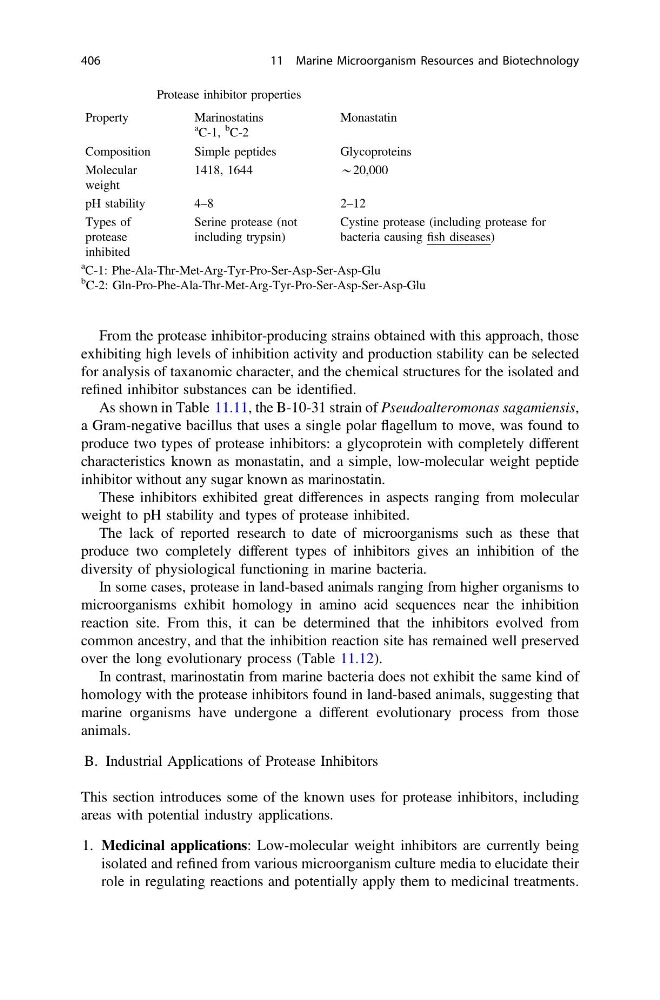
As shown in Table 11.11, the B-10-31 strain of Pseudoalteromonas sagamiensis,
a Gram-negative bacillus that uses a single polar flagellum to move, was found to
produce two types of protease inhibitors: a glycoprotein with completely different
characteristics known as monastatin, and a simple, low-molecular weight peptide
inhibitor without any sugar known as marinostatin.
These inhibitors exhibited great differences in aspects ranging from molecular
weight to pH stability and types of protease inhibited.
The lack of reported research to date of microorganisms such as these that
produce two completely different types of inhibitors gives an inhibition of the
diversity of physiological functioning in marine bacteria.
In some cases, protease in land-based animals ranging from higher organisms to
microorganisms exhibit homology in amino acid sequences near the inhibition
reaction site. From this, it can be determined that the inhibitors evolved from
common ancestry, and that the inhibition reaction site has remained well preserved
over the long evolutionary process (Table 11.12).
In contrast, marinostatin from marine bacteria does not exhibit the same kind of
homology with the protease inhibitors found in land-based animals, suggesting that
marine organisms have undergone a different evolutionary process from those
animals.
B. Industrial Applications of Protease Inhibitors
This section introduces some of the known uses for protease inhibitors, including
areas with potential industry applications.
1. Medicinal applications: Low-molecular weight inhibitors are currently being
isolated and refined from various microorganism culture media to elucidate their
role in regulating reactions and potentially apply them to medicinal treatments.
Table 11.11 Protease inhibitor properties
Property
Marinostatins
a C-1,
b
C-2
Monastatin
Composition
Simple peptides
Glycoproteins
Molecular
weight
1418, 1644
*20,000
pH stability
4–8
2 –12
Types of
protease
inhibited
Serine protease (not
including trypsin)
Cystine protease (including protease for
bacteria causing fish diseases)
a C-1: Phe-Ala-Thr-Met-Arg-Tyr-Pro-Ser-Asp-Ser-Asp-Glu
b
C-2: Gln-Pro-Phe-Ala-Thr-Met-Arg-Tyr-Pro-Ser-Asp-Ser-Asp-Glu
406
11 Marine Microorganism Resources and Biotechnology
exhibiting high levels of inhibition activity and production stability can be selected
for analysis of taxanomic character, and the chemical structures for the isolated and
refined inhibitor substances can be identified.
As shown in Table 11.11, the B-10-31 strain of Pseudoalteromonas sagamiensis,
a Gram-negative bacillus that uses a single polar flagellum to move, was found to
produce two types of protease inhibitors: a glycoprotein with completely different
characteristics known as monastatin, and a simple, low-molecular weight peptide
inhibitor without any sugar known as marinostatin.
These inhibitors exhibited great differences in aspects ranging from molecular
weight to pH stability and types of protease inhibited.
The lack of reported research to date of microorganisms such as these that
produce two completely different types of inhibitors gives an inhibition of the
diversity of physiological functioning in marine bacteria.
In some cases, protease in land-based animals ranging from higher organisms to
microorganisms exhibit homology in amino acid sequences near the inhibition
reaction site. From this, it can be determined that the inhibitors evolved from
common ancestry, and that the inhibition reaction site has remained well preserved
over the long evolutionary process (Table 11.12).
In contrast, marinostatin from marine bacteria does not exhibit the same kind of
homology with the protease inhibitors found in land-based animals, suggesting that
marine organisms have undergone a different evolutionary process from those
animals.
B. Industrial Applications of Protease Inhibitors
This section introduces some of the known uses for protease inhibitors, including
areas with potential industry applications.
1. Medicinal applications: Low-molecular weight inhibitors are currently being
isolated and refined from various microorganism culture media to elucidate their
role in regulating reactions and potentially apply them to medicinal treatments.
Table 11.11 Protease inhibitor properties
Property
Marinostatins
a C-1,
b
C-2
Monastatin
Composition
Simple peptides
Glycoproteins
Molecular
weight
1418, 1644
*20,000
pH stability
4–8
2 –12
Types of
protease
inhibited
Serine protease (not
including trypsin)
Cystine protease (including protease for
bacteria causing fish diseases)
a C-1: Phe-Ala-Thr-Met-Arg-Tyr-Pro-Ser-Asp-Ser-Asp-Glu
b
C-2: Gln-Pro-Phe-Ala-Thr-Met-Arg-Tyr-Pro-Ser-Asp-Ser-Asp-Glu
406
11 Marine Microorganism Resources and Biotechnology