

body. This enzyme exhibits stable activity at a range of 0–15 °C, but activity
decreases markedly at higher temperatures (Michener and Elliott 1964; Larkin and
Stokes 1968; Inniss 1975; Gounot 1986; D’Amico et al. 2006; Margesin and
Miteva 2011).
Table 11.1 shows results from a study of changes over time in the survival rates
at various temperatures for marine bacteria isolated from seawater collected at a
depth of 1200 m. These bacteria typically die within around six hours if placed in
environments at temperatures of 28.8 °C; they die out completely within around
one hour at temperatures of 33 °C or greater (Imada 2009).
It is chiefly the cell membrane and enzymes within the cell that are affected by
low temperatures. The cell membrane filters nutrients and secretes or excretes
substances from within the cell, while also functioning to maintain a certain level of
homeostasis within the cell in response to changes in the external environment. The
important components of this membrane are proteins and lipids; lipids have an
especially crucial role in maintaining the membrane’s functioning. Lipids in the cell
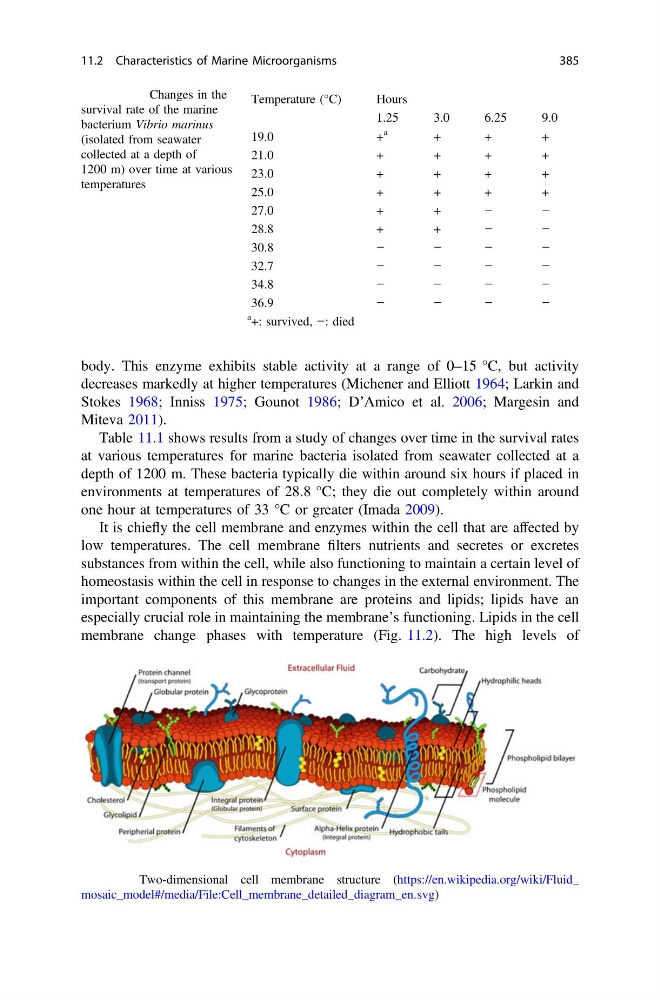
membrane change phases with temperature (Fig. 11.2). The high levels of
Table 11.1 Changes in the
survival rate of the marine
bacterium Vibrio marinus
(isolated from seawater
collected at a depth of
1200 m) over time at various
temperatures
Temperature (°C)
Hours
1.25
3.0
6.25
9.0
19.0
+
a
+
+
+
21.0
+
+
+
+
23.0
+
+
+
+
25.0
+
+
+
+
27.0
+
+
−
−
28.8
+
+
−
−
30.8
−
−
−
−
32.7
−
−
−
−
34.8
−
−
−
−
36.9
−
−
−
−
a +: survived, −: died
Fig. 11.2 Two-dimensional cell membrane structure (https://en.wikipedia.org/wiki/Fluid_
mosaic_model#/media/File:Cell_membrane_detailed_diagram_en.svg)
11.2 Characteristics of Marine Microorganisms
385
decreases markedly at higher temperatures (Michener and Elliott 1964; Larkin and
Stokes 1968; Inniss 1975; Gounot 1986; D’Amico et al. 2006; Margesin and
Miteva 2011).
Table 11.1 shows results from a study of changes over time in the survival rates
at various temperatures for marine bacteria isolated from seawater collected at a
depth of 1200 m. These bacteria typically die within around six hours if placed in
environments at temperatures of 28.8 °C; they die out completely within around
one hour at temperatures of 33 °C or greater (Imada 2009).
It is chiefly the cell membrane and enzymes within the cell that are affected by
low temperatures. The cell membrane filters nutrients and secretes or excretes
substances from within the cell, while also functioning to maintain a certain level of
homeostasis within the cell in response to changes in the external environment. The
important components of this membrane are proteins and lipids; lipids have an
especially crucial role in maintaining the membrane’s functioning. Lipids in the cell
membrane change phases with temperature (Fig. 11.2). The high levels of
Table 11.1 Changes in the
survival rate of the marine
bacterium Vibrio marinus
(isolated from seawater
collected at a depth of
1200 m) over time at various
temperatures
Temperature (°C)
Hours
1.25
3.0
6.25
9.0
19.0
+
a
+
+
+
21.0
+
+
+
+
23.0
+
+
+
+
25.0
+
+
+
+
27.0
+
+
−
−
28.8
+
+
−
−
30.8
−
−
−
−
32.7
−
−
−
−
34.8
−
−
−
−
36.9
−
−
−
−
a +: survived, −: died
Fig. 11.2 Two-dimensional cell membrane structure (https://en.wikipedia.org/wiki/Fluid_
mosaic_model#/media/File:Cell_membrane_detailed_diagram_en.svg)
11.2 Characteristics of Marine Microorganisms
385