

subtropical regions, oceans typically possess low temperatures of around 2–3 °C
and are inhabited by numerous psychrophilic bacteria.
Psychrophilic bacteria were first discovered in 1887 by Forster, who conducted
an experiment by placing an ice cube at 0 °C inside a test tube. The bacteria were
found growing alongside other bacteria that propagate at room temperature. In
1902, Schmidt-Nielsen used the term “psychrophile” to describe bacteria that
required temperatures of 0 °C to live and were capable of growing at such temperatures. This name was suggested to be inappropriate, however, after experiments
with these bacteria showed that some propagated at 0 °C while others had optimal
growth temperatures of 20 °C or more; the name “cold-tolerant bacteria” was
adopted for the latter. Psychrophilic bacteria as those capable of growth at temperatures of 5 °C or more.
Characteristics of psychrophilic bacteria include enzyme synthesis within the
organism in low-temperature environments, types and compositions of lipids within
the cell membrane, and the importance of other bioactive substances. Because of
their particular environment (i.e., low-temperature and high-pressure), these bacteria are the focus of growing attention to their characteristic bioactive substances,
which are not found in land-based organisms. Recently, research into bioactive
substances with bioengineering methods has become more active.
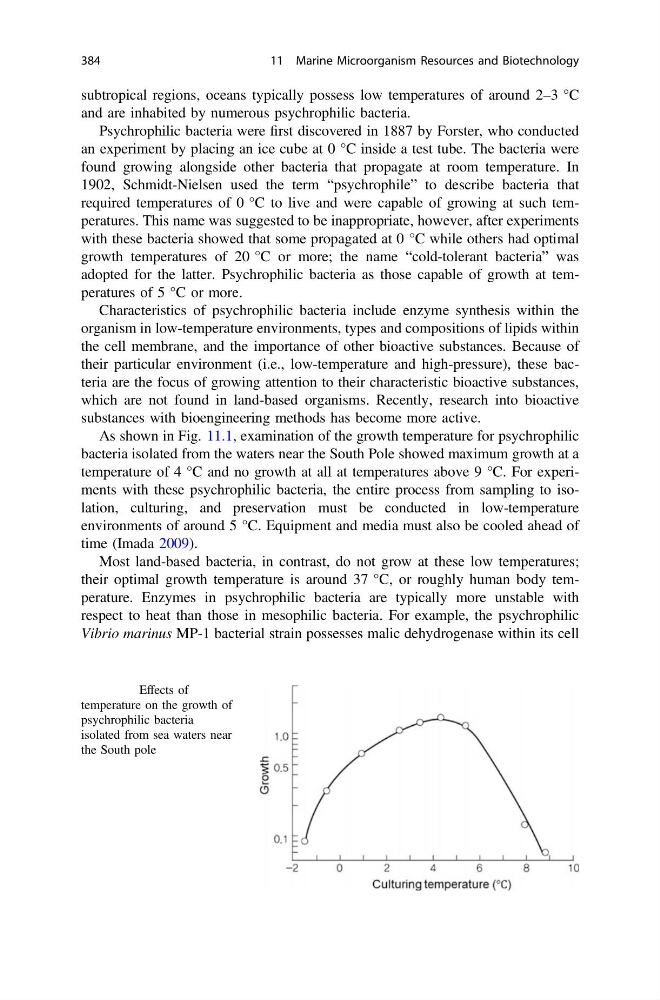
As shown in Fig. 11.1, examination of the growth temperature for psychrophilic
bacteria isolated from the waters near the South Pole showed maximum growth at a
temperature of 4 °C and no growth at all at temperatures above 9 °C. For experiments with these psychrophilic bacteria, the entire process from sampling to isolation, culturing, and preservation must be conducted in low-temperature
environments of around 5 °C. Equipment and media must also be cooled ahead of
time (Imada 2009).
Most land-based bacteria, in contrast, do not grow at these low temperatures;
their optimal growth temperature is around 37 °C, or roughly human body temperature. Enzymes in psychrophilic bacteria are typically more unstable with
respect to heat than those in mesophilic bacteria. For example, the psychrophilic
Vibrio marinus MP-1 bacterial strain possesses malic dehydrogenase within its cell
Fig. 11.1 Effects of
temperature on the growth of
psychrophilic bacteria
isolated from sea waters near
the South pole
384
11 Marine Microorganism Resources and Biotechnology
and are inhabited by numerous psychrophilic bacteria.
Psychrophilic bacteria were first discovered in 1887 by Forster, who conducted
an experiment by placing an ice cube at 0 °C inside a test tube. The bacteria were
found growing alongside other bacteria that propagate at room temperature. In
1902, Schmidt-Nielsen used the term “psychrophile” to describe bacteria that
required temperatures of 0 °C to live and were capable of growing at such temperatures. This name was suggested to be inappropriate, however, after experiments
with these bacteria showed that some propagated at 0 °C while others had optimal
growth temperatures of 20 °C or more; the name “cold-tolerant bacteria” was
adopted for the latter. Psychrophilic bacteria as those capable of growth at temperatures of 5 °C or more.
Characteristics of psychrophilic bacteria include enzyme synthesis within the
organism in low-temperature environments, types and compositions of lipids within
the cell membrane, and the importance of other bioactive substances. Because of
their particular environment (i.e., low-temperature and high-pressure), these bacteria are the focus of growing attention to their characteristic bioactive substances,
which are not found in land-based organisms. Recently, research into bioactive
substances with bioengineering methods has become more active.
As shown in Fig. 11.1, examination of the growth temperature for psychrophilic
bacteria isolated from the waters near the South Pole showed maximum growth at a
temperature of 4 °C and no growth at all at temperatures above 9 °C. For experiments with these psychrophilic bacteria, the entire process from sampling to isolation, culturing, and preservation must be conducted in low-temperature
environments of around 5 °C. Equipment and media must also be cooled ahead of
time (Imada 2009).
Most land-based bacteria, in contrast, do not grow at these low temperatures;
their optimal growth temperature is around 37 °C, or roughly human body temperature. Enzymes in psychrophilic bacteria are typically more unstable with
respect to heat than those in mesophilic bacteria. For example, the psychrophilic
Vibrio marinus MP-1 bacterial strain possesses malic dehydrogenase within its cell
Fig. 11.1 Effects of
temperature on the growth of
psychrophilic bacteria
isolated from sea waters near
the South pole
384
11 Marine Microorganism Resources and Biotechnology