

acid or ammonia should be used as a nitrogen source, and a medium should be
prepared in which the initial pH has been changed. The primary goal should be to
ensure diverse conditions to produce as wide a variety of strains as possible.
Because seawater contains various kinds of dissolved inorganic salts, one would
expect it to be dominated by pH-preferring microalgae in comparison with freshwater. Yet when the initial medium pH is set (for example at 6 and 10) and seawater
is loaded for enrichment culturing, entirely different microflora are observed a week
later. This is strong evidence that species that prefer both acidic and alkaline
conditions coexist even in an environment with a pH of 8.2. At the same time,
focusing too much on neutrality can result in the loss of many kinds of microorganisms. One must also be cautious of lowering pH when CO 2 is added. As noted
before, growth is stimulated with the addition of gaseous CO 2 . The presence of this
dissolved CO 2 results in the medium pH falling. This fact must be taken into
account as well when carrying out the initial pH adjustment (Rossignol et al. 1999)
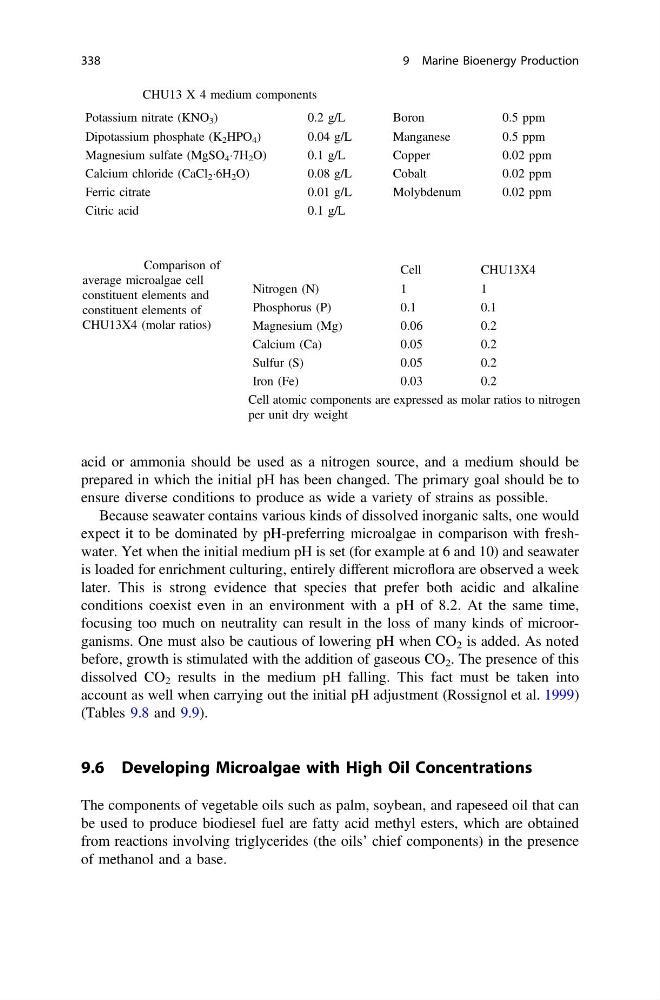
(Tables 9.8 and 9.9).
9.6 Developing Microalgae with High Oil Concentrations
The components of vegetable oils such as palm, soybean, and rapeseed oil that can
be used to produce biodiesel fuel are fatty acid methyl esters, which are obtained
from reactions involving triglycerides (the oils’ chief components) in the presence
of methanol and a base.
Table 9.8 CHU13 X 4 medium components
Potassium nitrate (KNO 3 )
0.2 g/L
Boron
0.5 ppm
Dipotassium phosphate (K 2 HPO 4 )
0.04 g/L
Manganese
0.5 ppm
Magnesium sulfate (MgSO 4 Á7H 2 O)
0.1 g/L
Copper
0.02 ppm
Calcium chloride (CaCl 2 Á6H 2 O)
0.08 g/L
Cobalt
0.02 ppm
Ferric citrate
0.01 g/L
Molybdenum
0.02 ppm
Citric acid
0.1 g/L
Table 9.9 Comparison of
average microalgae cell
constituent elements and
constituent elements of
CHU13X4 (molar ratios)
Cell
CHU13X4
Nitrogen (N)
1
1
Phosphorus (P)
0.1
0.1
Magnesium (Mg)
0.06
0.2
Calcium (Ca)
0.05
0.2
Sulfur (S)
0.05
0.2
Iron (Fe)
0.03
0.2
Cell atomic components are expressed as molar ratios to nitrogen
per unit dry weight
338
9 Marine Bioenergy Production
prepared in which the initial pH has been changed. The primary goal should be to
ensure diverse conditions to produce as wide a variety of strains as possible.
Because seawater contains various kinds of dissolved inorganic salts, one would
expect it to be dominated by pH-preferring microalgae in comparison with freshwater. Yet when the initial medium pH is set (for example at 6 and 10) and seawater
is loaded for enrichment culturing, entirely different microflora are observed a week
later. This is strong evidence that species that prefer both acidic and alkaline
conditions coexist even in an environment with a pH of 8.2. At the same time,
focusing too much on neutrality can result in the loss of many kinds of microorganisms. One must also be cautious of lowering pH when CO 2 is added. As noted
before, growth is stimulated with the addition of gaseous CO 2 . The presence of this
dissolved CO 2 results in the medium pH falling. This fact must be taken into
account as well when carrying out the initial pH adjustment (Rossignol et al. 1999)
(Tables 9.8 and 9.9).
9.6 Developing Microalgae with High Oil Concentrations
The components of vegetable oils such as palm, soybean, and rapeseed oil that can
be used to produce biodiesel fuel are fatty acid methyl esters, which are obtained
from reactions involving triglycerides (the oils’ chief components) in the presence
of methanol and a base.
Table 9.8 CHU13 X 4 medium components
Potassium nitrate (KNO 3 )
0.2 g/L
Boron
0.5 ppm
Dipotassium phosphate (K 2 HPO 4 )
0.04 g/L
Manganese
0.5 ppm
Magnesium sulfate (MgSO 4 Á7H 2 O)
0.1 g/L
Copper
0.02 ppm
Calcium chloride (CaCl 2 Á6H 2 O)
0.08 g/L
Cobalt
0.02 ppm
Ferric citrate
0.01 g/L
Molybdenum
0.02 ppm
Citric acid
0.1 g/L
Table 9.9 Comparison of
average microalgae cell
constituent elements and
constituent elements of
CHU13X4 (molar ratios)
Cell
CHU13X4
Nitrogen (N)
1
1
Phosphorus (P)
0.1
0.1
Magnesium (Mg)
0.06
0.2
Calcium (Ca)
0.05
0.2
Sulfur (S)
0.05
0.2
Iron (Fe)
0.03
0.2
Cell atomic components are expressed as molar ratios to nitrogen
per unit dry weight
338
9 Marine Bioenergy Production