

5. Peaks indicate positive (+) values. If only positive strains are found, check for
autofluorescence within the same wavelength range (measure culture medium
without added Nile red).
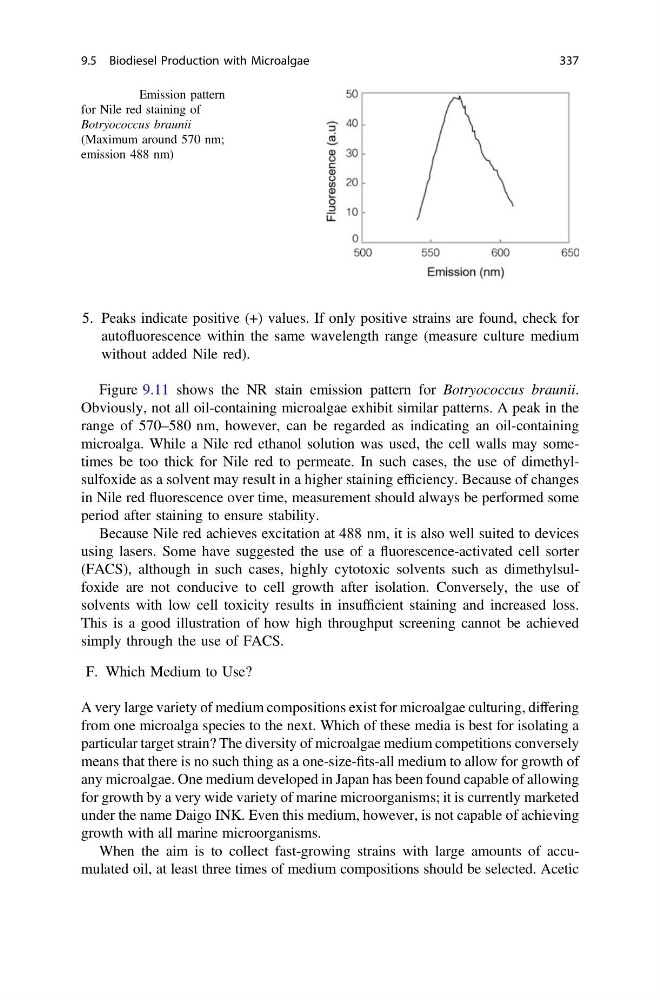
Figure 9.11 shows the NR stain emission pattern for Botryococcus braunii.
Obviously, not all oil-containing microalgae exhibit similar patterns. A peak in the
range of 570–580 nm, however, can be regarded as indicating an oil-containing
microalga. While a Nile red ethanol solution was used, the cell walls may sometimes be too thick for Nile red to permeate. In such cases, the use of dimethylsulfoxide as a solvent may result in a higher staining efficiency. Because of changes
in Nile red fluorescence over time, measurement should always be performed some
period after staining to ensure stability.
Because Nile red achieves excitation at 488 nm, it is also well suited to devices
using lasers. Some have suggested the use of a fluorescence-activated cell sorter
(FACS), although in such cases, highly cytotoxic solvents such as dimethylsulfoxide are not conducive to cell growth after isolation. Conversely, the use of
solvents with low cell toxicity results in insufficient staining and increased loss.
This is a good illustration of how high throughput screening cannot be achieved
simply through the use of FACS.
F. Which Medium to Use?
A very large variety of medium compositions exist for microalgae culturing, differing
from one microalga species to the next. Which of these media is best for isolating a
particular target strain? The diversity of microalgae medium competitions conversely
means that there is no such thing as a one-size-fits-all medium to allow for growth of
any microalgae. One medium developed in Japan has been found capable of allowing
for growth by a very wide variety of marine microorganisms; it is currently marketed
under the name Daigo INK. Even this medium, however, is not capable of achieving
growth with all marine microorganisms.
When the aim is to collect fast-growing strains with large amounts of accumulated oil, at least three times of medium compositions should be selected. Acetic
Fig. 9.11 Emission pattern
for Nile red staining of
Botryococcus braunii
(Maximum around 570 nm;
emission 488 nm)
9.5 Biodiesel Production with Microalgae
337
autofluorescence within the same wavelength range (measure culture medium
without added Nile red).
Figure 9.11 shows the NR stain emission pattern for Botryococcus braunii.
Obviously, not all oil-containing microalgae exhibit similar patterns. A peak in the
range of 570–580 nm, however, can be regarded as indicating an oil-containing
microalga. While a Nile red ethanol solution was used, the cell walls may sometimes be too thick for Nile red to permeate. In such cases, the use of dimethylsulfoxide as a solvent may result in a higher staining efficiency. Because of changes
in Nile red fluorescence over time, measurement should always be performed some
period after staining to ensure stability.
Because Nile red achieves excitation at 488 nm, it is also well suited to devices
using lasers. Some have suggested the use of a fluorescence-activated cell sorter
(FACS), although in such cases, highly cytotoxic solvents such as dimethylsulfoxide are not conducive to cell growth after isolation. Conversely, the use of
solvents with low cell toxicity results in insufficient staining and increased loss.
This is a good illustration of how high throughput screening cannot be achieved
simply through the use of FACS.
F. Which Medium to Use?
A very large variety of medium compositions exist for microalgae culturing, differing
from one microalga species to the next. Which of these media is best for isolating a
particular target strain? The diversity of microalgae medium competitions conversely
means that there is no such thing as a one-size-fits-all medium to allow for growth of
any microalgae. One medium developed in Japan has been found capable of allowing
for growth by a very wide variety of marine microorganisms; it is currently marketed
under the name Daigo INK. Even this medium, however, is not capable of achieving
growth with all marine microorganisms.
When the aim is to collect fast-growing strains with large amounts of accumulated oil, at least three times of medium compositions should be selected. Acetic
Fig. 9.11 Emission pattern
for Nile red staining of
Botryococcus braunii
(Maximum around 570 nm;
emission 488 nm)
9.5 Biodiesel Production with Microalgae
337