

A high-temperature anaerobic bioreactor follows a fermentation process in
which a fermentation tank is filled with NA1, a high-temperature anaerobic
microorganism (archaebacterial) that grows at temperatures of 70–90 °C and shuns
oxygen. Raw materials such as CO are then supplied, and the NA1 produce
hydrogen as they consume the CO and other materials.
The Linz-Donawitz converter gas (LDG) in current iron manufacturing plant
consists of around 60% CO, with most steel plants using a portion of that as a heat
source for their power generation. One way of using this gas by-product to produce
hydrogen would be to use the marine ultra-high-temperature archaebacterium
Thermococcus onnurimeus NA1 to consume formic acid or CO from the gas to
produce hydrogen while continuing to grow with the generation of ATP bioenergy.
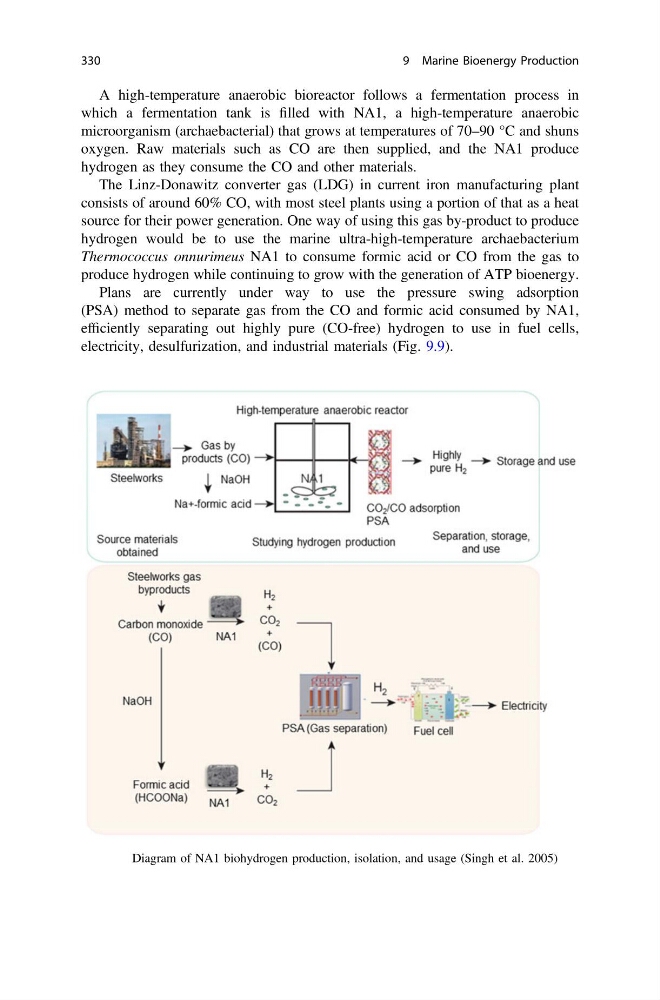
Plans are currently under way to use the pressure swing adsorption
(PSA) method to separate gas from the CO and formic acid consumed by NA1,
efficiently separating out highly pure (CO-free) hydrogen to use in fuel cells,
electricity, desulfurization, and industrial materials (Fig. 9.9).
Fig. 9.9 Diagram of NA1 biohydrogen production, isolation, and usage (Singh et al. 2005)
330
9 Marine Bioenergy Production
which a fermentation tank is filled with NA1, a high-temperature anaerobic
microorganism (archaebacterial) that grows at temperatures of 70–90 °C and shuns
oxygen. Raw materials such as CO are then supplied, and the NA1 produce
hydrogen as they consume the CO and other materials.
The Linz-Donawitz converter gas (LDG) in current iron manufacturing plant
consists of around 60% CO, with most steel plants using a portion of that as a heat
source for their power generation. One way of using this gas by-product to produce
hydrogen would be to use the marine ultra-high-temperature archaebacterium
Thermococcus onnurimeus NA1 to consume formic acid or CO from the gas to
produce hydrogen while continuing to grow with the generation of ATP bioenergy.
Plans are currently under way to use the pressure swing adsorption
(PSA) method to separate gas from the CO and formic acid consumed by NA1,
efficiently separating out highly pure (CO-free) hydrogen to use in fuel cells,
electricity, desulfurization, and industrial materials (Fig. 9.9).
Fig. 9.9 Diagram of NA1 biohydrogen production, isolation, and usage (Singh et al. 2005)
330
9 Marine Bioenergy Production