

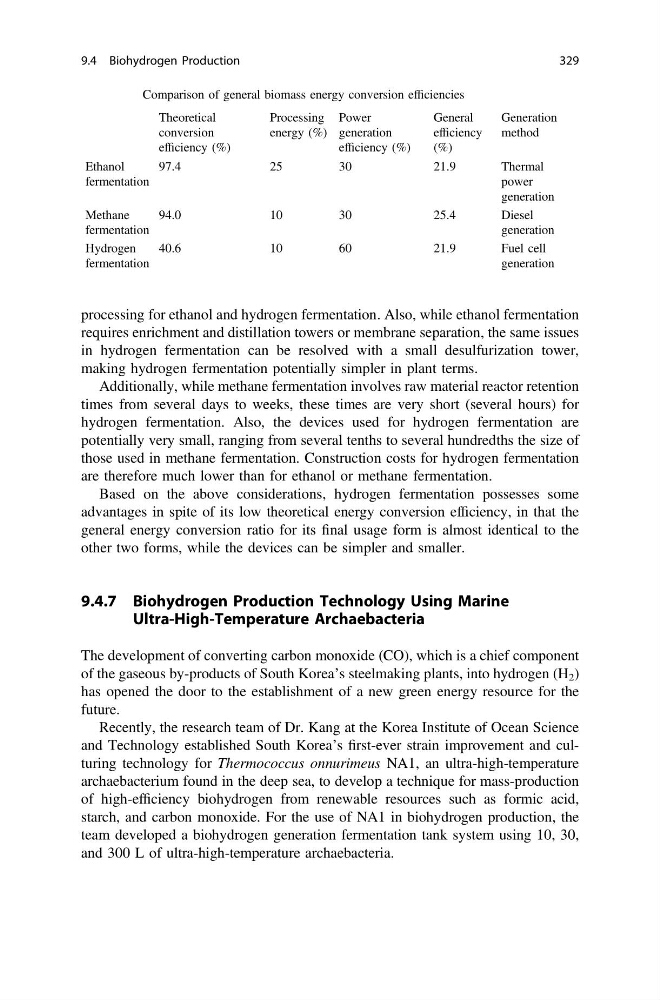
processing for ethanol and hydrogen fermentation. Also, while ethanol fermentation
requires enrichment and distillation towers or membrane separation, the same issues
in hydrogen fermentation can be resolved with a small desulfurization tower,
making hydrogen fermentation potentially simpler in plant terms.
Additionally, while methane fermentation involves raw material reactor retention
times from several days to weeks, these times are very short (several hours) for
hydrogen fermentation. Also, the devices used for hydrogen fermentation are
potentially very small, ranging from several tenths to several hundredths the size of
those used in methane fermentation. Construction costs for hydrogen fermentation
are therefore much lower than for ethanol or methane fermentation.
Based on the above considerations, hydrogen fermentation possesses some
advantages in spite of its low theoretical energy conversion efficiency, in that the
general energy conversion ratio for its final usage form is almost identical to the
other two forms, while the devices can be simpler and smaller.
9.4.7 Biohydrogen Production Technology Using Marine
Ultra-High-Temperature Archaebacteria
The development of converting carbon monoxide (CO), which is a chief component
of the gaseous by-products of South Korea’s steelmaking plants, into hydrogen (H 2 )
has opened the door to the establishment of a new green energy resource for the
future.
Recently, the research team of Dr. Kang at the Korea Institute of Ocean Science
and Technology established South Korea’s first-ever strain improvement and culturing technology for Thermococcus onnurimeus NA1, an ultra-high-temperature
archaebacterium found in the deep sea, to develop a technique for mass-production
of high-efficiency biohydrogen from renewable resources such as formic acid,
starch, and carbon monoxide. For the use of NA1 in biohydrogen production, the
team developed a biohydrogen generation fermentation tank system using 10, 30,
and 300 L of ultra-high-temperature archaebacteria.
Table 9.7 Comparison of general biomass energy conversion efficiencies
Theoretical
conversion
efficiency (%)
Processing
energy (%)
Power
generation
efficiency (%)
General
efficiency
(%)
Generation
method
Ethanol
fermentation
97.4
25
30
21.9
Thermal
power
generation
Methane
fermentation
94.0
10
30
25.4
Diesel
generation
Hydrogen
fermentation
40.6
10
60
21.9
Fuel cell
generation
9.4 Biohydrogen Production
329
requires enrichment and distillation towers or membrane separation, the same issues
in hydrogen fermentation can be resolved with a small desulfurization tower,
making hydrogen fermentation potentially simpler in plant terms.
Additionally, while methane fermentation involves raw material reactor retention
times from several days to weeks, these times are very short (several hours) for
hydrogen fermentation. Also, the devices used for hydrogen fermentation are
potentially very small, ranging from several tenths to several hundredths the size of
those used in methane fermentation. Construction costs for hydrogen fermentation
are therefore much lower than for ethanol or methane fermentation.
Based on the above considerations, hydrogen fermentation possesses some
advantages in spite of its low theoretical energy conversion efficiency, in that the
general energy conversion ratio for its final usage form is almost identical to the
other two forms, while the devices can be simpler and smaller.
9.4.7 Biohydrogen Production Technology Using Marine
Ultra-High-Temperature Archaebacteria
The development of converting carbon monoxide (CO), which is a chief component
of the gaseous by-products of South Korea’s steelmaking plants, into hydrogen (H 2 )
has opened the door to the establishment of a new green energy resource for the
future.
Recently, the research team of Dr. Kang at the Korea Institute of Ocean Science
and Technology established South Korea’s first-ever strain improvement and culturing technology for Thermococcus onnurimeus NA1, an ultra-high-temperature
archaebacterium found in the deep sea, to develop a technique for mass-production
of high-efficiency biohydrogen from renewable resources such as formic acid,
starch, and carbon monoxide. For the use of NA1 in biohydrogen production, the
team developed a biohydrogen generation fermentation tank system using 10, 30,
and 300 L of ultra-high-temperature archaebacteria.
Table 9.7 Comparison of general biomass energy conversion efficiencies
Theoretical
conversion
efficiency (%)
Processing
energy (%)
Power
generation
efficiency (%)
General
efficiency
(%)
Generation
method
Ethanol
fermentation
97.4
25
30
21.9
Thermal
power
generation
Methane
fermentation
94.0
10
30
25.4
Diesel
generation
Hydrogen
fermentation
40.6
10
60
21.9
Fuel cell
generation
9.4 Biohydrogen Production
329