

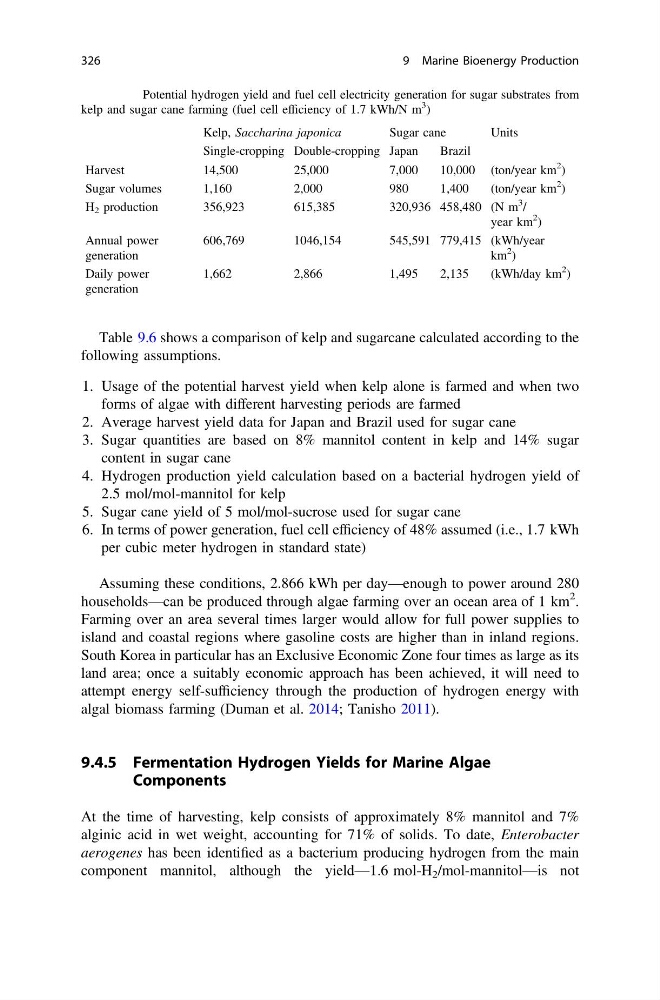
Table 9.6 shows a comparison of kelp and sugarcane calculated according to the
following assumptions.
1. Usage of the potential harvest yield when kelp alone is farmed and when two
forms of algae with different harvesting periods are farmed
2. Average harvest yield data for Japan and Brazil used for sugar cane
3. Sugar quantities are based on 8% mannitol content in kelp and 14% sugar
content in sugar cane
4. Hydrogen production yield calculation based on a bacterial hydrogen yield of
2.5 mol/mol-mannitol for kelp
5. Sugar cane yield of 5 mol/mol-sucrose used for sugar cane
6. In terms of power generation, fuel cell efficiency of 48% assumed (i.e., 1.7 kWh
per cubic meter hydrogen in standard state)
Assuming these conditions, 2.866 kWh per day—enough to power around 280
households—can be produced through algae farming over an ocean area of 1 km
2 .
Farming over an area several times larger would allow for full power supplies to
island and coastal regions where gasoline costs are higher than in inland regions.
South Korea in particular has an Exclusive Economic Zone four times as large as its
land area; once a suitably economic approach has been achieved, it will need to
attempt energy self-sufficiency through the production of hydrogen energy with
algal biomass farming (Duman et al. 2014; Tanisho 2011).
9.4.5 Fermentation Hydrogen Yields for Marine Algae
Components
At the time of harvesting, kelp consists of approximately 8% mannitol and 7%
alginic acid in wet weight, accounting for 71% of solids. To date, Enterobacter
aerogenes has been identified as a bacterium producing hydrogen from the main
component mannitol, although the yield—1.6 mol-H 2 /mol-mannitol—is not
Table 9.6 Potential hydrogen yield and fuel cell electricity generation for sugar substrates from
kelp and sugar cane farming (fuel cell efficiency of 1.7 kWh/N m
3
)
Kelp, Saccharina japonica
Sugar cane
Units
Single-cropping Double-cropping Japan
Brazil
Harvest
14,500
25,000
7,000
10,000 (ton/year km
2
)
Sugar volumes
1,160
2,000
980
1,400
(ton/year km
2
)
H 2 production
356,923
615,385
320,936 458,480 (N m
3
/
year km
2
)
Annual power
generation
606,769
1046,154
545,591 779,415 (kWh/year
km
2
)
Daily power
generation
1,662
2,866
1,495
2,135
(kWh/day km
2
)
326
9 Marine Bioenergy Production
following assumptions.
1. Usage of the potential harvest yield when kelp alone is farmed and when two
forms of algae with different harvesting periods are farmed
2. Average harvest yield data for Japan and Brazil used for sugar cane
3. Sugar quantities are based on 8% mannitol content in kelp and 14% sugar
content in sugar cane
4. Hydrogen production yield calculation based on a bacterial hydrogen yield of
2.5 mol/mol-mannitol for kelp
5. Sugar cane yield of 5 mol/mol-sucrose used for sugar cane
6. In terms of power generation, fuel cell efficiency of 48% assumed (i.e., 1.7 kWh
per cubic meter hydrogen in standard state)
Assuming these conditions, 2.866 kWh per day—enough to power around 280
households—can be produced through algae farming over an ocean area of 1 km
2 .
Farming over an area several times larger would allow for full power supplies to
island and coastal regions where gasoline costs are higher than in inland regions.
South Korea in particular has an Exclusive Economic Zone four times as large as its
land area; once a suitably economic approach has been achieved, it will need to
attempt energy self-sufficiency through the production of hydrogen energy with
algal biomass farming (Duman et al. 2014; Tanisho 2011).
9.4.5 Fermentation Hydrogen Yields for Marine Algae
Components
At the time of harvesting, kelp consists of approximately 8% mannitol and 7%
alginic acid in wet weight, accounting for 71% of solids. To date, Enterobacter
aerogenes has been identified as a bacterium producing hydrogen from the main
component mannitol, although the yield—1.6 mol-H 2 /mol-mannitol—is not
Table 9.6 Potential hydrogen yield and fuel cell electricity generation for sugar substrates from
kelp and sugar cane farming (fuel cell efficiency of 1.7 kWh/N m
3
)
Kelp, Saccharina japonica
Sugar cane
Units
Single-cropping Double-cropping Japan
Brazil
Harvest
14,500
25,000
7,000
10,000 (ton/year km
2
)
Sugar volumes
1,160
2,000
980
1,400
(ton/year km
2
)
H 2 production
356,923
615,385
320,936 458,480 (N m
3
/
year km
2
)
Annual power
generation
606,769
1046,154
545,591 779,415 (kWh/year
km
2
)
Daily power
generation
1,662
2,866
1,495
2,135
(kWh/day km
2
)
326
9 Marine Bioenergy Production