

components, it is chiefly mannitol that bacteria use when generating hydrogen. The
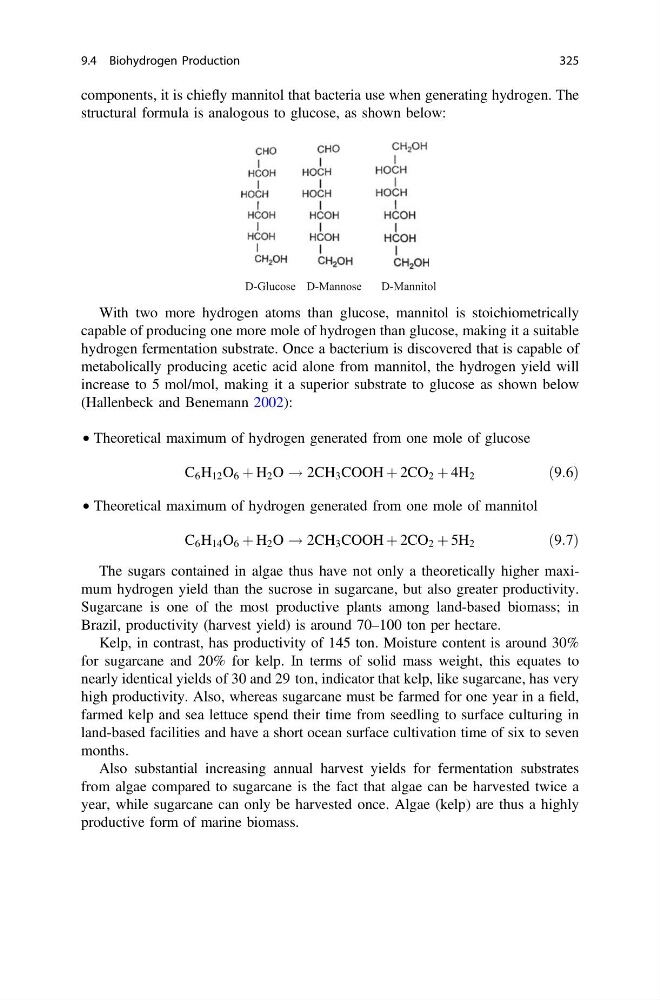
structural formula is analogous to glucose, as shown below:
D-Glucose D-Mannose
D-Mannitol
With two more hydrogen atoms than glucose, mannitol is stoichiometrically
capable of producing one more mole of hydrogen than glucose, making it a suitable
hydrogen fermentation substrate. Once a bacterium is discovered that is capable of
metabolically producing acetic acid alone from mannitol, the hydrogen yield will
increase to 5 mol/mol, making it a superior substrate to glucose as shown below
(Hallenbeck and Benemann 2002):
• Theoretical maximum of hydrogen generated from one mole of glucose
C 6 H 12 O 6 þ H 2 O ! 2CH 3 COOH þ 2CO 2 þ 4H 2
ð9:6Þ
• Theoretical maximum of hydrogen generated from one mole of mannitol
C 6 H 14 O 6 þ H 2 O ! 2CH 3 COOH þ 2CO 2 þ 5H 2
ð9:7Þ
The sugars contained in algae thus have not only a theoretically higher maximum hydrogen yield than the sucrose in sugarcane, but also greater productivity.
Sugarcane is one of the most productive plants among land-based biomass; in
Brazil, productivity (harvest yield) is around 70–100 ton per hectare.
Kelp, in contrast, has productivity of 145 ton. Moisture content is around 30%
for sugarcane and 20% for kelp. In terms of solid mass weight, this equates to
nearly identical yields of 30 and 29 ton, indicator that kelp, like sugarcane, has very
high productivity. Also, whereas sugarcane must be farmed for one year in a field,
farmed kelp and sea lettuce spend their time from seedling to surface culturing in
land-based facilities and have a short ocean surface cultivation time of six to seven
months.
Also substantial increasing annual harvest yields for fermentation substrates
from algae compared to sugarcane is the fact that algae can be harvested twice a
year, while sugarcane can only be harvested once. Algae (kelp) are thus a highly
productive form of marine biomass.
9.4 Biohydrogen Production
325
structural formula is analogous to glucose, as shown below:
D-Glucose D-Mannose
D-Mannitol
With two more hydrogen atoms than glucose, mannitol is stoichiometrically
capable of producing one more mole of hydrogen than glucose, making it a suitable
hydrogen fermentation substrate. Once a bacterium is discovered that is capable of
metabolically producing acetic acid alone from mannitol, the hydrogen yield will
increase to 5 mol/mol, making it a superior substrate to glucose as shown below
(Hallenbeck and Benemann 2002):
• Theoretical maximum of hydrogen generated from one mole of glucose
C 6 H 12 O 6 þ H 2 O ! 2CH 3 COOH þ 2CO 2 þ 4H 2
ð9:6Þ
• Theoretical maximum of hydrogen generated from one mole of mannitol
C 6 H 14 O 6 þ H 2 O ! 2CH 3 COOH þ 2CO 2 þ 5H 2
ð9:7Þ
The sugars contained in algae thus have not only a theoretically higher maximum hydrogen yield than the sucrose in sugarcane, but also greater productivity.
Sugarcane is one of the most productive plants among land-based biomass; in
Brazil, productivity (harvest yield) is around 70–100 ton per hectare.
Kelp, in contrast, has productivity of 145 ton. Moisture content is around 30%
for sugarcane and 20% for kelp. In terms of solid mass weight, this equates to
nearly identical yields of 30 and 29 ton, indicator that kelp, like sugarcane, has very
high productivity. Also, whereas sugarcane must be farmed for one year in a field,
farmed kelp and sea lettuce spend their time from seedling to surface culturing in
land-based facilities and have a short ocean surface cultivation time of six to seven
months.
Also substantial increasing annual harvest yields for fermentation substrates
from algae compared to sugarcane is the fact that algae can be harvested twice a
year, while sugarcane can only be harvested once. Algae (kelp) are thus a highly
productive form of marine biomass.
9.4 Biohydrogen Production
325