

B. Three Proteins Created by Byssi
The main constituents of the byssus are proteins. This was recognized relatively
early on, but closer research has not been a simple matter. Studying the ingredients
requires dissolving of the byssi and the refinement of their ingredients through
various methods. Once formed, however, a byssus is almost completely resistant to
dissolution with water, enzymes, or solvents, which prevents refinement through
simple methods. Around 1980, one of the main ingredients in the byssus was
successfully extracted from byssus secretion tissue in the U.S.
Byssus ingredients secreted from the foot could be eluted because they had not
yet hardened. The ingredient was a protein with a molecular weight of around
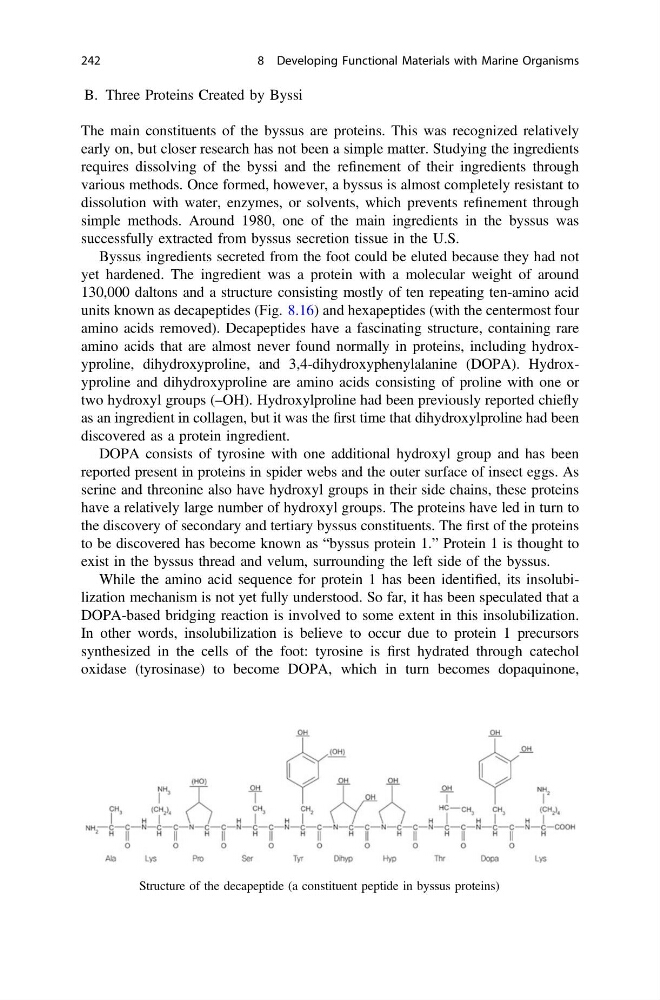
130,000 daltons and a structure consisting mostly of ten repeating ten-amino acid
units known as decapeptides (Fig. 8.16) and hexapeptides (with the centermost four
amino acids removed). Decapeptides have a fascinating structure, containing rare
amino acids that are almost never found normally in proteins, including hydroxyproline, dihydroxyproline, and 3,4-dihydroxyphenylalanine (DOPA). Hydroxyproline and dihydroxyproline are amino acids consisting of proline with one or
two hydroxyl groups (–OH). Hydroxylproline had been previously reported chiefly
as an ingredient in collagen, but it was the first time that dihydroxylproline had been
discovered as a protein ingredient.
DOPA consists of tyrosine with one additional hydroxyl group and has been
reported present in proteins in spider webs and the outer surface of insect eggs. As
serine and threonine also have hydroxyl groups in their side chains, these proteins
have a relatively large number of hydroxyl groups. The proteins have led in turn to
the discovery of secondary and tertiary byssus constituents. The first of the proteins
to be discovered has become known as “byssus protein 1.” Protein 1 is thought to
exist in the byssus thread and velum, surrounding the left side of the byssus.
While the amino acid sequence for protein 1 has been identified, its insolubilization mechanism is not yet fully understood. So far, it has been speculated that a
DOPA-based bridging reaction is involved to some extent in this insolubilization.
In other words, insolubilization is believe to occur due to protein 1 precursors
synthesized in the cells of the foot: tyrosine is first hydrated through catechol
oxidase (tyrosinase) to become DOPA, which in turn becomes dopaquinone,
Fig. 8.16 Structure of the decapeptide (a constituent peptide in byssus proteins)
242
8 Developing Functional Materials with Marine Organisms
The main constituents of the byssus are proteins. This was recognized relatively
early on, but closer research has not been a simple matter. Studying the ingredients
requires dissolving of the byssi and the refinement of their ingredients through
various methods. Once formed, however, a byssus is almost completely resistant to
dissolution with water, enzymes, or solvents, which prevents refinement through
simple methods. Around 1980, one of the main ingredients in the byssus was
successfully extracted from byssus secretion tissue in the U.S.
Byssus ingredients secreted from the foot could be eluted because they had not
yet hardened. The ingredient was a protein with a molecular weight of around
130,000 daltons and a structure consisting mostly of ten repeating ten-amino acid
units known as decapeptides (Fig. 8.16) and hexapeptides (with the centermost four
amino acids removed). Decapeptides have a fascinating structure, containing rare
amino acids that are almost never found normally in proteins, including hydroxyproline, dihydroxyproline, and 3,4-dihydroxyphenylalanine (DOPA). Hydroxyproline and dihydroxyproline are amino acids consisting of proline with one or
two hydroxyl groups (–OH). Hydroxylproline had been previously reported chiefly
as an ingredient in collagen, but it was the first time that dihydroxylproline had been
discovered as a protein ingredient.
DOPA consists of tyrosine with one additional hydroxyl group and has been
reported present in proteins in spider webs and the outer surface of insect eggs. As
serine and threonine also have hydroxyl groups in their side chains, these proteins
have a relatively large number of hydroxyl groups. The proteins have led in turn to
the discovery of secondary and tertiary byssus constituents. The first of the proteins
to be discovered has become known as “byssus protein 1.” Protein 1 is thought to
exist in the byssus thread and velum, surrounding the left side of the byssus.
While the amino acid sequence for protein 1 has been identified, its insolubilization mechanism is not yet fully understood. So far, it has been speculated that a
DOPA-based bridging reaction is involved to some extent in this insolubilization.
In other words, insolubilization is believe to occur due to protein 1 precursors
synthesized in the cells of the foot: tyrosine is first hydrated through catechol
oxidase (tyrosinase) to become DOPA, which in turn becomes dopaquinone,
Fig. 8.16 Structure of the decapeptide (a constituent peptide in byssus proteins)
242
8 Developing Functional Materials with Marine Organisms