

A. Underwater Adhesion by Attached Organisms
Various forms of attached organisms inhabit the seas, including shellfish and sea
squirts. They have earned a negative reputation as “fouling organisms” because of
the economic damage they can cause with their powerful adhesion to underwater
rocks, the bottoms of boats, fishing nets, and artificial structures such as generators,
which can diminish the speed of boats and block mesh knots and waters. So strong
is the adhesive force of sessile organisms that they are difficult to remove once
attached to a surface. Such are the mysterious principles of nature: if their adhesion
were weaker, they would be vulnerable to being carried away on incoming waves
and would be unable to survive (Kamino 2008).
Attached organisms thus represent a powerful form of underwater adhesion that
humans have been unable to achieve. Their adhesive substances have been to found
to consist of proteins, and active research is currently under way to identify the
genes for those proteins for mass-production of underwater adhesives through
genetic engineering.
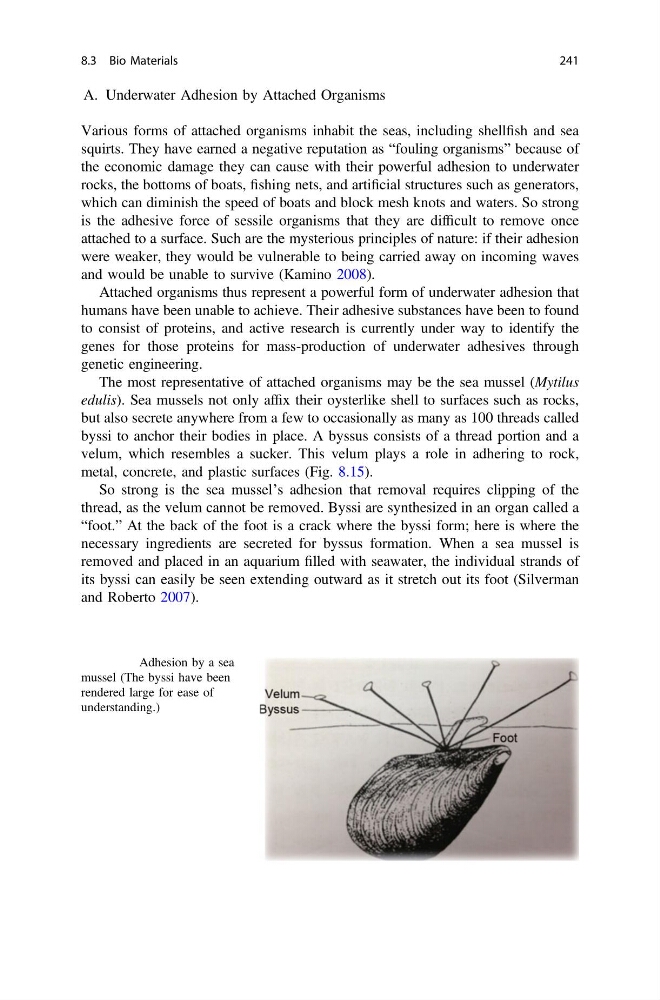
The most representative of attached organisms may be the sea mussel (Mytilus
edulis). Sea mussels not only affix their oysterlike shell to surfaces such as rocks,
but also secrete anywhere from a few to occasionally as many as 100 threads called
byssi to anchor their bodies in place. A byssus consists of a thread portion and a
velum, which resembles a sucker. This velum plays a role in adhering to rock,
metal, concrete, and plastic surfaces (Fig. 8.15).
So strong is the sea mussel’s adhesion that removal requires clipping of the
thread, as the velum cannot be removed. Byssi are synthesized in an organ called a
“foot.” At the back of the foot is a crack where the byssi form; here is where the
necessary ingredients are secreted for byssus formation. When a sea mussel is
removed and placed in an aquarium filled with seawater, the individual strands of
its byssi can easily be seen extending outward as it stretch out its foot (Silverman
and Roberto 2007).
Fig. 8.15 Adhesion by a sea
mussel (The byssi have been
rendered large for ease of
understanding.)
8.3 Bio Materials
241
Various forms of attached organisms inhabit the seas, including shellfish and sea
squirts. They have earned a negative reputation as “fouling organisms” because of
the economic damage they can cause with their powerful adhesion to underwater
rocks, the bottoms of boats, fishing nets, and artificial structures such as generators,
which can diminish the speed of boats and block mesh knots and waters. So strong
is the adhesive force of sessile organisms that they are difficult to remove once
attached to a surface. Such are the mysterious principles of nature: if their adhesion
were weaker, they would be vulnerable to being carried away on incoming waves
and would be unable to survive (Kamino 2008).
Attached organisms thus represent a powerful form of underwater adhesion that
humans have been unable to achieve. Their adhesive substances have been to found
to consist of proteins, and active research is currently under way to identify the
genes for those proteins for mass-production of underwater adhesives through
genetic engineering.
The most representative of attached organisms may be the sea mussel (Mytilus
edulis). Sea mussels not only affix their oysterlike shell to surfaces such as rocks,
but also secrete anywhere from a few to occasionally as many as 100 threads called
byssi to anchor their bodies in place. A byssus consists of a thread portion and a
velum, which resembles a sucker. This velum plays a role in adhering to rock,
metal, concrete, and plastic surfaces (Fig. 8.15).
So strong is the sea mussel’s adhesion that removal requires clipping of the
thread, as the velum cannot be removed. Byssi are synthesized in an organ called a
“foot.” At the back of the foot is a crack where the byssi form; here is where the
necessary ingredients are secreted for byssus formation. When a sea mussel is
removed and placed in an aquarium filled with seawater, the individual strands of
its byssi can easily be seen extending outward as it stretch out its foot (Silverman
and Roberto 2007).
Fig. 8.15 Adhesion by a sea
mussel (The byssi have been
rendered large for ease of
understanding.)
8.3 Bio Materials
241