

8.2.4 Anti-inflammatory Substances
Marine natural substances with strong anti-inflammatory and pain-relieving properties have made many contributions to studies on arachidonic acid metabolism and
calcium ion (Ca
2+ ) movement in inflammation reactions. Inflammation reactions are
ultimately the result of calcium ion emission and movement within the cell. The
calcium ion movement mechanism begins when an agonist combines with a receptor.
The receptor communicates a signal by messenger of G-proteins (guanine
nucleotide-binding proteins), activating phospholipases such as PLA 2 or PLC. The
phospholipases hydrolyze phospholipids in the cell membrane, producing secondary
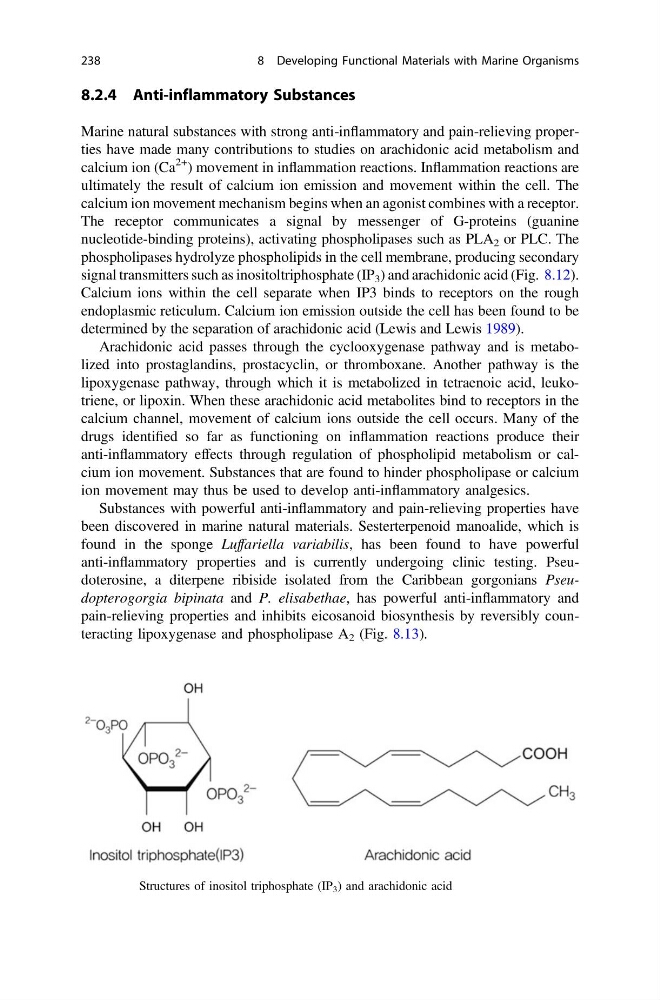
signal transmitters such as inositoltriphosphate (IP 3 ) and arachidonic acid (Fig. 8.12).
Calcium ions within the cell separate when IP3 binds to receptors on the rough
endoplasmic reticulum. Calcium ion emission outside the cell has been found to be
determined by the separation of arachidonic acid (Lewis and Lewis 1989).
Arachidonic acid passes through the cyclooxygenase pathway and is metabolized into prostaglandins, prostacyclin, or thromboxane. Another pathway is the
lipoxygenase pathway, through which it is metabolized in tetraenoic acid, leukotriene, or lipoxin. When these arachidonic acid metabolites bind to receptors in the
calcium channel, movement of calcium ions outside the cell occurs. Many of the
drugs identified so far as functioning on inflammation reactions produce their
anti-inflammatory effects through regulation of phospholipid metabolism or calcium ion movement. Substances that are found to hinder phospholipase or calcium
ion movement may thus be used to develop anti-inflammatory analgesics.
Substances with powerful anti-inflammatory and pain-relieving properties have
been discovered in marine natural materials. Sesterterpenoid manoalide, which is
found in the sponge Luffariella variabilis, has been found to have powerful
anti-inflammatory properties and is currently undergoing clinic testing. Pseudoterosine, a diterpene ribiside isolated from the Caribbean gorgonians Pseudopterogorgia bipinata and P. elisabethae, has powerful anti-inflammatory and
pain-relieving properties and inhibits eicosanoid biosynthesis by reversibly counteracting lipoxygenase and phospholipase A 2 (Fig. 8.13).
Fig. 8.12 Structures of inositol triphosphate (IP 3 ) and arachidonic acid
238
8 Developing Functional Materials with Marine Organisms
Marine natural substances with strong anti-inflammatory and pain-relieving properties have made many contributions to studies on arachidonic acid metabolism and
calcium ion (Ca
2+ ) movement in inflammation reactions. Inflammation reactions are
ultimately the result of calcium ion emission and movement within the cell. The
calcium ion movement mechanism begins when an agonist combines with a receptor.
The receptor communicates a signal by messenger of G-proteins (guanine
nucleotide-binding proteins), activating phospholipases such as PLA 2 or PLC. The
phospholipases hydrolyze phospholipids in the cell membrane, producing secondary
signal transmitters such as inositoltriphosphate (IP 3 ) and arachidonic acid (Fig. 8.12).
Calcium ions within the cell separate when IP3 binds to receptors on the rough
endoplasmic reticulum. Calcium ion emission outside the cell has been found to be
determined by the separation of arachidonic acid (Lewis and Lewis 1989).
Arachidonic acid passes through the cyclooxygenase pathway and is metabolized into prostaglandins, prostacyclin, or thromboxane. Another pathway is the
lipoxygenase pathway, through which it is metabolized in tetraenoic acid, leukotriene, or lipoxin. When these arachidonic acid metabolites bind to receptors in the
calcium channel, movement of calcium ions outside the cell occurs. Many of the
drugs identified so far as functioning on inflammation reactions produce their
anti-inflammatory effects through regulation of phospholipid metabolism or calcium ion movement. Substances that are found to hinder phospholipase or calcium
ion movement may thus be used to develop anti-inflammatory analgesics.
Substances with powerful anti-inflammatory and pain-relieving properties have
been discovered in marine natural materials. Sesterterpenoid manoalide, which is
found in the sponge Luffariella variabilis, has been found to have powerful
anti-inflammatory properties and is currently undergoing clinic testing. Pseudoterosine, a diterpene ribiside isolated from the Caribbean gorgonians Pseudopterogorgia bipinata and P. elisabethae, has powerful anti-inflammatory and
pain-relieving properties and inhibits eicosanoid biosynthesis by reversibly counteracting lipoxygenase and phospholipase A 2 (Fig. 8.13).
Fig. 8.12 Structures of inositol triphosphate (IP 3 ) and arachidonic acid
238
8 Developing Functional Materials with Marine Organisms