

Inuits, who consume more fish and shellfish than meat-favoring Westerners, are
noted for their very low morbidity rate from conditions such as hypertension and
heart disease. This has been shown to result from the activities of eicosapantaenoic
acid (EPA) and docosahexaenoic acid (DHA), which are unsaturated fatty acids
found in fish oil. EPA, which has been shown to have effects in reducing platelet
aggregation suppression, neutral fats, and cholesterol, was marketed in Japan in
1990 as a treatment for arteriosclerosis obliterans (Childs et al. 1990).
DHA is another nutrient that is expected to have a wide range of pharmacological properties. Research on DHA’s pharmacological functions to date has shown
effects in improving senile dementia and calcium functions, along with anticancer,
antiallergy, and lipid reduction properties. Because EPA and DHA are nutrients
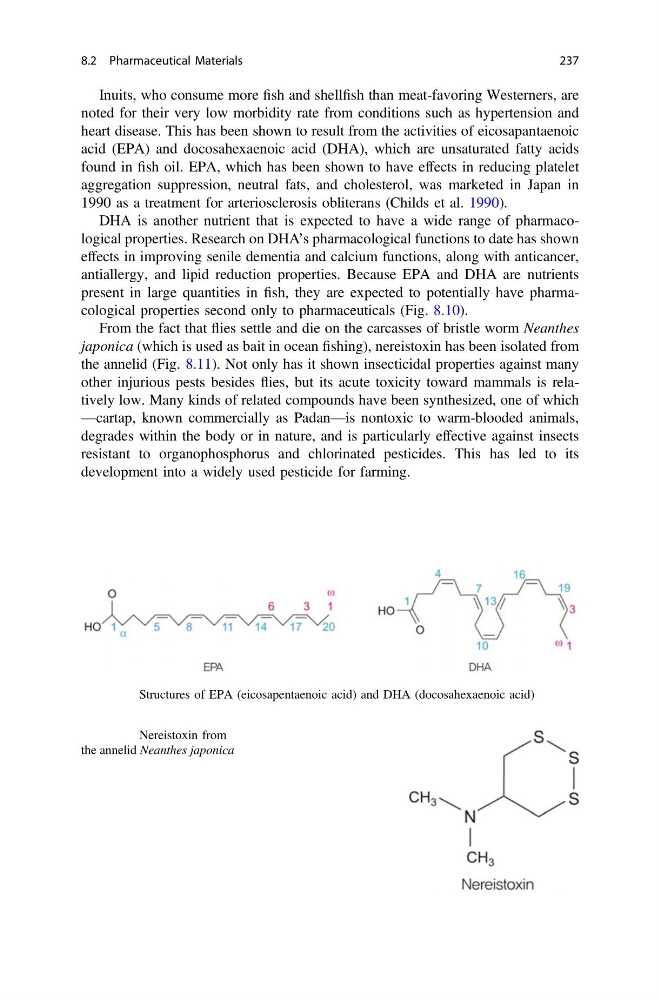
present in large quantities in fish, they are expected to potentially have pharmacological properties second only to pharmaceuticals (Fig. 8.10).
From the fact that flies settle and die on the carcasses of bristle worm Neanthes
japonica (which is used as bait in ocean fishing), nereistoxin has been isolated from
the annelid (Fig. 8.11). Not only has it shown insecticidal properties against many
other injurious pests besides flies, but its acute toxicity toward mammals is relatively low. Many kinds of related compounds have been synthesized, one of which
—cartap, known commercially as Padan—is nontoxic to warm-blooded animals,
degrades within the body or in nature, and is particularly effective against insects
resistant to organophosphorus and chlorinated pesticides. This has led to its
development into a widely used pesticide for farming.
Fig. 8.10 Structures of EPA (eicosapentaenoic acid) and DHA (docosahexaenoic acid)
Fig. 8.11 Nereistoxin from
the annelid Neanthes japonica
8.2 Pharmaceutical Materials
237
noted for their very low morbidity rate from conditions such as hypertension and
heart disease. This has been shown to result from the activities of eicosapantaenoic
acid (EPA) and docosahexaenoic acid (DHA), which are unsaturated fatty acids
found in fish oil. EPA, which has been shown to have effects in reducing platelet
aggregation suppression, neutral fats, and cholesterol, was marketed in Japan in
1990 as a treatment for arteriosclerosis obliterans (Childs et al. 1990).
DHA is another nutrient that is expected to have a wide range of pharmacological properties. Research on DHA’s pharmacological functions to date has shown
effects in improving senile dementia and calcium functions, along with anticancer,
antiallergy, and lipid reduction properties. Because EPA and DHA are nutrients
present in large quantities in fish, they are expected to potentially have pharmacological properties second only to pharmaceuticals (Fig. 8.10).
From the fact that flies settle and die on the carcasses of bristle worm Neanthes
japonica (which is used as bait in ocean fishing), nereistoxin has been isolated from
the annelid (Fig. 8.11). Not only has it shown insecticidal properties against many
other injurious pests besides flies, but its acute toxicity toward mammals is relatively low. Many kinds of related compounds have been synthesized, one of which
—cartap, known commercially as Padan—is nontoxic to warm-blooded animals,
degrades within the body or in nature, and is particularly effective against insects
resistant to organophosphorus and chlorinated pesticides. This has led to its
development into a widely used pesticide for farming.
Fig. 8.10 Structures of EPA (eicosapentaenoic acid) and DHA (docosahexaenoic acid)
Fig. 8.11 Nereistoxin from
the annelid Neanthes japonica
8.2 Pharmaceutical Materials
237