

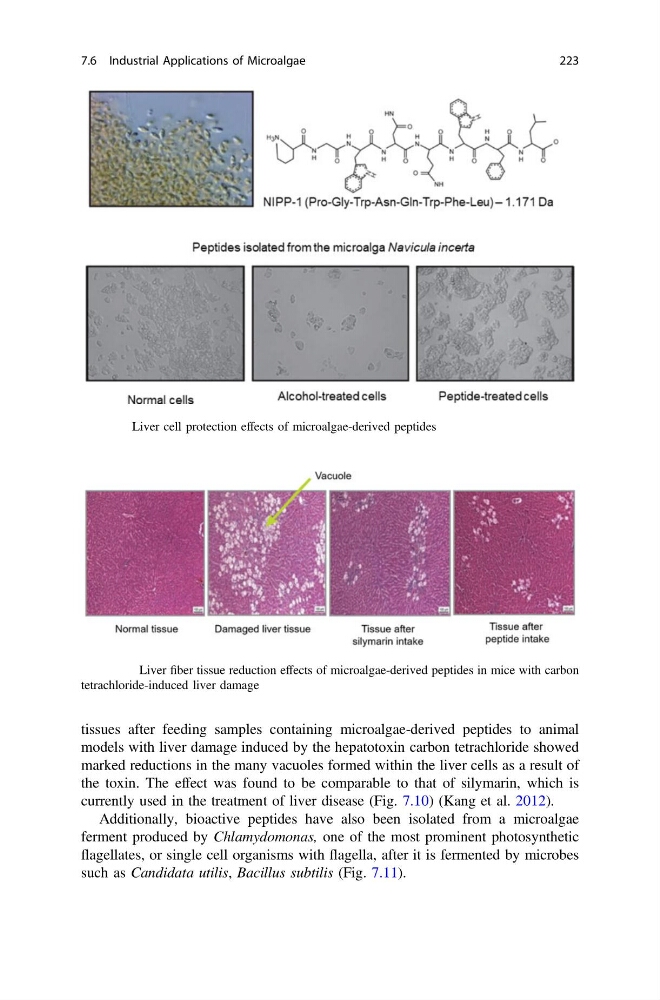
tissues after feeding samples containing microalgae-derived peptides to animal
models with liver damage induced by the hepatotoxin carbon tetrachloride showed
marked reductions in the many vacuoles formed within the liver cells as a result of
the toxin. The effect was found to be comparable to that of silymarin, which is
currently used in the treatment of liver disease (Fig. 7.10) (Kang et al. 2012).
Additionally, bioactive peptides have also been isolated from a microalgae
ferment produced by Chlamydomonas, one of the most prominent photosynthetic
flagellates, or single cell organisms with flagella, after it is fermented by microbes
such as Candidata utilis, Bacillus subtilis (Fig. 7.11).
Fig. 7.9 Liver cell protection effects of microalgae-derived peptides
Fig. 7.10 Liver fiber tissue reduction effects of microalgae-derived peptides in mice with carbon
tetrachloride-induced liver damage
7.6 Industrial Applications of Microalgae
223
models with liver damage induced by the hepatotoxin carbon tetrachloride showed
marked reductions in the many vacuoles formed within the liver cells as a result of
the toxin. The effect was found to be comparable to that of silymarin, which is
currently used in the treatment of liver disease (Fig. 7.10) (Kang et al. 2012).
Additionally, bioactive peptides have also been isolated from a microalgae
ferment produced by Chlamydomonas, one of the most prominent photosynthetic
flagellates, or single cell organisms with flagella, after it is fermented by microbes
such as Candidata utilis, Bacillus subtilis (Fig. 7.11).
Fig. 7.9 Liver cell protection effects of microalgae-derived peptides
Fig. 7.10 Liver fiber tissue reduction effects of microalgae-derived peptides in mice with carbon
tetrachloride-induced liver damage
7.6 Industrial Applications of Microalgae
223