

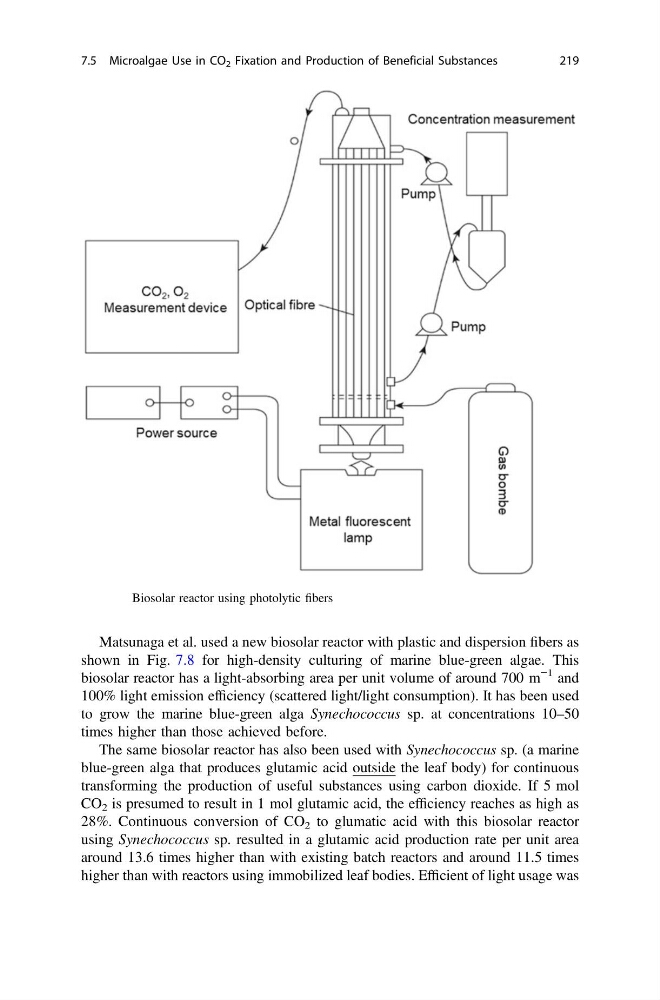
Matsunaga et al. used a new biosolar reactor with plastic and dispersion fibers as
shown in Fig. 7.8 for high-density culturing of marine blue-green algae. This
biosolar reactor has a light-absorbing area per unit volume of around 700 m
−1 and
100% light emission efficiency (scattered light/light consumption). It has been used
to grow the marine blue-green alga Synechococcus sp. at concentrations 10–50
times higher than those achieved before.
The same biosolar reactor has also been used with Synechococcus sp. (a marine
blue-green alga that produces glutamic acid outside the leaf body) for continuous
transforming the production of useful substances using carbon dioxide. If 5 mol
CO 2 is presumed to result in 1 mol glutamic acid, the efficiency reaches as high as
28%. Continuous conversion of CO 2 to glumatic acid with this biosolar reactor
using Synechococcus sp. resulted in a glutamic acid production rate per unit area
around 13.6 times higher than with existing batch reactors and around 11.5 times
higher than with reactors using immobilized leaf bodies. Efficient of light usage was
Fig. 7.8 Biosolar reactor using photolytic fibers
7.5 Microalgae Use in CO 2 Fixation and Production of Beneficial Substances
219
shown in Fig. 7.8 for high-density culturing of marine blue-green algae. This
biosolar reactor has a light-absorbing area per unit volume of around 700 m
−1 and
100% light emission efficiency (scattered light/light consumption). It has been used
to grow the marine blue-green alga Synechococcus sp. at concentrations 10–50
times higher than those achieved before.
The same biosolar reactor has also been used with Synechococcus sp. (a marine
blue-green alga that produces glutamic acid outside the leaf body) for continuous
transforming the production of useful substances using carbon dioxide. If 5 mol
CO 2 is presumed to result in 1 mol glutamic acid, the efficiency reaches as high as
28%. Continuous conversion of CO 2 to glumatic acid with this biosolar reactor
using Synechococcus sp. resulted in a glutamic acid production rate per unit area
around 13.6 times higher than with existing batch reactors and around 11.5 times
higher than with reactors using immobilized leaf bodies. Efficient of light usage was
Fig. 7.8 Biosolar reactor using photolytic fibers
7.5 Microalgae Use in CO 2 Fixation and Production of Beneficial Substances
219