

The resulting conjugant was confirmed through the expression of kanamycin
resistance, resulting from Tn5’s entry into the bacteriophage genome to code for the
same transposon. In other words, replication occurs in this line at the time of
conjugation, and the plasmid is introduced into the recipient cell. Once it has
entered the genome, the effectiveness of the conjugative transfer method can be
assessed without taking into account differences in replication units due to plasmid
instability or variations between types.
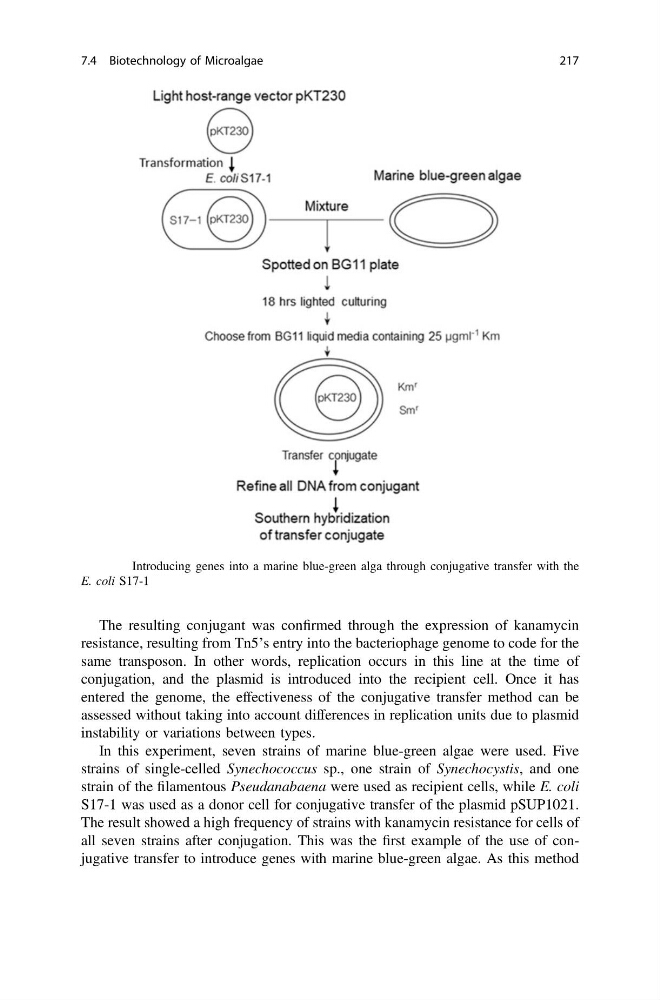
In this experiment, seven strains of marine blue-green algae were used. Five
strains of single-celled Synechococcus sp., one strain of Synechocystis, and one
strain of the filamentous Pseudanabaena were used as recipient cells, while E. coli
S17-1 was used as a donor cell for conjugative transfer of the plasmid pSUP1021.
The result showed a high frequency of strains with kanamycin resistance for cells of
all seven strains after conjugation. This was the first example of the use of conjugative transfer to introduce genes with marine blue-green algae. As this method
Fig. 7.7 Introducing genes into a marine blue-green alga through conjugative transfer with the
E. coli S17-1
7.4 Biotechnology of Microalgae
217
resistance, resulting from Tn5’s entry into the bacteriophage genome to code for the
same transposon. In other words, replication occurs in this line at the time of
conjugation, and the plasmid is introduced into the recipient cell. Once it has
entered the genome, the effectiveness of the conjugative transfer method can be
assessed without taking into account differences in replication units due to plasmid
instability or variations between types.
In this experiment, seven strains of marine blue-green algae were used. Five
strains of single-celled Synechococcus sp., one strain of Synechocystis, and one
strain of the filamentous Pseudanabaena were used as recipient cells, while E. coli
S17-1 was used as a donor cell for conjugative transfer of the plasmid pSUP1021.
The result showed a high frequency of strains with kanamycin resistance for cells of
all seven strains after conjugation. This was the first example of the use of conjugative transfer to introduce genes with marine blue-green algae. As this method
Fig. 7.7 Introducing genes into a marine blue-green alga through conjugative transfer with the
E. coli S17-1
7.4 Biotechnology of Microalgae
217