

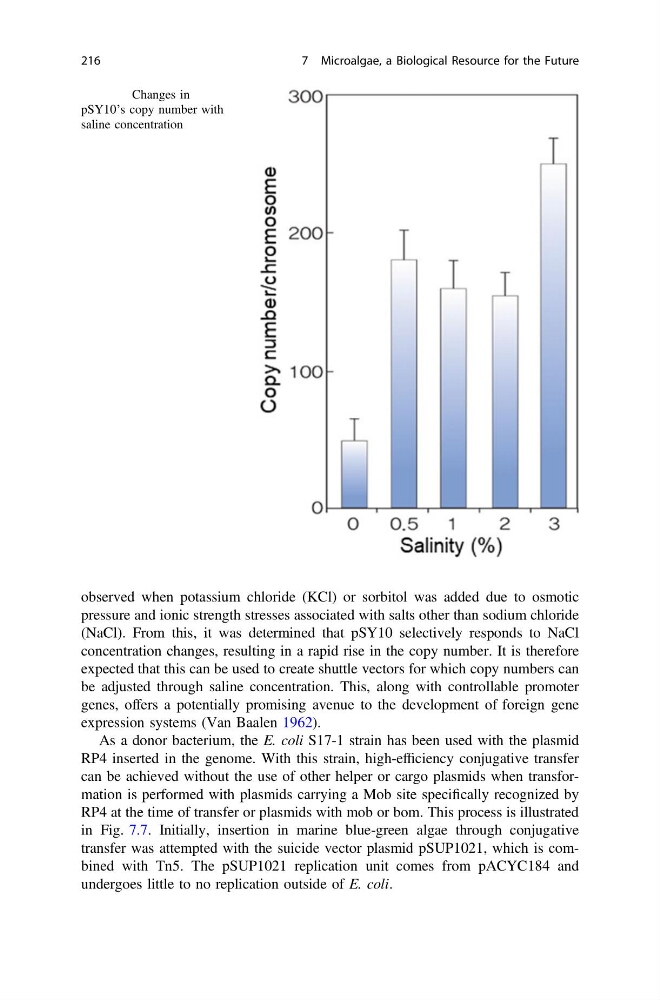
observed when potassium chloride (KCl) or sorbitol was added due to osmotic
pressure and ionic strength stresses associated with salts other than sodium chloride
(NaCl). From this, it was determined that pSY10 selectively responds to NaCl
concentration changes, resulting in a rapid rise in the copy number. It is therefore
expected that this can be used to create shuttle vectors for which copy numbers can
be adjusted through saline concentration. This, along with controllable promoter
genes, offers a potentially promising avenue to the development of foreign gene
expression systems (Van Baalen 1962).
As a donor bacterium, the E. coli S17-1 strain has been used with the plasmid
RP4 inserted in the genome. With this strain, high-efficiency conjugative transfer
can be achieved without the use of other helper or cargo plasmids when transformation is performed with plasmids carrying a Mob site specifically recognized by
RP4 at the time of transfer or plasmids with mob or bom. This process is illustrated
in Fig. 7.7. Initially, insertion in marine blue-green algae through conjugative
transfer was attempted with the suicide vector plasmid pSUP1021, which is combined with Tn5. The pSUP1021 replication unit comes from pACYC184 and
undergoes little to no replication outside of E. coli.
Fig. 7.6 Changes in
pSY10’s copy number with
saline concentration
216
7 Microalgae, a Biological Resource for the Future
pressure and ionic strength stresses associated with salts other than sodium chloride
(NaCl). From this, it was determined that pSY10 selectively responds to NaCl
concentration changes, resulting in a rapid rise in the copy number. It is therefore
expected that this can be used to create shuttle vectors for which copy numbers can
be adjusted through saline concentration. This, along with controllable promoter
genes, offers a potentially promising avenue to the development of foreign gene
expression systems (Van Baalen 1962).
As a donor bacterium, the E. coli S17-1 strain has been used with the plasmid
RP4 inserted in the genome. With this strain, high-efficiency conjugative transfer
can be achieved without the use of other helper or cargo plasmids when transformation is performed with plasmids carrying a Mob site specifically recognized by
RP4 at the time of transfer or plasmids with mob or bom. This process is illustrated
in Fig. 7.7. Initially, insertion in marine blue-green algae through conjugative
transfer was attempted with the suicide vector plasmid pSUP1021, which is combined with Tn5. The pSUP1021 replication unit comes from pACYC184 and
undergoes little to no replication outside of E. coli.
Fig. 7.6 Changes in
pSY10’s copy number with
saline concentration
216
7 Microalgae, a Biological Resource for the Future