

body, and the carbon source growth yield (dry weight of leaf bodies produced
divided by grams of carbon source consumed) is an important indicator in leaf body
production (Kumar et al. 2010).
In heterotrophic culture, glucose and acetic acid have respective growth yields of
0.4 and 0.35, which means that 40 and 35 g of leaf bodies can be produced with
100 g of carbon source. Carbon dioxide has a growth yield of 0.5, and in principle it
should be possible to produce around 1 kg dry weight from 1 L of CO 2 . In culturing with open aquaria, however, the surface yield drops because of the low rate
of CO 2 usage (Maruyama and Ando 1992).
(4) Harvesting and drying
Once culturing is completed, Chlorella cells are separated from the culturing
solution and undergo processing and drying to become dry leaf bodies.
Separation and enrichment of Chlorella cells involves use of a centrifuge.
Enrichment of around five times can be achieved through a single passage of a cell
suspension. Chlorella cells are first separated from the culturing medium through
enrichment, after which water is added to enrich them and remove any remaining
medium. The end result is a cell suspension with a leaf body concentration of 100 g
dry weight per liter or greater. For the production of seedlings for seafood, a
Trochelminthes generation product has been developed in this cell suspension state.
Next, the cell suspension is subjected to three minutes of heat treatment with a
plate heater at 100 °C. Heating is performed to deactivate enzymes within the cell,
increasing preservability of the dry leaf bodies and the digestive absorption rate for
humans and animals (Taub and Dollar 1964; Watanabe et al. 2005; Maruyama and
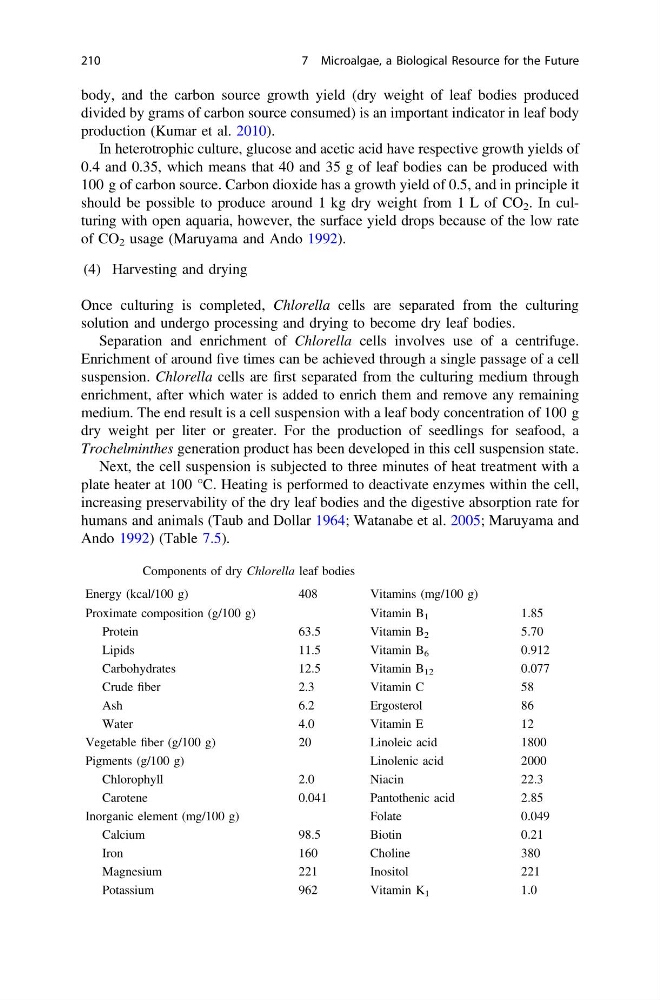
Ando 1992) (Table 7.5).
Table 7.5 Components of dry Chlorella leaf bodies
Energy (kcal/100 g)
408
Vitamins (mg/100 g)
Proximate composition (g/100 g)
Vitamin B 1
1.85
Protein
63.5
Vitamin B 2
5.70
Lipids
11.5
Vitamin B 6
0.912
Carbohydrates
12.5
Vitamin B 12
0.077
Crude fiber
2.3
Vitamin C
58
Ash
6.2
Ergosterol
86
Water
4.0
Vitamin E
12
Vegetable fiber (g/100 g)
20
Linoleic acid
1800
Pigments (g/100 g)
Linolenic acid
2000
Chlorophyll
2.0
Niacin
22.3
Carotene
0.041
Pantothenic acid
2.85
Inorganic element (mg/100 g)
Folate
0.049
Calcium
98.5
Biotin
0.21
Iron
160
Choline
380
Magnesium
221
Inositol
221
Potassium
962
Vitamin K 1
1.0
210
7 Microalgae, a Biological Resource for the Future
divided by grams of carbon source consumed) is an important indicator in leaf body
production (Kumar et al. 2010).
In heterotrophic culture, glucose and acetic acid have respective growth yields of
0.4 and 0.35, which means that 40 and 35 g of leaf bodies can be produced with
100 g of carbon source. Carbon dioxide has a growth yield of 0.5, and in principle it
should be possible to produce around 1 kg dry weight from 1 L of CO 2 . In culturing with open aquaria, however, the surface yield drops because of the low rate
of CO 2 usage (Maruyama and Ando 1992).
(4) Harvesting and drying
Once culturing is completed, Chlorella cells are separated from the culturing
solution and undergo processing and drying to become dry leaf bodies.
Separation and enrichment of Chlorella cells involves use of a centrifuge.
Enrichment of around five times can be achieved through a single passage of a cell
suspension. Chlorella cells are first separated from the culturing medium through
enrichment, after which water is added to enrich them and remove any remaining
medium. The end result is a cell suspension with a leaf body concentration of 100 g
dry weight per liter or greater. For the production of seedlings for seafood, a
Trochelminthes generation product has been developed in this cell suspension state.
Next, the cell suspension is subjected to three minutes of heat treatment with a
plate heater at 100 °C. Heating is performed to deactivate enzymes within the cell,
increasing preservability of the dry leaf bodies and the digestive absorption rate for
humans and animals (Taub and Dollar 1964; Watanabe et al. 2005; Maruyama and
Ando 1992) (Table 7.5).
Table 7.5 Components of dry Chlorella leaf bodies
Energy (kcal/100 g)
408
Vitamins (mg/100 g)
Proximate composition (g/100 g)
Vitamin B 1
1.85
Protein
63.5
Vitamin B 2
5.70
Lipids
11.5
Vitamin B 6
0.912
Carbohydrates
12.5
Vitamin B 12
0.077
Crude fiber
2.3
Vitamin C
58
Ash
6.2
Ergosterol
86
Water
4.0
Vitamin E
12
Vegetable fiber (g/100 g)
20
Linoleic acid
1800
Pigments (g/100 g)
Linolenic acid
2000
Chlorophyll
2.0
Niacin
22.3
Carotene
0.041
Pantothenic acid
2.85
Inorganic element (mg/100 g)
Folate
0.049
Calcium
98.5
Biotin
0.21
Iron
160
Choline
380
Magnesium
221
Inositol
221
Potassium
962
Vitamin K 1
1.0
210
7 Microalgae, a Biological Resource for the Future