

For culturing that uses organic carbon, it is advantageous to use strains with a
high rate of proliferation when using organic carbon. The rate of microbe proliferation can be expressed as dx=dt ¼ lx for cell concentration x (g/L), time t, and
specific growth rate lC/h, which allows for comparison between the proliferation
rate and the specific growth rate.
The specific growth rate for different forms of culturing varies greatly between
strains. Some strains proliferate better through photosynthesis than through heterotrophic multiplication, while others show no difference between the two.
The specific growth rate is also strongly influenced by the culturing temperature,
and high-temperature strains with optimal growth temperatures of 35–40 °C may
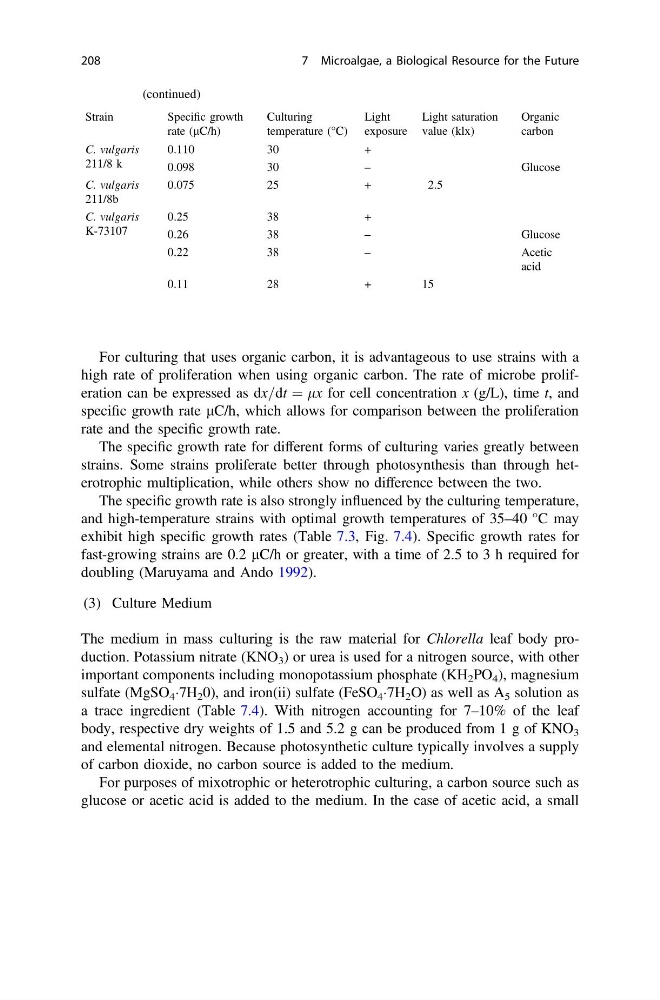
exhibit high specific growth rates (Table 7.3, Fig. 7.4). Specific growth rates for
fast-growing strains are 0.2 lC/h or greater, with a time of 2.5 to 3 h required for
doubling (Maruyama and Ando 1992).
(3) Culture Medium
The medium in mass culturing is the raw material for Chlorella leaf body production. Potassium nitrate (KNO 3 ) or urea is used for a nitrogen source, with other
important components including monopotassium phosphate (KH 2 PO 4 ), magnesium
sulfate (MgSO 4 Á7H 2 0), and iron(ii) sulfate (FeSO 4 Á7H 2 O) as well as A 5 solution as
a trace ingredient (Table 7.4). With nitrogen accounting for 7–10% of the leaf
body, respective dry weights of 1.5 and 5.2 g can be produced from 1 g of KNO 3
and elemental nitrogen. Because photosynthetic culture typically involves a supply
of carbon dioxide, no carbon source is added to the medium.
For purposes of mixotrophic or heterotrophic culturing, a carbon source such as
glucose or acetic acid is added to the medium. In the case of acetic acid, a small
Table 7.3 (continued)
Strain
Specific growth
rate (lC/h)
Culturing
temperature (°C)
Light
exposure
Light saturation
value (klx)
Organic
carbon
C. vulgaris
211/8 k
0.110
30
+
0.098
30
–
Glucose
C. vulgaris
211/8b
0.075
25
+
2.5
C. vulgaris
K-73107
0.25
38
+
0.26
38
–
Glucose
0.22
38
–
Acetic
acid
0.11
28
+
15
208
7 Microalgae, a Biological Resource for the Future
high rate of proliferation when using organic carbon. The rate of microbe proliferation can be expressed as dx=dt ¼ lx for cell concentration x (g/L), time t, and
specific growth rate lC/h, which allows for comparison between the proliferation
rate and the specific growth rate.
The specific growth rate for different forms of culturing varies greatly between
strains. Some strains proliferate better through photosynthesis than through heterotrophic multiplication, while others show no difference between the two.
The specific growth rate is also strongly influenced by the culturing temperature,
and high-temperature strains with optimal growth temperatures of 35–40 °C may
exhibit high specific growth rates (Table 7.3, Fig. 7.4). Specific growth rates for
fast-growing strains are 0.2 lC/h or greater, with a time of 2.5 to 3 h required for
doubling (Maruyama and Ando 1992).
(3) Culture Medium
The medium in mass culturing is the raw material for Chlorella leaf body production. Potassium nitrate (KNO 3 ) or urea is used for a nitrogen source, with other
important components including monopotassium phosphate (KH 2 PO 4 ), magnesium
sulfate (MgSO 4 Á7H 2 0), and iron(ii) sulfate (FeSO 4 Á7H 2 O) as well as A 5 solution as
a trace ingredient (Table 7.4). With nitrogen accounting for 7–10% of the leaf
body, respective dry weights of 1.5 and 5.2 g can be produced from 1 g of KNO 3
and elemental nitrogen. Because photosynthetic culture typically involves a supply
of carbon dioxide, no carbon source is added to the medium.
For purposes of mixotrophic or heterotrophic culturing, a carbon source such as
glucose or acetic acid is added to the medium. In the case of acetic acid, a small
Table 7.3 (continued)
Strain
Specific growth
rate (lC/h)
Culturing
temperature (°C)
Light
exposure
Light saturation
value (klx)
Organic
carbon
C. vulgaris
211/8 k
0.110
30
+
0.098
30
–
Glucose
C. vulgaris
211/8b
0.075
25
+
2.5
C. vulgaris
K-73107
0.25
38
+
0.26
38
–
Glucose
0.22
38
–
Acetic
acid
0.11
28
+
15
208
7 Microalgae, a Biological Resource for the Future