

220% in microbial phagocytic functions for macrophages in the Chlorella dosage
group (Wilde and Benemann 1993; Lee 1997; Muller-Feuga 2000; Becker 2007,
Raja et al. 2008; Costa and De Morais 2011).
Spirulina, which has recently become the focus of some attention, has long been
consumed in Africa as a foodstuff, with records of its cultivation as food by the
indigenous population in Mexico. Spirulina is roughly 100 times larger than
Chlorella and is easy to culture. In addition to its low production cost, its
digestibility is reported to be quite high at around 80%. Use as a foodstuff was
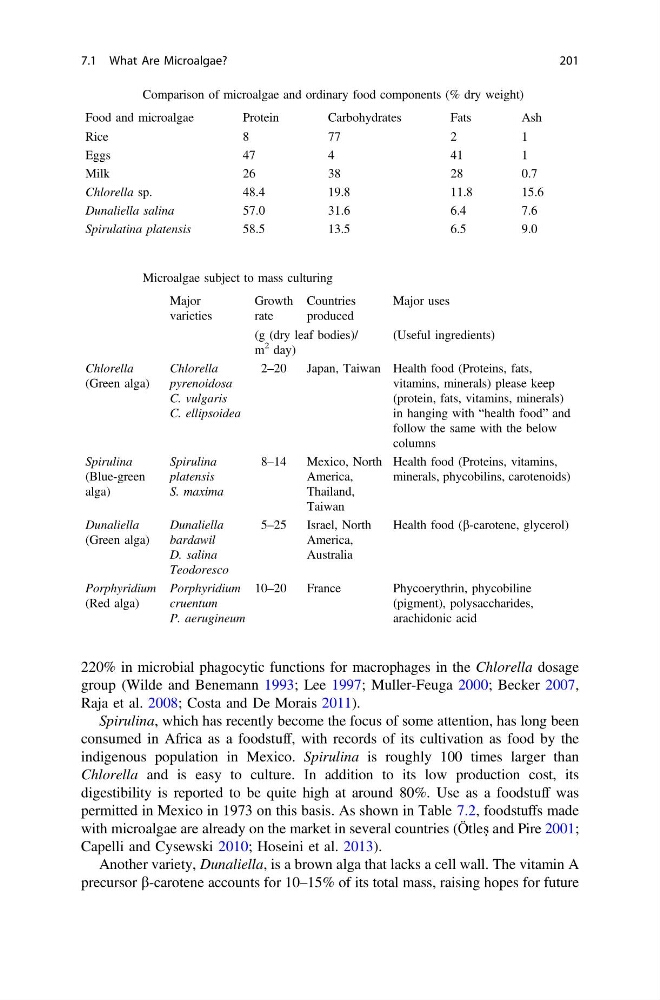
permitted in Mexico in 1973 on this basis. As shown in Table 7.2, foodstuffs made
with microalgae are already on the market in several countries (Ötleş and Pire 2001;
Capelli and Cysewski 2010; Hoseini et al. 2013).
Another variety, Dunaliella, is a brown alga that lacks a cell wall. The vitamin A
precursor b-carotene accounts for 10–15% of its total mass, raising hopes for future
Table 7.1 Comparison of microalgae and ordinary food components (% dry weight)
Food and microalgae
Protein
Carbohydrates
Fats
Ash
Rice
8
77
2
1
Eggs
47
4
41
1
Milk
26
38
28
0.7
Chlorella sp.
48.4
19.8
11.8
15.6
Dunaliella salina
57.0
31.6
6.4
7.6
Spirulatina platensis
58.5
13.5
6.5
9.0
Table 7.2 Microalgae subject to mass culturing
Major
varieties
Growth
rate
Countries
produced
Major uses
(g (dry leaf bodies)/
m
2 day)
(Useful ingredients)
Chlorella
(Green alga)
Chlorella
pyrenoidosa
C. vulgaris
C. ellipsoidea
2–20
Japan, Taiwan Health food (Proteins, fats,
vitamins, minerals) please keep
(protein, fats, vitamins, minerals)
in hanging with “health food” and
follow the same with the below
columns
Spirulina
(Blue-green
alga)
Spirulina
platensis
S. maxima
8–14
Mexico, North
America,
Thailand,
Taiwan
Health food (Proteins, vitamins,
minerals, phycobilins, carotenoids)
Dunaliella
(Green alga)
Dunaliella
bardawil
D. salina
Teodoresco
5–25
Israel, North
America,
Australia
Health food (b-carotene, glycerol)
Porphyridium
(Red alga)
Porphyridium
cruentum
P. aerugineum
10–20
France
Phycoerythrin, phycobiline
(pigment), polysaccharides,
arachidonic acid
7.1 What Are Microalgae?
201
group (Wilde and Benemann 1993; Lee 1997; Muller-Feuga 2000; Becker 2007,
Raja et al. 2008; Costa and De Morais 2011).
Spirulina, which has recently become the focus of some attention, has long been
consumed in Africa as a foodstuff, with records of its cultivation as food by the
indigenous population in Mexico. Spirulina is roughly 100 times larger than
Chlorella and is easy to culture. In addition to its low production cost, its
digestibility is reported to be quite high at around 80%. Use as a foodstuff was
permitted in Mexico in 1973 on this basis. As shown in Table 7.2, foodstuffs made
with microalgae are already on the market in several countries (Ötleş and Pire 2001;
Capelli and Cysewski 2010; Hoseini et al. 2013).
Another variety, Dunaliella, is a brown alga that lacks a cell wall. The vitamin A
precursor b-carotene accounts for 10–15% of its total mass, raising hopes for future
Table 7.1 Comparison of microalgae and ordinary food components (% dry weight)
Food and microalgae
Protein
Carbohydrates
Fats
Ash
Rice
8
77
2
1
Eggs
47
4
41
1
Milk
26
38
28
0.7
Chlorella sp.
48.4
19.8
11.8
15.6
Dunaliella salina
57.0
31.6
6.4
7.6
Spirulatina platensis
58.5
13.5
6.5
9.0
Table 7.2 Microalgae subject to mass culturing
Major
varieties
Growth
rate
Countries
produced
Major uses
(g (dry leaf bodies)/
m
2 day)
(Useful ingredients)
Chlorella
(Green alga)
Chlorella
pyrenoidosa
C. vulgaris
C. ellipsoidea
2–20
Japan, Taiwan Health food (Proteins, fats,
vitamins, minerals) please keep
(protein, fats, vitamins, minerals)
in hanging with “health food” and
follow the same with the below
columns
Spirulina
(Blue-green
alga)
Spirulina
platensis
S. maxima
8–14
Mexico, North
America,
Thailand,
Taiwan
Health food (Proteins, vitamins,
minerals, phycobilins, carotenoids)
Dunaliella
(Green alga)
Dunaliella
bardawil
D. salina
Teodoresco
5–25
Israel, North
America,
Australia
Health food (b-carotene, glycerol)
Porphyridium
(Red alga)
Porphyridium
cruentum
P. aerugineum
10–20
France
Phycoerythrin, phycobiline
(pigment), polysaccharides,
arachidonic acid
7.1 What Are Microalgae?
201