

The microalgae of the seas thus exhibit greater diversity than land-based plants
in terms of several aspects, including photosynthetic pigments, cell shape, and
motility. With all of this diversity and its vast production volumes, how might we
put microalgae to work for us?
7.1.3 Uses of Microalgae
Microalgae algae are known to produce many different useful substances as primary
metabolite, including proteins, fats, sugars, and extractives. Most current studies on
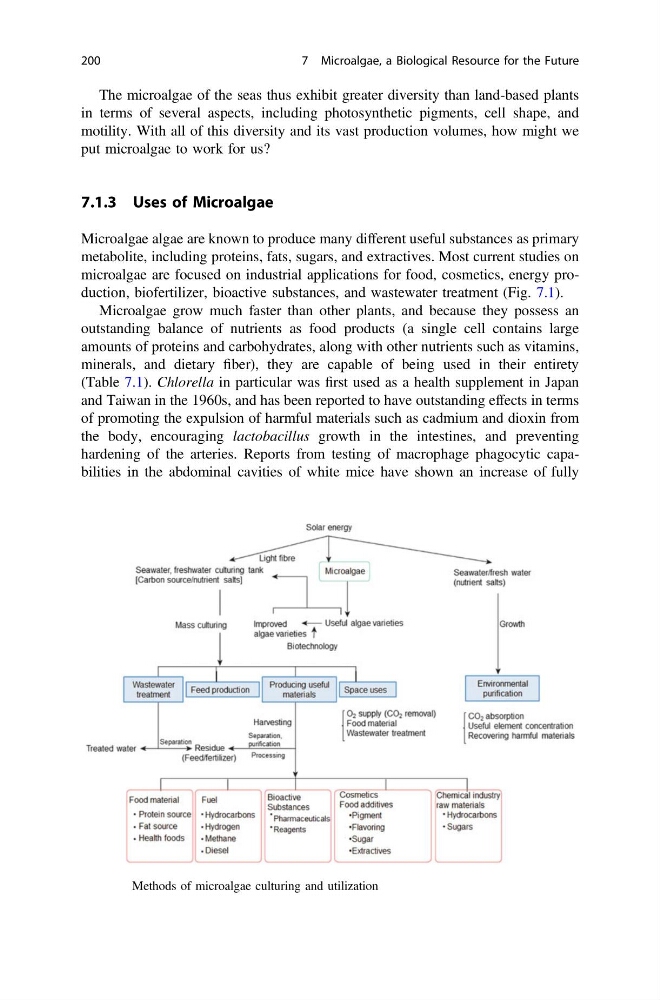
microalgae are focused on industrial applications for food, cosmetics, energy production, biofertilizer, bioactive substances, and wastewater treatment (Fig. 7.1).
Microalgae grow much faster than other plants, and because they possess an
outstanding balance of nutrients as food products (a single cell contains large
amounts of proteins and carbohydrates, along with other nutrients such as vitamins,
minerals, and dietary fiber), they are capable of being used in their entirety
(Table 7.1). Chlorella in particular was first used as a health supplement in Japan
and Taiwan in the 1960s, and has been reported to have outstanding effects in terms
of promoting the expulsion of harmful materials such as cadmium and dioxin from
the body, encouraging lactobacillus growth in the intestines, and preventing
hardening of the arteries. Reports from testing of macrophage phagocytic capabilities in the abdominal cavities of white mice have shown an increase of fully
Fig. 7.1 Methods of microalgae culturing and utilization
200
7 Microalgae, a Biological Resource for the Future
in terms of several aspects, including photosynthetic pigments, cell shape, and
motility. With all of this diversity and its vast production volumes, how might we
put microalgae to work for us?
7.1.3 Uses of Microalgae
Microalgae algae are known to produce many different useful substances as primary
metabolite, including proteins, fats, sugars, and extractives. Most current studies on
microalgae are focused on industrial applications for food, cosmetics, energy production, biofertilizer, bioactive substances, and wastewater treatment (Fig. 7.1).
Microalgae grow much faster than other plants, and because they possess an
outstanding balance of nutrients as food products (a single cell contains large
amounts of proteins and carbohydrates, along with other nutrients such as vitamins,
minerals, and dietary fiber), they are capable of being used in their entirety
(Table 7.1). Chlorella in particular was first used as a health supplement in Japan
and Taiwan in the 1960s, and has been reported to have outstanding effects in terms
of promoting the expulsion of harmful materials such as cadmium and dioxin from
the body, encouraging lactobacillus growth in the intestines, and preventing
hardening of the arteries. Reports from testing of macrophage phagocytic capabilities in the abdominal cavities of white mice have shown an increase of fully
Fig. 7.1 Methods of microalgae culturing and utilization
200
7 Microalgae, a Biological Resource for the Future