

From this perspective, around two of ten brown algae orders are typologically
capable of meeting these conditions, and around ten species are actually used.
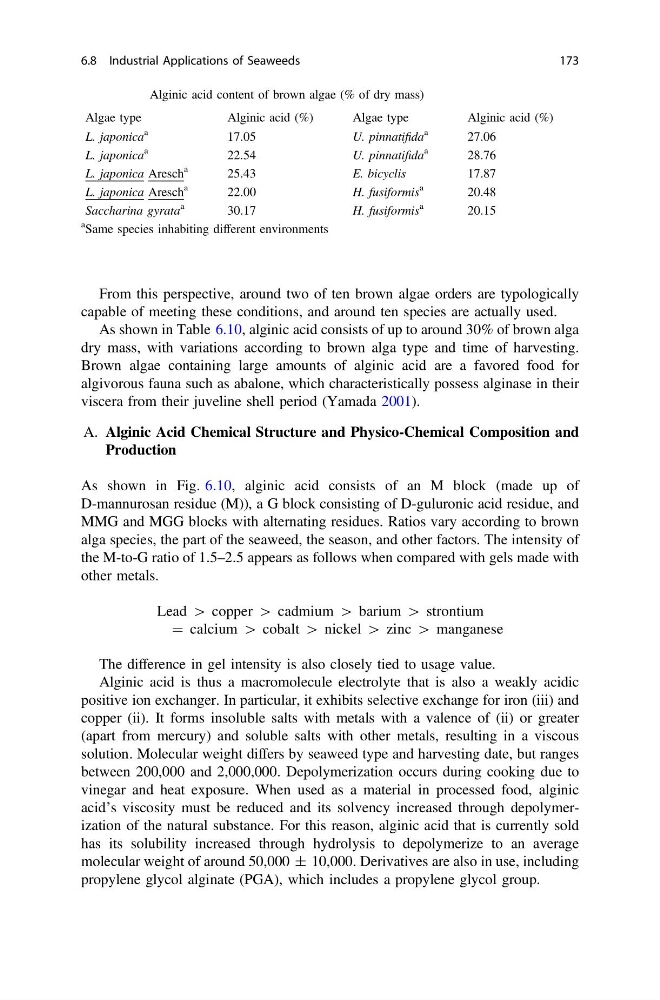
As shown in Table 6.10, alginic acid consists of up to around 30% of brown alga
dry mass, with variations according to brown alga type and time of harvesting.
Brown algae containing large amounts of alginic acid are a favored food for
algivorous fauna such as abalone, which characteristically possess alginase in their
viscera from their juveline shell period (Yamada 2001).
A. Alginic Acid Chemical Structure and Physico-Chemical Composition and
Production
As shown in Fig. 6.10, alginic acid consists of an M block (made up of
D-mannurosan residue (M)), a G block consisting of D-guluronic acid residue, and
MMG and MGG blocks with alternating residues. Ratios vary according to brown
alga species, the part of the seaweed, the season, and other factors. The intensity of
the M-to-G ratio of 1.5–2.5 appears as follows when compared with gels made with
other metals.
Lead [ copper [ cadmium [ barium [ strontium
¼ calcium [ cobalt [ nickel [ zinc [ manganese
The difference in gel intensity is also closely tied to usage value.
Alginic acid is thus a macromolecule electrolyte that is also a weakly acidic
positive ion exchanger. In particular, it exhibits selective exchange for iron (iii) and
copper (ii). It forms insoluble salts with metals with a valence of (ii) or greater
(apart from mercury) and soluble salts with other metals, resulting in a viscous
solution. Molecular weight differs by seaweed type and harvesting date, but ranges
between 200,000 and 2,000,000. Depolymerization occurs during cooking due to
vinegar and heat exposure. When used as a material in processed food, alginic
acid’s viscosity must be reduced and its solvency increased through depolymerization of the natural substance. For this reason, alginic acid that is currently sold
has its solubility increased through hydrolysis to depolymerize to an average
molecular weight of around 50,000 ± 10,000. Derivatives are also in use, including
propylene glycol alginate (PGA), which includes a propylene glycol group.
Table 6.10 Alginic acid content of brown algae (% of dry mass)
Algae type
Alginic acid (%)
Algae type
Alginic acid (%)
L. japonica
a
17.05
U. pinnatifida
a
27.06
L. japonica
a
22.54
U. pinnatifida
a
28.76
L. japonica Aresch
a
25.43
E. bicyclis
17.87
L. japonica Aresch
a
22.00
H. fusiformis
a
20.48
Saccharina gyrata
a
30.17
H. fusiformis
a
20.15
a Same species inhabiting different environments
6.8 Industrial Applications of Seaweeds
173
capable of meeting these conditions, and around ten species are actually used.
As shown in Table 6.10, alginic acid consists of up to around 30% of brown alga
dry mass, with variations according to brown alga type and time of harvesting.
Brown algae containing large amounts of alginic acid are a favored food for
algivorous fauna such as abalone, which characteristically possess alginase in their
viscera from their juveline shell period (Yamada 2001).
A. Alginic Acid Chemical Structure and Physico-Chemical Composition and
Production
As shown in Fig. 6.10, alginic acid consists of an M block (made up of
D-mannurosan residue (M)), a G block consisting of D-guluronic acid residue, and
MMG and MGG blocks with alternating residues. Ratios vary according to brown
alga species, the part of the seaweed, the season, and other factors. The intensity of
the M-to-G ratio of 1.5–2.5 appears as follows when compared with gels made with
other metals.
Lead [ copper [ cadmium [ barium [ strontium
¼ calcium [ cobalt [ nickel [ zinc [ manganese
The difference in gel intensity is also closely tied to usage value.
Alginic acid is thus a macromolecule electrolyte that is also a weakly acidic
positive ion exchanger. In particular, it exhibits selective exchange for iron (iii) and
copper (ii). It forms insoluble salts with metals with a valence of (ii) or greater
(apart from mercury) and soluble salts with other metals, resulting in a viscous
solution. Molecular weight differs by seaweed type and harvesting date, but ranges
between 200,000 and 2,000,000. Depolymerization occurs during cooking due to
vinegar and heat exposure. When used as a material in processed food, alginic
acid’s viscosity must be reduced and its solvency increased through depolymerization of the natural substance. For this reason, alginic acid that is currently sold
has its solubility increased through hydrolysis to depolymerize to an average
molecular weight of around 50,000 ± 10,000. Derivatives are also in use, including
propylene glycol alginate (PGA), which includes a propylene glycol group.
Table 6.10 Alginic acid content of brown algae (% of dry mass)
Algae type
Alginic acid (%)
Algae type
Alginic acid (%)
L. japonica
a
17.05
U. pinnatifida
a
27.06
L. japonica
a
22.54
U. pinnatifida
a
28.76
L. japonica Aresch
a
25.43
E. bicyclis
17.87
L. japonica Aresch
a
22.00
H. fusiformis
a
20.48
Saccharina gyrata
a
30.17
H. fusiformis
a
20.15
a Same species inhabiting different environments
6.8 Industrial Applications of Seaweeds
173