

B. Linkage Analysis in Standard Lines
Genetic markers may be used to visually distinguish male and female genetic
loci in a particular region of the genome. If, for example, a gene locus determining
disease resistance is located on near a DNA marker, with a gene for disease
resistance on a chromosome from either the paternal or maternal line, the
disease-resistant fish can be mated with a disease-sensitive fish to produce offspring
of four types, with combinations of genes coming from the disease-resistant and
disease-sensitive fish. Among these, only organisms with the disease-resistant gene
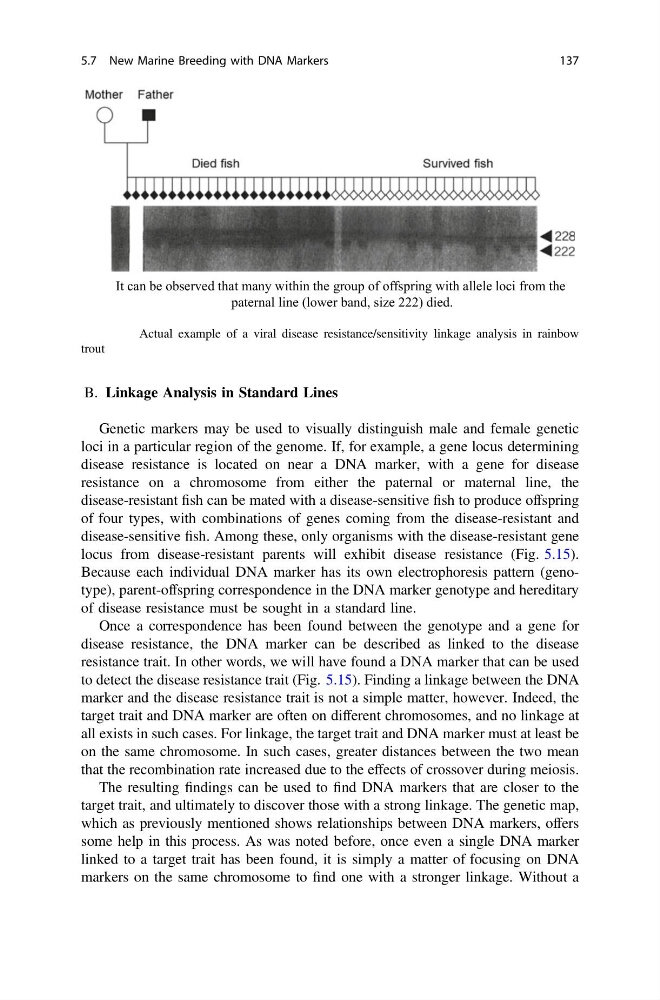
locus from disease-resistant parents will exhibit disease resistance (Fig. 5.15).
Because each individual DNA marker has its own electrophoresis pattern (genotype), parent-offspring correspondence in the DNA marker genotype and hereditary
of disease resistance must be sought in a standard line.
Once a correspondence has been found between the genotype and a gene for
disease resistance, the DNA marker can be described as linked to the disease
resistance trait. In other words, we will have found a DNA marker that can be used
to detect the disease resistance trait (Fig. 5.15). Finding a linkage between the DNA
marker and the disease resistance trait is not a simple matter, however. Indeed, the
target trait and DNA marker are often on different chromosomes, and no linkage at
all exists in such cases. For linkage, the target trait and DNA marker must at least be
on the same chromosome. In such cases, greater distances between the two mean
that the recombination rate increased due to the effects of crossover during meiosis.
The resulting findings can be used to find DNA markers that are closer to the
target trait, and ultimately to discover those with a strong linkage. The genetic map,
which as previously mentioned shows relationships between DNA markers, offers
some help in this process. As was noted before, once even a single DNA marker
linked to a target trait has been found, it is simply a matter of focusing on DNA
markers on the same chromosome to find one with a stronger linkage. Without a
It can be observed that many within the group of offspring with allele loci from the
paternal line (lower band, size 222) died.
Fig. 5.15 Actual example of a viral disease resistance/sensitivity linkage analysis in rainbow
trout
5.7 New Marine Breeding with DNA Markers
137
Genetic markers may be used to visually distinguish male and female genetic
loci in a particular region of the genome. If, for example, a gene locus determining
disease resistance is located on near a DNA marker, with a gene for disease
resistance on a chromosome from either the paternal or maternal line, the
disease-resistant fish can be mated with a disease-sensitive fish to produce offspring
of four types, with combinations of genes coming from the disease-resistant and
disease-sensitive fish. Among these, only organisms with the disease-resistant gene
locus from disease-resistant parents will exhibit disease resistance (Fig. 5.15).
Because each individual DNA marker has its own electrophoresis pattern (genotype), parent-offspring correspondence in the DNA marker genotype and hereditary
of disease resistance must be sought in a standard line.
Once a correspondence has been found between the genotype and a gene for
disease resistance, the DNA marker can be described as linked to the disease
resistance trait. In other words, we will have found a DNA marker that can be used
to detect the disease resistance trait (Fig. 5.15). Finding a linkage between the DNA
marker and the disease resistance trait is not a simple matter, however. Indeed, the
target trait and DNA marker are often on different chromosomes, and no linkage at
all exists in such cases. For linkage, the target trait and DNA marker must at least be
on the same chromosome. In such cases, greater distances between the two mean
that the recombination rate increased due to the effects of crossover during meiosis.
The resulting findings can be used to find DNA markers that are closer to the
target trait, and ultimately to discover those with a strong linkage. The genetic map,
which as previously mentioned shows relationships between DNA markers, offers
some help in this process. As was noted before, once even a single DNA marker
linked to a target trait has been found, it is simply a matter of focusing on DNA
markers on the same chromosome to find one with a stronger linkage. Without a
It can be observed that many within the group of offspring with allele loci from the
paternal line (lower band, size 222) died.
Fig. 5.15 Actual example of a viral disease resistance/sensitivity linkage analysis in rainbow
trout
5.7 New Marine Breeding with DNA Markers
137