

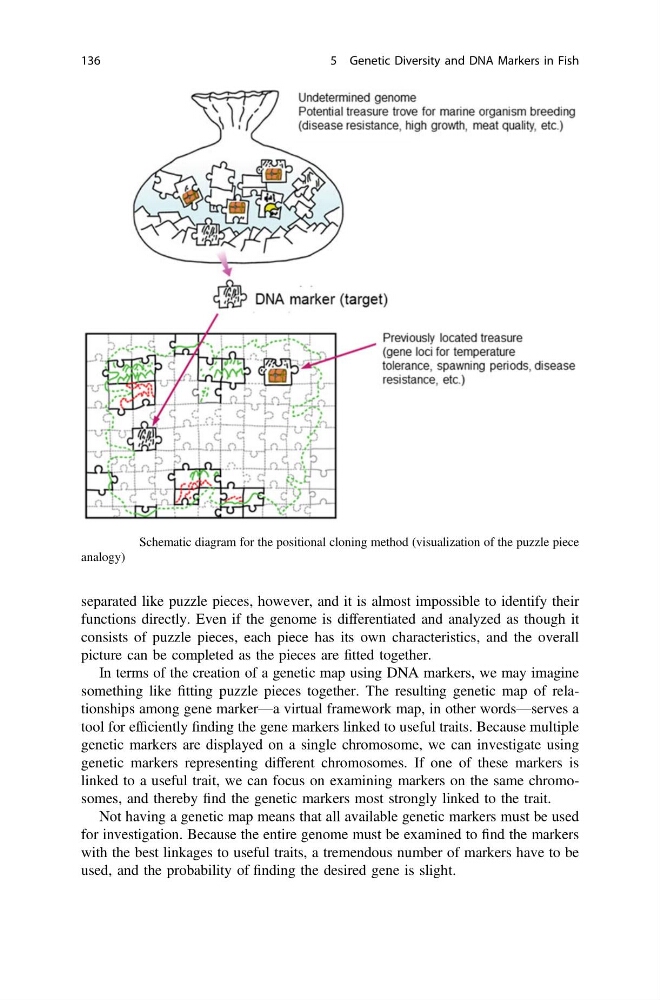
separated like puzzle pieces, however, and it is almost impossible to identify their
functions directly. Even if the genome is differentiated and analyzed as though it
consists of puzzle pieces, each piece has its own characteristics, and the overall
picture can be completed as the pieces are fitted together.
In terms of the creation of a genetic map using DNA markers, we may imagine
something like fitting puzzle pieces together. The resulting genetic map of relationships among gene marker—a virtual framework map, in other words—serves a
tool for efficiently finding the gene markers linked to useful traits. Because multiple
genetic markers are displayed on a single chromosome, we can investigate using
genetic markers representing different chromosomes. If one of these markers is
linked to a useful trait, we can focus on examining markers on the same chromosomes, and thereby find the genetic markers most strongly linked to the trait.
Not having a genetic map means that all available genetic markers must be used
for investigation. Because the entire genome must be examined to find the markers
with the best linkages to useful traits, a tremendous number of markers have to be
used, and the probability of finding the desired gene is slight.
Fig. 5.14 Schematic diagram for the positional cloning method (visualization of the puzzle piece
analogy)
136
5 Genetic Diversity and DNA Markers in Fish
functions directly. Even if the genome is differentiated and analyzed as though it
consists of puzzle pieces, each piece has its own characteristics, and the overall
picture can be completed as the pieces are fitted together.
In terms of the creation of a genetic map using DNA markers, we may imagine
something like fitting puzzle pieces together. The resulting genetic map of relationships among gene marker—a virtual framework map, in other words—serves a
tool for efficiently finding the gene markers linked to useful traits. Because multiple
genetic markers are displayed on a single chromosome, we can investigate using
genetic markers representing different chromosomes. If one of these markers is
linked to a useful trait, we can focus on examining markers on the same chromosomes, and thereby find the genetic markers most strongly linked to the trait.
Not having a genetic map means that all available genetic markers must be used
for investigation. Because the entire genome must be examined to find the markers
with the best linkages to useful traits, a tremendous number of markers have to be
used, and the probability of finding the desired gene is slight.
Fig. 5.14 Schematic diagram for the positional cloning method (visualization of the puzzle piece
analogy)
136
5 Genetic Diversity and DNA Markers in Fish