

5.6.3 Farming Population Variability and Line Differentiation
Mitochondrial DNA haplotype reduction: Farming populations of red seabream
showed an average of 11 haplotypes by the seventh generation, a clear decrease
from the average of 27 for wild populations.
While the haplotype diversity level decreased from 0.905 to 0.791, a high level
of variability was maintained despite generational crossbreeding, and the inbreeding coefficient was observed to remain low. Consistent with findings from
microsatellite DNA polymorphs, this shows the ability to detect changes in genetic
diversity with great sensitivity (Avise et al. 1992; Tabata et al. 1997).
Decrease in average alleles: Artificial seedling development has been attempted
for various fish species for farming and release. Because of the founder and bottleneck effects, steep changes in the genetic composition of artificial seedling
populations and the level of mutation possession are predicted to occur.
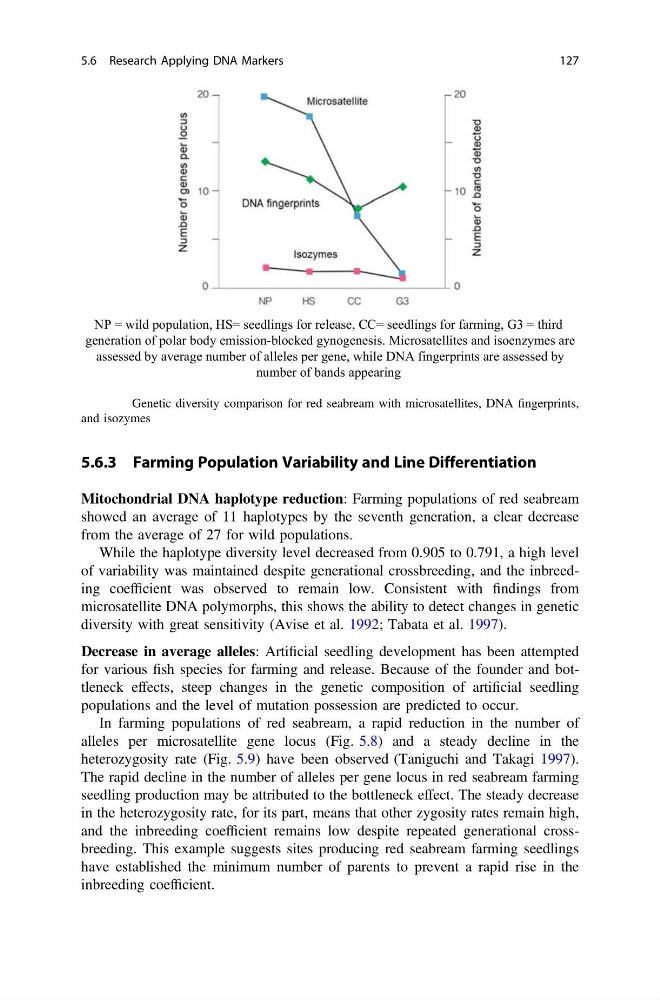
In farming populations of red seabream, a rapid reduction in the number of
alleles per microsatellite gene locus (Fig. 5.8) and a steady decline in the
heterozygosity rate (Fig. 5.9) have been observed (Taniguchi and Takagi 1997).
The rapid decline in the number of alleles per gene locus in red seabream farming
seedling production may be attributed to the bottleneck effect. The steady decrease
in the heterozygosity rate, for its part, means that other zygosity rates remain high,
and the inbreeding coefficient remains low despite repeated generational crossbreeding. This example suggests sites producing red seabream farming seedlings
have established the minimum number of parents to prevent a rapid rise in the
inbreeding coefficient.
NP = wild population, HS= seedlings for release, CC= seedlings for farming, G3 = third
generation of polar body emission-blocked gynogenesis. Microsatellites and isoenzymes are
assessed by average number of alleles per gene, while DNA fingerprints are assessed by
number of bands appearing
Fig. 5.8 Genetic diversity comparison for red seabream with microsatellites, DNA fingerprints,
and isozymes
5.6 Research Applying DNA Markers
127
Mitochondrial DNA haplotype reduction: Farming populations of red seabream
showed an average of 11 haplotypes by the seventh generation, a clear decrease
from the average of 27 for wild populations.
While the haplotype diversity level decreased from 0.905 to 0.791, a high level
of variability was maintained despite generational crossbreeding, and the inbreeding coefficient was observed to remain low. Consistent with findings from
microsatellite DNA polymorphs, this shows the ability to detect changes in genetic
diversity with great sensitivity (Avise et al. 1992; Tabata et al. 1997).
Decrease in average alleles: Artificial seedling development has been attempted
for various fish species for farming and release. Because of the founder and bottleneck effects, steep changes in the genetic composition of artificial seedling
populations and the level of mutation possession are predicted to occur.
In farming populations of red seabream, a rapid reduction in the number of
alleles per microsatellite gene locus (Fig. 5.8) and a steady decline in the
heterozygosity rate (Fig. 5.9) have been observed (Taniguchi and Takagi 1997).
The rapid decline in the number of alleles per gene locus in red seabream farming
seedling production may be attributed to the bottleneck effect. The steady decrease
in the heterozygosity rate, for its part, means that other zygosity rates remain high,
and the inbreeding coefficient remains low despite repeated generational crossbreeding. This example suggests sites producing red seabream farming seedlings
have established the minimum number of parents to prevent a rapid rise in the
inbreeding coefficient.
NP = wild population, HS= seedlings for release, CC= seedlings for farming, G3 = third
generation of polar body emission-blocked gynogenesis. Microsatellites and isoenzymes are
assessed by average number of alleles per gene, while DNA fingerprints are assessed by
number of bands appearing
Fig. 5.8 Genetic diversity comparison for red seabream with microsatellites, DNA fingerprints,
and isozymes
5.6 Research Applying DNA Markers
127