

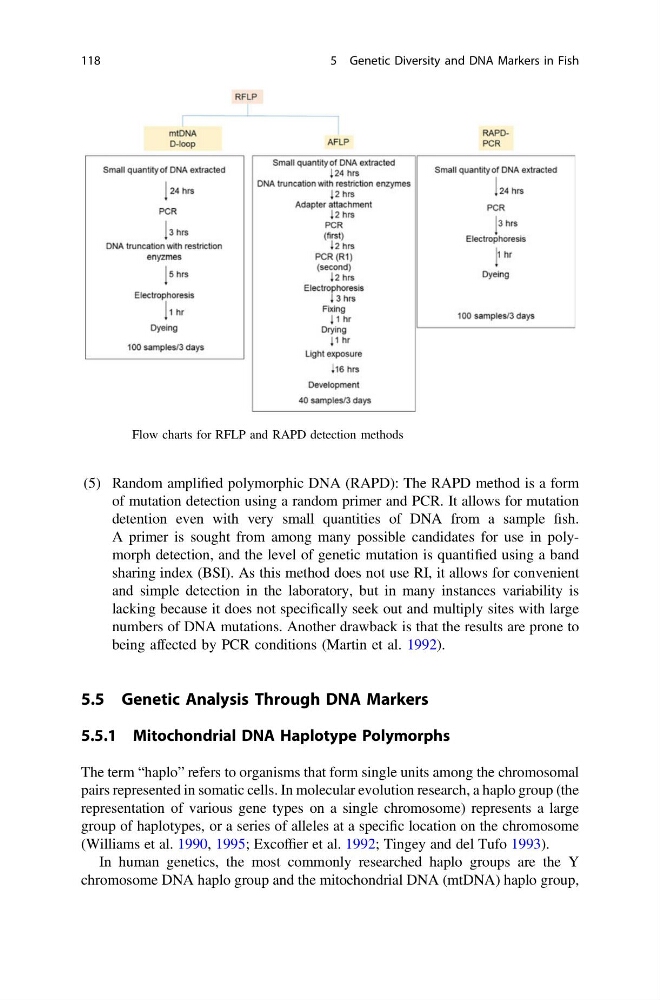
(5) Random amplified polymorphic DNA (RAPD): The RAPD method is a form
of mutation detection using a random primer and PCR. It allows for mutation
detention even with very small quantities of DNA from a sample fish.
A primer is sought from among many possible candidates for use in polymorph detection, and the level of genetic mutation is quantified using a band
sharing index (BSI). As this method does not use RI, it allows for convenient
and simple detection in the laboratory, but in many instances variability is
lacking because it does not specifically seek out and multiply sites with large
numbers of DNA mutations. Another drawback is that the results are prone to
being affected by PCR conditions (Martin et al. 1992).
5.5 Genetic Analysis Through DNA Markers
5.5.1 Mitochondrial DNA Haplotype Polymorphs
The term “haplo” refers to organisms that form single units among the chromosomal
pairs represented in somatic cells. In molecular evolution research, a haplo group (the
representation of various gene types on a single chromosome) represents a large
group of haplotypes, or a series of alleles at a specific location on the chromosome
(Williams et al. 1990, 1995; Excoffier et al. 1992; Tingey and del Tufo 1993).
In human genetics, the most commonly researched haplo groups are the Y
chromosome DNA haplo group and the mitochondrial DNA (mtDNA) haplo group,
Fig. 5.4 Flow charts for RFLP and RAPD detection methods
118
5 Genetic Diversity and DNA Markers in Fish
of mutation detection using a random primer and PCR. It allows for mutation
detention even with very small quantities of DNA from a sample fish.
A primer is sought from among many possible candidates for use in polymorph detection, and the level of genetic mutation is quantified using a band
sharing index (BSI). As this method does not use RI, it allows for convenient
and simple detection in the laboratory, but in many instances variability is
lacking because it does not specifically seek out and multiply sites with large
numbers of DNA mutations. Another drawback is that the results are prone to
being affected by PCR conditions (Martin et al. 1992).
5.5 Genetic Analysis Through DNA Markers
5.5.1 Mitochondrial DNA Haplotype Polymorphs
The term “haplo” refers to organisms that form single units among the chromosomal
pairs represented in somatic cells. In molecular evolution research, a haplo group (the
representation of various gene types on a single chromosome) represents a large
group of haplotypes, or a series of alleles at a specific location on the chromosome
(Williams et al. 1990, 1995; Excoffier et al. 1992; Tingey and del Tufo 1993).
In human genetics, the most commonly researched haplo groups are the Y
chromosome DNA haplo group and the mitochondrial DNA (mtDNA) haplo group,
Fig. 5.4 Flow charts for RFLP and RAPD detection methods
118
5 Genetic Diversity and DNA Markers in Fish