

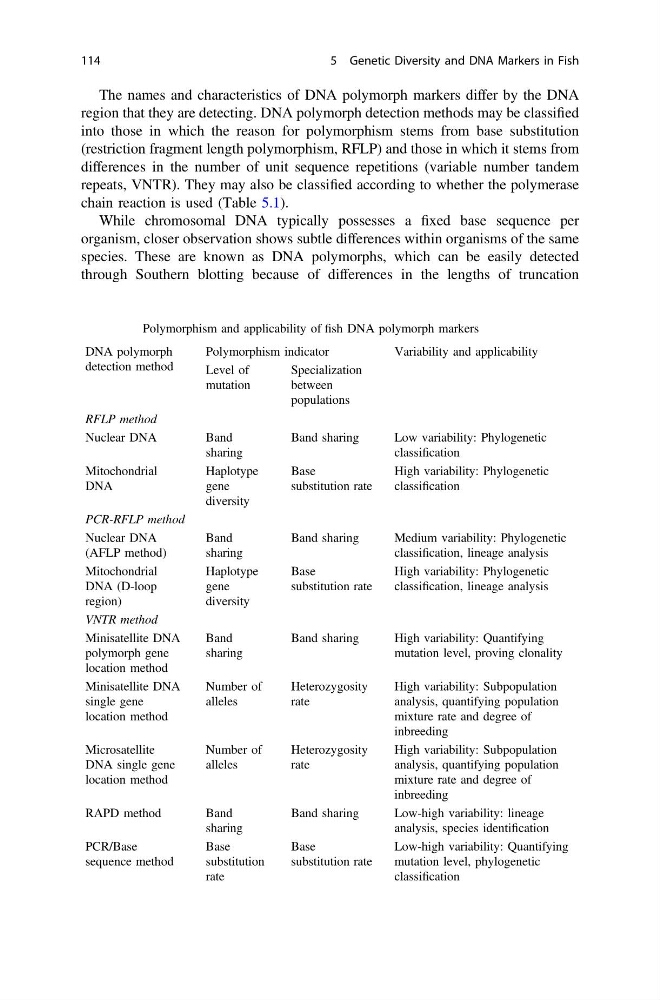
The names and characteristics of DNA polymorph markers differ by the DNA
region that they are detecting. DNA polymorph detection methods may be classified
into those in which the reason for polymorphism stems from base substitution
(restriction fragment length polymorphism, RFLP) and those in which it stems from
differences in the number of unit sequence repetitions (variable number tandem
repeats, VNTR). They may also be classified according to whether the polymerase
chain reaction is used (Table 5.1).
While chromosomal DNA typically possesses a fixed base sequence per
organism, closer observation shows subtle differences within organisms of the same
species. These are known as DNA polymorphs, which can be easily detected
through Southern blotting because of differences in the lengths of truncation
Table 5.1 Polymorphism and applicability of fish DNA polymorph markers
DNA polymorph
detection method
Polymorphism indicator
Variability and applicability
Level of
mutation
Specialization
between
populations
RFLP method
Nuclear DNA
Band
sharing
Band sharing
Low variability: Phylogenetic
classification
Mitochondrial
DNA
Haplotype
gene
diversity
Base
substitution rate
High variability: Phylogenetic
classification
PCR-RFLP method
Nuclear DNA
(AFLP method)
Band
sharing
Band sharing
Medium variability: Phylogenetic
classification, lineage analysis
Mitochondrial
DNA (D-loop
region)
Haplotype
gene
diversity
Base
substitution rate
High variability: Phylogenetic
classification, lineage analysis
VNTR method
Minisatellite DNA
polymorph gene
location method
Band
sharing
Band sharing
High variability: Quantifying
mutation level, proving clonality
Minisatellite DNA
single gene
location method
Number of
alleles
Heterozygosity
rate
High variability: Subpopulation
analysis, quantifying population
mixture rate and degree of
inbreeding
Microsatellite
DNA single gene
location method
Number of
alleles
Heterozygosity
rate
High variability: Subpopulation
analysis, quantifying population
mixture rate and degree of
inbreeding
RAPD method
Band
sharing
Band sharing
Low-high variability: lineage
analysis, species identification
PCR/Base
sequence method
Base
substitution
rate
Base
substitution rate
Low-high variability: Quantifying
mutation level, phylogenetic
classification
114
5 Genetic Diversity and DNA Markers in Fish
region that they are detecting. DNA polymorph detection methods may be classified
into those in which the reason for polymorphism stems from base substitution
(restriction fragment length polymorphism, RFLP) and those in which it stems from
differences in the number of unit sequence repetitions (variable number tandem
repeats, VNTR). They may also be classified according to whether the polymerase
chain reaction is used (Table 5.1).
While chromosomal DNA typically possesses a fixed base sequence per
organism, closer observation shows subtle differences within organisms of the same
species. These are known as DNA polymorphs, which can be easily detected
through Southern blotting because of differences in the lengths of truncation
Table 5.1 Polymorphism and applicability of fish DNA polymorph markers
DNA polymorph
detection method
Polymorphism indicator
Variability and applicability
Level of
mutation
Specialization
between
populations
RFLP method
Nuclear DNA
Band
sharing
Band sharing
Low variability: Phylogenetic
classification
Mitochondrial
DNA
Haplotype
gene
diversity
Base
substitution rate
High variability: Phylogenetic
classification
PCR-RFLP method
Nuclear DNA
(AFLP method)
Band
sharing
Band sharing
Medium variability: Phylogenetic
classification, lineage analysis
Mitochondrial
DNA (D-loop
region)
Haplotype
gene
diversity
Base
substitution rate
High variability: Phylogenetic
classification, lineage analysis
VNTR method
Minisatellite DNA
polymorph gene
location method
Band
sharing
Band sharing
High variability: Quantifying
mutation level, proving clonality
Minisatellite DNA
single gene
location method
Number of
alleles
Heterozygosity
rate
High variability: Subpopulation
analysis, quantifying population
mixture rate and degree of
inbreeding
Microsatellite
DNA single gene
location method
Number of
alleles
Heterozygosity
rate
High variability: Subpopulation
analysis, quantifying population
mixture rate and degree of
inbreeding
RAPD method
Band
sharing
Band sharing
Low-high variability: lineage
analysis, species identification
PCR/Base
sequence method
Base
substitution
rate
Base
substitution rate
Low-high variability: Quantifying
mutation level, phylogenetic
classification
114
5 Genetic Diversity and DNA Markers in Fish