

Among DNA base sequences, high-variability intron have been in frequent use
recently, including D-loop regions of mitochondrial DNA, nuclear DNA minisatellites (sections of non-genetic regions with large numbers of repeating
sequence units), sites (DNA fingerprints), and microsatellites (sections of
non-genetic regions with small numbers of repeating sequence units). Since these
sites have a great number of accumulated genetic polymorphs, they may be used as
genetic markers in identifying as yet undetected local populations (clades) with a
very low level of differentiation, assessing genetic variability, and clearly identifying changes in genetic diversity for artificially produced selective populations or
genetically manipulated populations, as well as increases in the inbreeding
coefficient.
As an example, the number of bases in fish DNA may range from the hundreds
of millions to billions per genome. Various genetic individual mutations are
included in that sequence. Mutations in an organism’s DNA accumulate in greater
numbers on non-coding introns than on coding exons. Non-genetic regions include
repeating sequences of bases in the single to double digits; when the number of
repeating base units for the site is large, it is known as a minisatellite, while
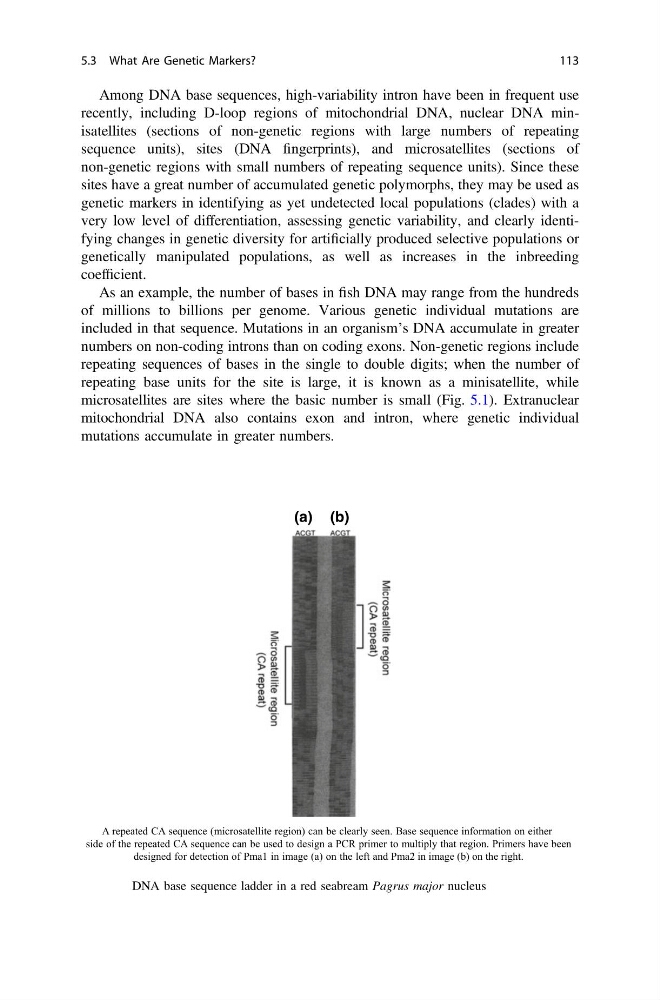
microsatellites are sites where the basic number is small (Fig. 5.1). Extranuclear
mitochondrial DNA also contains exon and intron, where genetic individual
mutations accumulate in greater numbers.
A repeated CA sequence (microsatellite region) can be clearly seen. Base sequence information on either
side of the repeated CA sequence can be used to design a PCR primer to multiply that region. Primers have been
designed for detection of Pma1 in image (a) on the left and Pma2 in image (b) on the right.
(a) (b)
Fig. 5.1 DNA base sequence ladder in a red seabream Pagrus major nucleus
5.3 What Are Genetic Markers?
113
recently, including D-loop regions of mitochondrial DNA, nuclear DNA minisatellites (sections of non-genetic regions with large numbers of repeating
sequence units), sites (DNA fingerprints), and microsatellites (sections of
non-genetic regions with small numbers of repeating sequence units). Since these
sites have a great number of accumulated genetic polymorphs, they may be used as
genetic markers in identifying as yet undetected local populations (clades) with a
very low level of differentiation, assessing genetic variability, and clearly identifying changes in genetic diversity for artificially produced selective populations or
genetically manipulated populations, as well as increases in the inbreeding
coefficient.
As an example, the number of bases in fish DNA may range from the hundreds
of millions to billions per genome. Various genetic individual mutations are
included in that sequence. Mutations in an organism’s DNA accumulate in greater
numbers on non-coding introns than on coding exons. Non-genetic regions include
repeating sequences of bases in the single to double digits; when the number of
repeating base units for the site is large, it is known as a minisatellite, while
microsatellites are sites where the basic number is small (Fig. 5.1). Extranuclear
mitochondrial DNA also contains exon and intron, where genetic individual
mutations accumulate in greater numbers.
A repeated CA sequence (microsatellite region) can be clearly seen. Base sequence information on either
side of the repeated CA sequence can be used to design a PCR primer to multiply that region. Primers have been
designed for detection of Pma1 in image (a) on the left and Pma2 in image (b) on the right.
(a) (b)
Fig. 5.1 DNA base sequence ladder in a red seabream Pagrus major nucleus
5.3 What Are Genetic Markers?
113