

4.3.1 Basic Techniques
A wide range of cell manipulation techniques have been developed over the history
of cell biology, but those corresponding to the following four basic goals may be
applicable for breeding (see Fig. 4.5). Each of them is closely connected the
characteristic properties exhibited by the cell as a biological unit, and acquisition of
them requires some degree of professional temperament in terms of understanding
the cell completely and becoming one with it. These days, however, the development of special devices for the different purposes has made it possible for even a
non-expert to manipulate cells with relative ease.
A. Culturing
Cells may be propagated in a suitable culturing medium, or cell propagation
factors or growth factors may be added to a culture medium to maintain these
functions, in addition to salts to control osmotic pressure and nutrients such as
amino acids and vitamins. Recent methods have been applied to culture and produce large quantities of animal cells for useful substances that cannot be produced
with E. coli, including complex proteins such as gonadotopic hormones and
monoclonal antibodies.
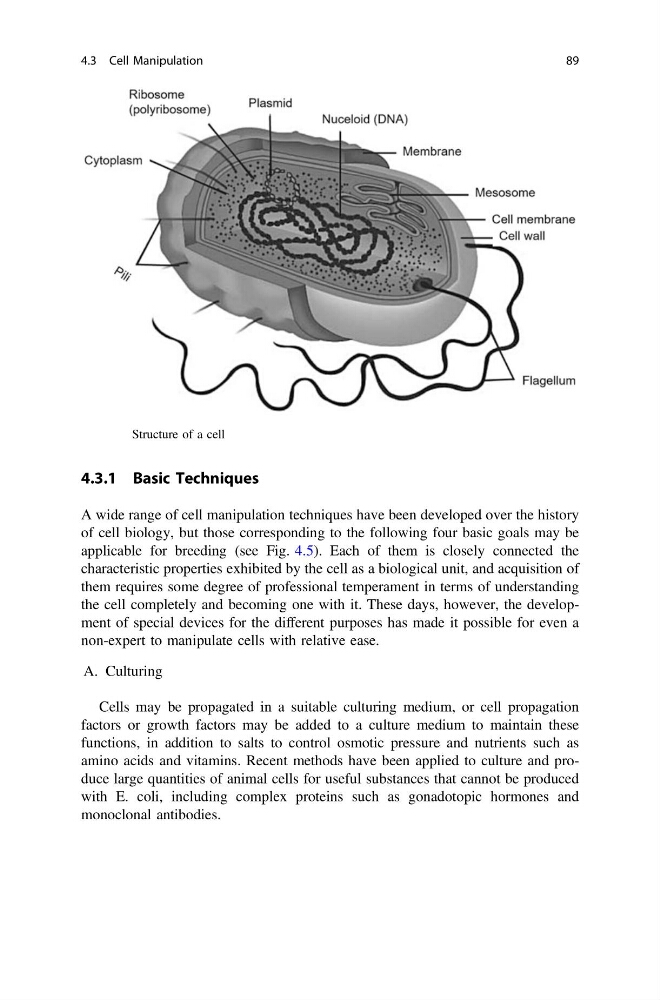
Fig. 4.4 Structure of a cell
4.3 Cell Manipulation
89
A wide range of cell manipulation techniques have been developed over the history
of cell biology, but those corresponding to the following four basic goals may be
applicable for breeding (see Fig. 4.5). Each of them is closely connected the
characteristic properties exhibited by the cell as a biological unit, and acquisition of
them requires some degree of professional temperament in terms of understanding
the cell completely and becoming one with it. These days, however, the development of special devices for the different purposes has made it possible for even a
non-expert to manipulate cells with relative ease.
A. Culturing
Cells may be propagated in a suitable culturing medium, or cell propagation
factors or growth factors may be added to a culture medium to maintain these
functions, in addition to salts to control osmotic pressure and nutrients such as
amino acids and vitamins. Recent methods have been applied to culture and produce large quantities of animal cells for useful substances that cannot be produced
with E. coli, including complex proteins such as gonadotopic hormones and
monoclonal antibodies.
Fig. 4.4 Structure of a cell
4.3 Cell Manipulation
89